
Why SEO Can Look Successful While Revenue Quietly Stalls
SEO traffic but no revenue is a surprisingly common problem for SaaS companies. At some point, many SaaS leadership teams find themselves staring at two reports that seem to contradict each other…
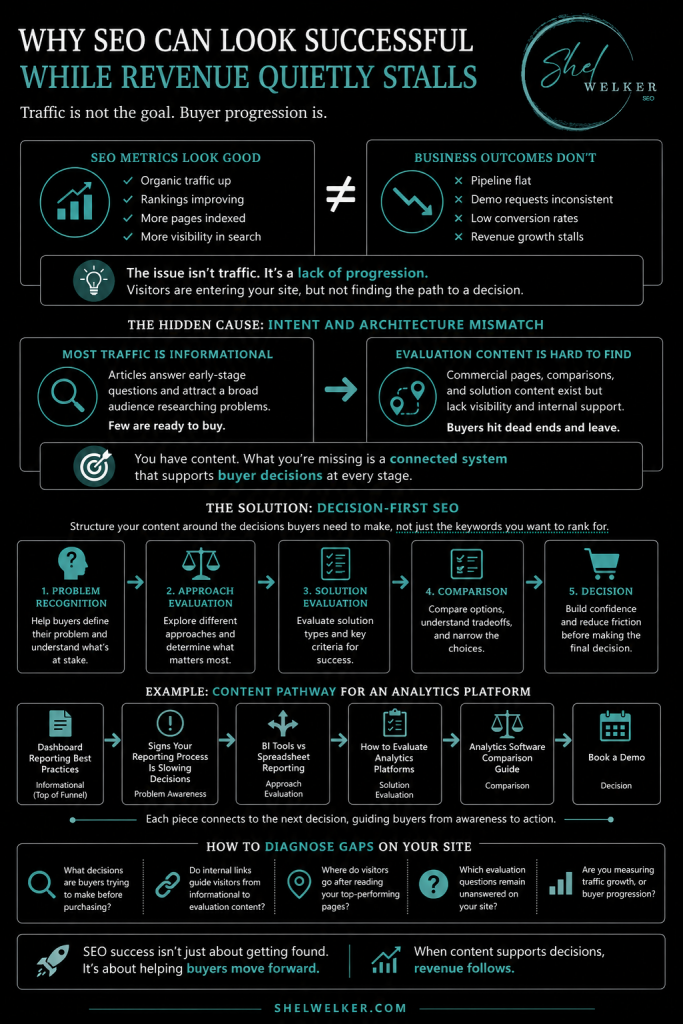
Traffic and revenue measure different outcomes.
Traffic measures visibility, while revenue measures buyer decisions. That’s an important distinction because search visibility can increase without increasing the number of people actively evaluating solutions.
Many SaaS content programs generate awareness successfully. They attract visitors researching problems, learning concepts, or exploring a category for the first time. From an SEO perspective, this can look like steady progress. Traffic grows, rankings improve, and more people discover the brand through search.
The challenge is that awareness alone does not create pipeline.
If visitors never encounter the information needed to evaluate approaches, compare options, or reduce purchasing uncertainty, traffic growth and revenue growth begin to separate. The business gains visibility, but buyers are not receiving the guidance they need to continue moving toward a decision. This is especially common in SaaS, where a weak B2B SaaS SEO strategy often creates traffic growth without meaningful pipeline impact.
At that point, the issue is no longer visibility.
It’s progression.
Why Is Our SEO Traffic Growing but Revenue Staying Flat?
The simplest explanation is that traffic and revenue measure two very different things.
Traffic measures attention.
Revenue measures decisions.
A SaaS company can dramatically increase organic visibility while attracting visitors who are not actively evaluating solutions.
Consider a project management platform publishing content about productivity techniques, remote work trends, and team collaboration best practices. Those topics can generate substantial search traffic because they appeal to a broad audience.
The challenge is that broad audiences rarely convert at the same rate as active buyers.
Traffic grows.
Rankings improve.
The SEO dashboard looks healthy.
Yet very few visitors move into an evaluation process because the content attracting them is disconnected from the decisions required to purchase software.
This is where many organizations make a costly mistake. They see traffic growth without revenue growth and conclude that they simply need more traffic.
In reality, they may already have enough visibility. What they lack is a clear pathway that helps visitors progress toward a buying decision.
Why Standard SEO Metrics Miss the Problem
Traditional SEO reporting focuses heavily on visibility metrics.
Organic traffic, rankings, impressions, click-through rates, and indexed pages all help measure whether content is being discovered.
What they do not measure is whether content is helping buyers move forward.
A cybersecurity SaaS company might rank exceptionally well for educational content about phishing attacks, ransomware prevention, and compliance requirements. Those rankings are valuable. The traffic is real.
But what happens next?
Do visitors find content explaining how to evaluate security vendors?
Do they encounter comparisons between different approaches?
Do they learn what implementation looks like or what tradeoffs exist between competing solutions?
If not, the company may be generating awareness without supporting evaluation.
The SEO program appears successful because visibility is improving. Pipeline remains stagnant because buyers never receive the information needed to continue their journey.
The issue is not traffic.
The issue is progression.
Why Intent Alone Does Not Fully Explain the Problem
Many SEO professionals would correctly point out that this is partly an intent issue.
Informational content attracts people researching a topic, while commercial content attracts people evaluating solutions. That distinction matters, and many SaaS companies struggle because they have built far more informational content than evaluation-focused content.
However, intent alone does not fully explain why SEO is not impacting pipeline.
Many SaaS companies already have commercial content. They have product pages, feature pages, pricing pages, and even comparison pages designed to support evaluation. The problem is that those assets often exist in isolation.
Visitors discover informational content but never reach evaluation content. Evaluation content exists but is difficult to find. Comparison content exists but receives little internal support. In many cases, the content itself is not missing. What is missing are the pathways connecting those assets together.
This is where the conversation shifts from intent to architecture.
The Real Problem Is Content Architecture
Most SEO strategies are built around topics, keywords, and individual rankings. As a result, content often behaves like a collection of separate assets rather than a connected system.
Pages rank independently. Articles attract visitors independently. Resources are published independently. From an SEO perspective, this can look healthy. From a buyer perspective, it can feel fragmented.
Modern B2B buying journeys are rarely linear. Buyers move through multiple questions before they commit to a solution. They explore options, compare approaches, validate assumptions, and revisit concerns.
When content is not structured around that progression, buyers eventually reach a dead end. They leave, continue researching elsewhere, or begin evaluating competitors that provide clearer guidance.
This is often the hidden cause behind rankings but no sales, traffic growth with no conversions, and other common SaaS SEO ROI problems.
If you’ve ever looked at a website and thought, “We already have plenty of content, so why isn’t it working?” the issue may not be content volume at all. It may be structure.
In fact, I recently explored this problem in more depth when discussing why more content usually doesn’t fix structural SEO problems. Publishing additional content can increase visibility, but it rarely solves buyer-journey gaps that already exist within the site.
A Decision-First View of the Problem
This is where Decision-First SEO changes the conversation.
Instead of starting with the question, “What keywords should we target?”, it starts with a different question: “What decisions must buyers make before they become customers?”
The distinction may seem subtle, but it fundamentally changes how content is planned and structured.
Keywords still matter. Search visibility still matters. Intent still matters. The difference is that every piece of content is evaluated according to the role it plays in helping a buyer move closer to a decision.
Some content helps buyers define a problem. Other content helps them evaluate potential approaches, compare solutions, or reduce uncertainty before making a purchase. Rather than viewing content as a collection of individual ranking opportunities, it becomes part of a larger system designed to support progression through the buyer journey.
That is the foundation of Decision-First SEO.
Instead of organizing strategy solely around traffic opportunities, the focus shifts to the decisions buyers need to make throughout their journey. Content, keywords, internal linking, and site architecture are then structured to support those decisions.
Traffic becomes far more valuable when it enters a system designed to help buyers move forward.
What This Looks Like in Practice
Imagine a SaaS analytics platform targeting organizations struggling with fragmented reporting.
A traditional content strategy might include:
- What Is Business Intelligence?
- KPI Tracking Guide
- Dashboard Reporting Best Practices
- Data Visualization Techniques
These articles can generate meaningful traffic.
A Decision-First structure asks what the visitor needs to understand next.
A reader who lands on “Dashboard Reporting Best Practices” might be guided through a progression like this:
Dashboard Reporting Best Practices
↓
Signs Your Reporting Process Is Slowing Decision-Making
↓
BI Tools vs Spreadsheet Reporting
↓
How to Evaluate Analytics Platforms
↓
Analytics Software Comparison Guide
↓
Product Demo
Each piece supports the next decision.
Instead of attracting a visitor and hoping they eventually find their way to a product page, the content ecosystem intentionally supports movement from awareness to evaluation.
The outcome is not necessarily more traffic.
It is more value from the traffic already being earned.
Why This Matters for Modern Search and AI Visibility
Modern search systems increasingly evaluate topics through relationships and context rather than individual pages alone.
Search engines and AI retrieval systems attempt to understand how content fits within a broader subject area. They look for signals that demonstrate depth, consistency, and meaningful coverage.
A disconnected content library can still rank individual pages.
However, a connected content ecosystem helps establish stronger relationships between problems, evaluations, comparisons, and solutions.
In practical terms, the same structure that helps buyers navigate a topic often helps search systems understand the topic more completely.
The benefit is not simply improved visibility.
It is improved alignment between visibility and business outcomes.
How to Diagnose Whether This Is Happening on Your Site
Before creating more content, examine the pathways that already exist.
Ask:
- Which decisions are buyers trying to make before purchasing our product?
- Do we have content that supports those decisions?
- Where does a visitor go after reading one of our top-performing articles?
- Which evaluation questions remain unanswered?
- How many internal links connect informational content to evaluation content?
- Do comparison pages, alternatives pages, and solution-focused assets receive meaningful support?
- Are we measuring traffic growth, or buyer progression?
These questions often reveal structural gaps that traditional SEO reporting never surfaces.
For many SaaS companies, the next breakthrough does not come from publishing another awareness article.
It comes from improving the pathways between the content they already have.
What Businesses Should Do Next
Once you identify a progression problem, the instinct is often to create more content. In many cases, that is not the best next move.
If buyers are already entering your website through search but failing to advance toward evaluation and decision-making, publishing additional awareness content may simply increase traffic to the same broken pathways.
A more productive approach is to examine how your existing content supports buyer decisions. Look at your highest-traffic pages and ask: What decision is the visitor trying to make when they arrive? What question should they naturally ask next? Where does the content direct them afterward?
Many SaaS websites discover that the problem is not a lack of content. The problem is a lack of progression.
The strongest SEO programs are not simply collections of articles. They function as connected systems that help buyers move from problem recognition to evaluation, comparison, and ultimately selection.
This is one of the core ideas behind Decision-First SEO.
Rather than treating content as individual ranking assets, Decision-First SEO starts by identifying the decisions buyers need to make throughout their journey. Content, keywords, internal linking, and site architecture are then structured around supporting those decisions.
The result is not just stronger visibility. It is a clearer path between visibility and business outcomes.
Where Decision-First SEO Fits
Where Decision-First SEO Fits
When organizations experience SEO traffic but no revenue, the root cause is often structural rather than promotional.
If traffic is growing while revenue remains stagnant, the issue may not be rankings, content volume, or even lead quality. It may be that your SEO strategy is successfully attracting attention but lacks the structure needed to support buyer progression.
Decision-First SEO is built around solving that problem.
Instead of asking how to generate more traffic, it asks how to help buyers move from one decision stage to the next. That shift often reveals gaps that traditional SEO reporting never surfaces because rankings and traffic alone cannot show where progression breaks down.
Understanding how buyer decisions influence content structure, internal linking, and page relationships is often the next step for organizations trying to connect SEO performance with revenue outcomes.
If you’d like to explore that idea further, I recommend starting with the Decision-First SEO guide, where I break down how buyer decisions influence content strategy, site architecture, and long-term search visibility.
If you’re trying to determine where buyer progression is breaking down on your site, the SaaS SEO Blueprint provides a structured analysis of content architecture, buyer-journey coverage, decision-stage gaps, and the pathways connecting search visibility to commercial outcomes.
Traffic growth is valuable. Rankings matter. Visibility matters. But none of those metrics are the final goal.
For SaaS companies, the real objective is helping buyers move confidently from recognizing a problem to making a decision. When that progression breaks down, revenue can stall even while SEO metrics continue improving.
Recognizing the difference between a visibility problem and a progression problem is often the first step toward fixing what is actually limiting growth.
Related Information
If your SaaS SEO is getting traffic but not enough conversions, these articles can help you identify where the buyer path is breaking.