
Most SaaS SEO Strategies Ignore the Questions Buyers Ask Before Purchasing
Most SaaS companies do not realize they have an SEO problem because, on paper, nothing looks broken.
Traffic is growing. Rankings are improving. Organic visibility appears healthy. The reporting dashboard suggests progress.
Then someone listens to a sales call.
The same concerns come up again. A prospect wants to know how difficult implementation will be. Someone else asks whether the product integrates with Salesforce. Another buyer wants a clear comparison against a competitor they are already considering. The sales team has answered these questions dozens, sometimes hundreds, of times.
Yet very little of that shows up in the SEO strategy.
This is where seo and sales misalignment becomes a serious growth issue for SaaS companies.
In many SaaS companies, marketing creates content around search demand while sales spends every day navigating buyer hesitation. Those two systems are supposed to support the same revenue engine, but they often operate from very different assumptions about what buyers actually need before they are ready to purchase.
That disconnect creates a common pattern: visibility improves while revenue growth feels stubbornly inconsistent.
Why SEO and Sales Misalignment Happens
At its core, seo and sales misalignment happens when marketing focuses primarily on attracting traffic while sales focuses on resolving buyer hesitation. Both teams contribute to growth, but they often operate from different assumptions about what buyers need before they are ready to purchase. That gap creates friction throughout the buyer journey.
Why does SEO feel disconnected from sales conversations?
The root issue usually comes down to what each team is optimizing for.
SEO is often measured through visibility metrics such as rankings, traffic, and share of search. Sales is measured by something much closer to revenue: whether a buyer feels confident enough to move forward.
Those goals sound aligned at a high level, but in practice they produce very different priorities.
An SEO team may feel good about ranking for broad commercial terms like “CRM automation” or “customer success platform.” Those rankings can absolutely drive relevant traffic.
At the same time, sales calls may reveal a completely different layer of buyer friction. Prospects are asking about implementation complexity, migration risks, onboarding timelines, pricing structure, or competitor differences.
These are not minor details. They are often the final barriers standing between interest and commitment.
When content fails to address those barriers, organic traffic may grow without making sales conversations meaningfully easier.
Why is SEO traffic growing while revenue stays flat?
This is where many teams misdiagnose the problem. Many teams assume lead quality is the problem, but seo and sales misalignment is often the deeper structural issue.
The first instinct is usually to question lead quality or sales execution. Sometimes that is warranted. More often, the issue is structural.
A large percentage of SaaS SEO strategies are built heavily around top-of-funnel traffic generation. That means strong coverage of informational topics, broad industry education, and high-volume search terms. These assets are valuable, but they do not automatically move buyers toward a decision.
Imagine a project management SaaS company producing content around agile workflows, productivity systems, and sprint planning templates. That content may attract exactly the right audience. Traffic quality may be perfectly fine.
The problem emerges when that same website has little or no content addressing the questions buyers ask during evaluation. There may be no meaningful comparison content, no pages addressing implementation concerns, no resources covering onboarding expectations, and no content reducing perceived risk.
In that scenario, traffic arrives with nowhere to go.
People learn about the category. They become more informed. But they do not become more confident about choosing that specific solution.
That is the real SEO pipeline disconnect.
Visibility increases. Buyer confidence does not.
The real problem is not rankings. It is missing decision-stage content.
Most SaaS SEO strategies still follow a straightforward model: find keywords, create content, rank pages, generate traffic.
That system works well for visibility.
It is much less effective when the goal is influencing pipeline and revenue.
That shift matters even more as buying behavior changes. According to Gartner, 61% of B2B buyers prefer a rep-free buying experience, which means buyers are increasingly researching, comparing, and forming opinions long before speaking with sales. If your content only supports awareness while leaving evaluation and decision-stage questions unanswered, you create gaps at the exact point buyers need clarity most.
Modern search systems, including AI-driven retrieval systems, increasingly evaluate content through context, relationships, and completeness rather than simple keyword matching. They assess how topics connect, how well a site covers a subject, and whether content genuinely helps answer related questions across the buyer journey.
In practical terms, this means disconnected content creates two problems at once.
First, buyers struggle because important questions remain unanswered.
Second, search systems increasingly see incomplete topical coverage. A site may demonstrate strong awareness-stage content while showing clear gaps in evaluation and decision-stage relevance.
This matters because modern visibility is becoming more connected to structural completeness.
The strongest sites do not just answer broad informational questions. They build clear pathways that support buyer progression.
Why does content keep missing buyer objections?
Because search data only tells part of the story. In many SaaS companies, seo and sales misalignment becomes most visible when sales repeatedly handle objections that content never addresses.
Search data reveals what people are curious about. It does not reliably reveal what is preventing them from buying.
Sales conversations reveal that.
This is why sales calls are one of the most underused SEO research assets in SaaS.
Consider a cybersecurity SaaS company. Their content strategy performs well around topics like ransomware prevention, endpoint security, and cybersecurity best practices. Those pages generate consistent traffic and establish authority.
But sales calls tell a deeper story.
Prospects repeatedly ask how disruptive deployment will be, whether implementation will interfere with existing systems, how the platform compares to CrowdStrike, and what onboarding support looks like.
Those questions represent decision friction.
If those concerns are not addressed on the site, sales is forced to resolve uncertainty manually in every conversation. Content contributes to awareness but does little to support movement toward purchase.
Good SEO should not stop at attracting visitors. It should reduce uncertainty before sales conversations even begin.
What Decision-First SEO looks like in practice
This is where Decision-First SEO changes how strategy gets built.
Instead of asking, “What keywords should we target next?” the better question is, “What does a buyer need to understand before they can confidently move forward?” Decision-First SEO and traditional SEO complement each other; they don’t compete.
That shift changes how content gets planned.
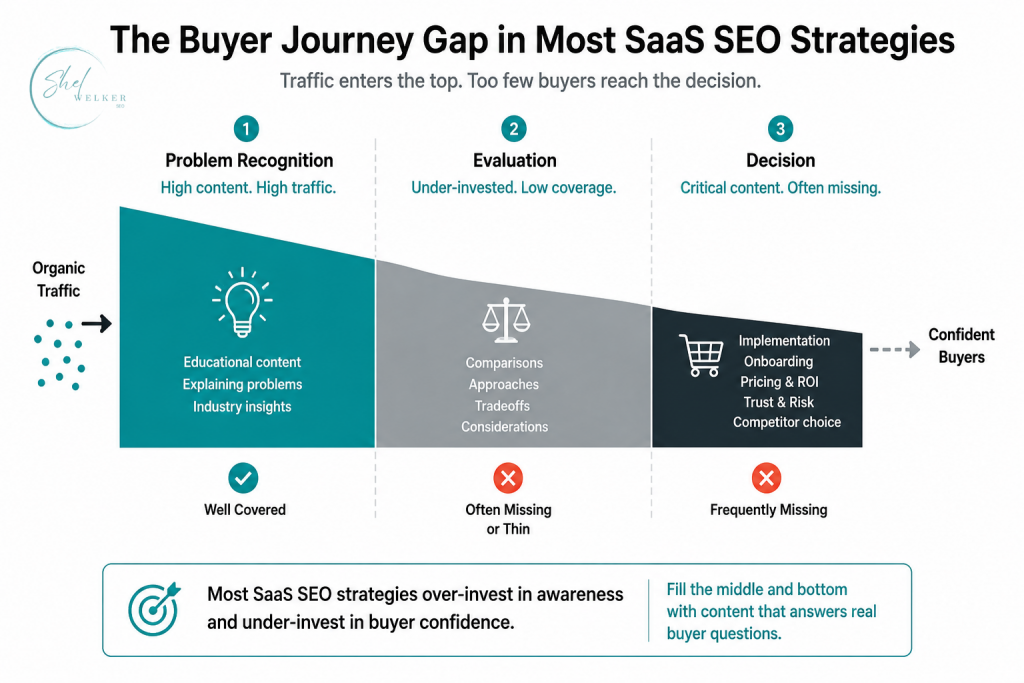
A Decision-First SEO model structures content around the progression buyers actually move through:
- Problem Recognition
- Evaluation
- Decision
Problem Recognition content helps buyers understand the problem and its business impact.
Evaluation content helps them compare approaches, explore tradeoffs, and assess possible solutions.
Decision-stage content addresses the final friction points that prevent action: implementation, migration, onboarding, pricing, trust, and risk.
This creates a much more effective content ecosystem.
Instead of publishing disconnected articles, you build content pathways aligned with buyer movement.
Take a customer support SaaS platform selling to mid-market teams.
Problem Recognition content might focus on why slow response times hurt retention or early signs that support operations are breaking down.
Evaluation content could compare help desk software versus shared inbox systems or explain which automation capabilities matter most for growing teams.
Decision-stage content might include Zendesk alternative pages, onboarding walkthroughs, implementation timelines, pricing considerations, and competitor comparisons.
Now internal linking becomes strategic.
A reader lands on an article about support delays hurting retention. That article naturally links to evaluation-stage content comparing solution types. Evaluation pages link into decision-stage pages covering implementation and product comparisons.
The content mirrors how buyers actually make decisions.
That is where SEO becomes far more valuable to sales.
What SaaS companies should do differently
The companies seeing stronger revenue outcomes from SEO are not necessarily publishing more content.
They are building tighter alignment between visibility and buyer progression.
That starts with better inputs.
Sales calls, demos, onboarding conversations, and win-loss reviews should all feed the content strategy. The goal is to identify repeated questions, recurring objections, and common hesitation points.
This does not need to be complicated.
A simple operational process works well:
- Have sales tag recurring objections inside CRM notes or call summaries
- Review recurring patterns monthly or quarterly
- Map those questions against existing content
- Build missing evaluation and decision-stage assets
Ownership matters here as well.
This works best when SEO, content, and sales leadership treat buyer questions as shared strategic data rather than isolated departmental knowledge.
Measurement should evolve too.
Rankings and traffic still matter, but they should not be the only indicators of success. Strong decision-stage content often shows up in more meaningful ways: shorter sales cycles, fewer repeated objections, better demo conversion rates, and stronger pipeline quality from organic traffic.
Those are the signals that indicate SEO is supporting revenue, not just visibility.
If your SEO strategy is generating visibility but still feels disconnected from revenue, the issue is often structural. The SaaS SEO Blueprint helps identify where buyer journey gaps exist and what to fix first.
The strongest SaaS SEO strategies are not built around keywords alone. They are built around the decisions buyers must make before purchasing.
That is the difference between traffic that simply arrives and traffic that is actually prepared to move forward. Fixing seo and sales misalignment requires better alignment between content strategy, buyer intent, and real sales conversations.