
Why Your SaaS Blog Traffic Isn’t Generating Demos
How fragmented evaluation paths quietly kill the pipeline
You have traffic. You have rankings. Your analytics look healthy. But demo requests and pipeline are barely moving, and leadership is starting to ask the uncomfortable version of that question out loud.
If that is where you are, the instinct is usually to look at the content. Maybe the posts are too generic. Maybe the CTAs are weak. Maybe you need more volume. Those are reasonable guesses, and they are almost always wrong.
The traffic is not the problem.
The path after the click is.
The Structural Gap Between Traffic and Pipeline
Most SaaS content strategies are built to attract, not to advance. A blog post ranks for a relevant term, answers the question reasonably well, and succeeds at pulling people in. Then it ends. The visitor finishes reading, looks around, sees a “Book a Demo” button, and leaves.
They are not leaving because the content was bad. They are leaving because they still have unanswered questions, and the site gives them nowhere to go.
Take a real scenario. A SaaS company selling customer support software publishes a post titled “How to Reduce First Response Time.” It ranks well. It pulls in operations managers and support leads.
Good audience. But when those readers finish the article, they still need answers to questions like:
- Does this integrate with our current stack?
- Is this built for enterprise teams or small support departments?
- How does pricing scale as we grow?
- What does onboarding actually look like?
- How does this compare to what we are already doing?
None of those questions are unreasonable. They are the exact questions a serious buyer asks before agreeing to a sales call. And if the site cannot answer them, the buyer goes somewhere else to find the answers.
Traffic Problem vs. Conversion Structure Problem – Why SaaS Blog Traffic Doesn’t Generate Demos
This distinction matters more than most teams realize because the two problems require completely different fixes.
A traffic problem means the wrong people are arriving, or not enough of the right ones. The solution is better keyword targeting, better distribution, more content.
A conversion structure problem means the right people are arriving and leaving without converting. The solution has nothing to do with traffic volume.
The pattern that signals a conversion structure problem looks like this: strong organic growth, high blog engagement, minimal movement into product or evaluation pages, and demo requests that stay flat regardless of how much traffic goes up. If that is what your analytics show, publishing more content will not fix it. You will just create more leakage at the same rate.
The underlying cause is almost always the same. Most SaaS sites compress the buyer journey into two steps: read a blog post, request a demo. That works if someone arrives already sold. It fails for the majority of organic search visitors, who arrive during evaluation rather than at the end.
What the Middle of the Journey Actually Needs
Between a blog post and a demo request, there is a layer of content most SaaS sites are missing entirely. This is not a new idea, but most teams treat it as optional or defer it indefinitely because blog posts are easier to produce.
Most SaaS teams already know they should build comparison pages and evaluation content. The problem is usually prioritization. They do not know which assets matter first or how those pages should connect structurally.
Here is what that missing layer looks like in practice. A project management SaaS targeting engineering teams might have dozens of posts about sprint planning and distributed team workflows.
Good traffic. But the typical buyer journey ends like this:
Blog post → Demo request
A site built actually to advance buyers looks like this:
Step 1. “Why Sprint Planning Breaks Across Distributed Teams” (blog post)
Step 2. “Project Management Software for Engineering Teams” (use case page)
Step 3. “Linear vs [Your Product]” (comparison page)
Step 4. “How Engineering Managers Track Delivery Bottlenecks” (workflow explainer)
Step 5. Demo or free trial
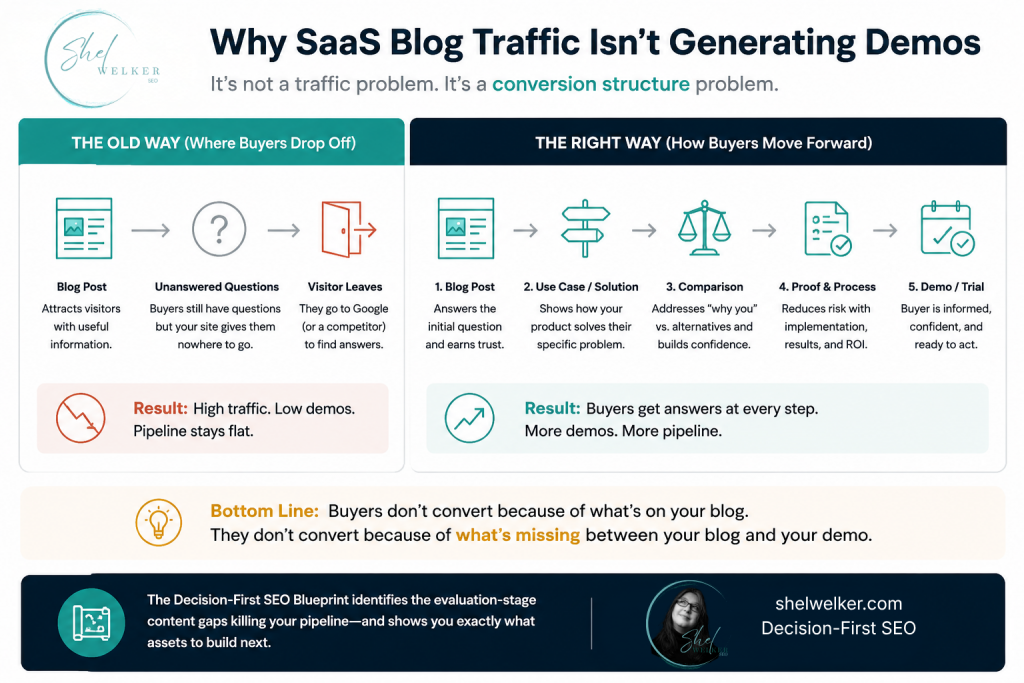
Each step reduces a specific uncertainty. Each page answers a question that would otherwise push the buyer back to Google. The internal linking structure that connects these pages also strengthens the SEO value of the entire cluster, which makes this a compounding investment, not a one-time fix.
What most teams discover when they map this out is that they have plenty of awareness-stage content and almost nothing at the evaluation stage. A few strong comparison pages or implementation guides can meaningfully improve the performance of existing traffic without a single new blog post.
Where to Look for Drop-Off Signals
Most SaaS companies already have enough traffic data to diagnose where the breakdown is happening. You do not need more visits to find the problem. You need to look at the right metrics.
The signals that point to a structural gap:
- High time-on-page for blog content, low visits to product or solution pages
- Organic traffic growing while demo requests stay flat or decline as a percentage
- Visitors returning multiple times through different search queries without converting
- Traffic concentrated on informational posts with minimal movement into evaluation content
- Exit rates spiking on blog posts rather than on pricing or comparison pages
Visitors do not disappear randomly. They leave when a question goes unanswered and the site has nothing to offer them next. Those exit points are structural clues, not content quality problems.
What Decision-First SEO Actually Is
Decision-First SEO is a structured framework that sits on top of traditional SEO. It does not replace keyword research, technical optimization, or link building. Those fundamentals still matter. What Decision-First SEO adds is a layer of intentional architecture around what happens after someone lands on your site.
Traditional SEO asks: what keywords should we rank for?
Decision-First SEO asks: what decision is the visitor trying to make, and what content do they need at each stage to keep moving toward it?
In practice this means mapping searches by decision stage, not just by topic or volume. Some searches signal that someone is recognizing a problem for the first time. Others signal active evaluation. Others signal purchase readiness. Each stage needs different content, and the connections between those pages determine whether buyers progress or stall.
The teams that benefit most from this framework are not the ones with bad content. They are the ones with good awareness-stage content and no evaluation architecture. They have built a strong top of funnel and then left buyers with nowhere to land.
The Decision-First SEO Blueprint
If the pattern above sounds familiar, the Blueprint is designed specifically for this situation.
It is a structured audit and build plan that maps your existing content against the full buyer decision journey. It identifies which evaluation-stage assets are missing, which blog posts have no logical progression path, and where buyer momentum is breaking. It then prioritizes the specific pages that will have the highest impact on converting the traffic you already have.
Most teams that go through the Blueprint identify three to six missing evaluation assets in the first review. These are often comparison pages, migration explainers, implementation guides, workflow pages, or use-case assets tied to existing high-traffic topics.
These are not net-new content investments. They are the pages that should already exist given the traffic the site is already pulling in.
The Blueprint costs $500. That is a fraction of what most SaaS teams spend on a single month of content production that compounds the same structural problem. The difference is that the Blueprint tells you exactly what to build and why, rather than adding more volume into a leaking funnel.
The Real Problem Is Rarely the Traffic
If your blog is ranking and your demos are not moving, the traffic is probably doing its job. The gap is in what comes after it.
Fixing that does not require a content overhaul or a new SEO strategy. It requires mapping the decision journey your buyers are actually on and building the specific pages that support it.
The Decision-First SEO Blueprint maps where your buyer journey is breaking, which evaluation assets are missing, and what should be built next to turn existing traffic into pipeline.
Related Buyer Questions
If your SaaS SEO is getting traffic but not enough conversions, these guides can help you identify where the buyer path is breaking.