SEO vs AEO vs Decision-First SEO: What Actually Happens After Visibility?
A B2B project management SaaS starts seeing stronger organic visibility.
A few important pages are ranking on page one.
AI Overviews are beginning to reference their category content.
Organic traffic is climbing steadily.
Branded searches are increasing.
But demo requests barely move.
The sales team notices something interesting during calls. Prospects are arriving more informed than before. They already understand the category. They know the common features. They have usually compared several options already.
What they are struggling with is evaluation.
They are trying to figure out:
- which platform actually fits their workflow
- how difficult migration will be
- whether onboarding will become operationally painful
- how pricing scales over time
- and whether the product feels trustworthy enough to commit to
That distinction matters because many SEO discussions right now are heavily focused on visibility while spending very little time on what happens after discovery.
Traditional SEO vs AEO vs Decision-First SEO, paired with AI Visibility, are often discussed as if they solve the same problem.
They do not.
Each one supports a different part of the buyer journey.
What is the difference between SEO and AEO?
Traditional SEO is primarily a discoverability system.
It helps search engines understand:
- what your pages are about
- which problems they solve
- how your content relates to search intent
- and where your site fits within a broader topic ecosystem
That includes:
- topical authority
- crawlability
- internal linking
- semantic relationships
- content depth
- structured site architecture
AEO, or Answer Engine Optimization, extends many of those same foundations into AI-driven discovery environments.
That includes:
- AI Overviews
- conversational search experiences
- synthesized comparisons
- AI-generated recommendations
- answer-first interfaces
In practical terms, strong AEO usually depends on strong SEO.
Google’s AI search documentation repeatedly reinforces the importance of:
- helpful content
- expertise
- trustworthy information
- clear structure
- and strong source material
That is part of the reason E-E-A-T signals still matter heavily in AI-driven search environments. AI systems are still pulling from the web itself as their source layer.
So the conversation around SEO vs AEO is often framed too aggressively.
This is not:
- old SEO versus AI search
It is:
What AI-driven search behavior is actually changing
AI search experiences are making early-stage discovery faster.
A user researching:
“best project management software for agencies”
can now quickly receive:
- category summaries
- comparison snapshots
- implementation considerations
- common feature expectations
- and vendor overviews
before clicking a single website.
That changes how buyers arrive.
Many users now land on SaaS websites with their basic awareness questions already answered.
The remaining questions are harder.
They are no longer asking:
“What is this category?”
They are asking:
“Does this fit my situation?”
That shift matters because most SaaS sites are still heavily optimized for awareness-stage discovery.
They often contain:
- informational blog posts
- high-volume keyword targeting
- educational explainers
- introductory content
- broad SEO traffic pages
But very little structured evaluation support.
As AI-driven search compresses the early information-gathering phase, evaluation friction becomes more visible further downstream.
What is Decision-First SEO?
Decision-First SEO focuses on what happens after discovery.
Traditional SEO helps users find information.
AEO helps expand discoverability into AI-driven search experiences.
Decision-First SEO focuses on helping buyers move through:
- evaluation
- comparison
- uncertainty reduction
- and final decision-making
using connected content pathways built around buyer progression.
It is not a replacement for SEO or AEO.
It is the layer that connects visibility to decision support.
That distinction becomes easier to see when looking at how many SaaS sites are currently structured.
A typical SaaS company may have:
- dozens of informational articles
- strong search visibility
- increasing AI mentions
- growing branded searches
But almost no content helping buyers evaluate:
- implementation complexity
- migration concerns
- onboarding expectations
- operational tradeoffs
- pricing fit
- workflow compatibility
- competitor differences
The visibility layer functions.
The evaluation layer weakens.
What Decision-First SEO looks like in practice
The biggest difference between traditional traffic-focused SEO and Decision-First SEO is usually structure.
In many SaaS environments, informational content exists in isolation.
A user lands on a discovery-stage article.
Reads the content.
Leaves to continue researching elsewhere.
Decision-First SEO attempts to reduce that fragmentation by building connected pathways between discovery and evaluation.
For example:
A buyer lands on an informational article about agency project management workflows.
From there, the site may naturally guide them toward:
- a comparison page between competing tools
- migration guidance for switching platforms
- onboarding expectations for agencies
- pricing structure explanations
- workflow-specific use cases
- implementation timelines
- proof from similar agency teams
The goal is not simply generating awareness.
The goal is helping users continue progressing naturally through the evaluation process without restarting their research from scratch.
The types of content that support buyer progression
As AI visibility expands, decision-stage content becomes increasingly important.
Some of the highest-value formats include:
Genuine comparison pages
Not aggressive competitor attack pages.
Real comparison content explaining:
- strengths
- limitations
- workflow differences
- implementation realities
- operational tradeoffs
Buyers are already comparing vendors. The question is whether your site helps them evaluate those differences clearly.
Migration and onboarding content
One of the biggest blockers in SaaS purchasing is fear of switching costs.
Detailed migration content can help answer:
- how long implementation takes
- who owns onboarding
- what support exists
- what operational disruption is realistic
- and what preparation is required internally
This type of content often reduces more friction than another informational blog post targeting broad awareness keywords.
Workflow-specific pages
Generic product pages explain features.
Workflow pages explain fit.
A project management tool used by software agencies has different operational needs than one used by enterprise manufacturing teams. Buyers want to understand whether the product matches their actual environment.
Pricing clarity content
This does not always mean publishing full pricing publicly.
But buyers usually need enough context to understand:
- how pricing scales
- what affects implementation costs
- what different tiers include
- and whether the product realistically fits their operational range
Lack of pricing clarity often creates unnecessary hesitation during evaluation.
Evaluation frameworks
One of the most underused SaaS content formats is the evaluation framework.
For example:
“How to Evaluate Project Management Software for Agencies”
This type of content helps buyers understand:
- what questions matter
- what tradeoffs to evaluate
- what operational factors to consider
- and how to assess long-term fit
It also naturally supports both:
- search visibility
- and buyer trust
because the content demonstrates genuine expertise instead of simply promoting features.
How SEO, AEO, and Decision-First SEO work together
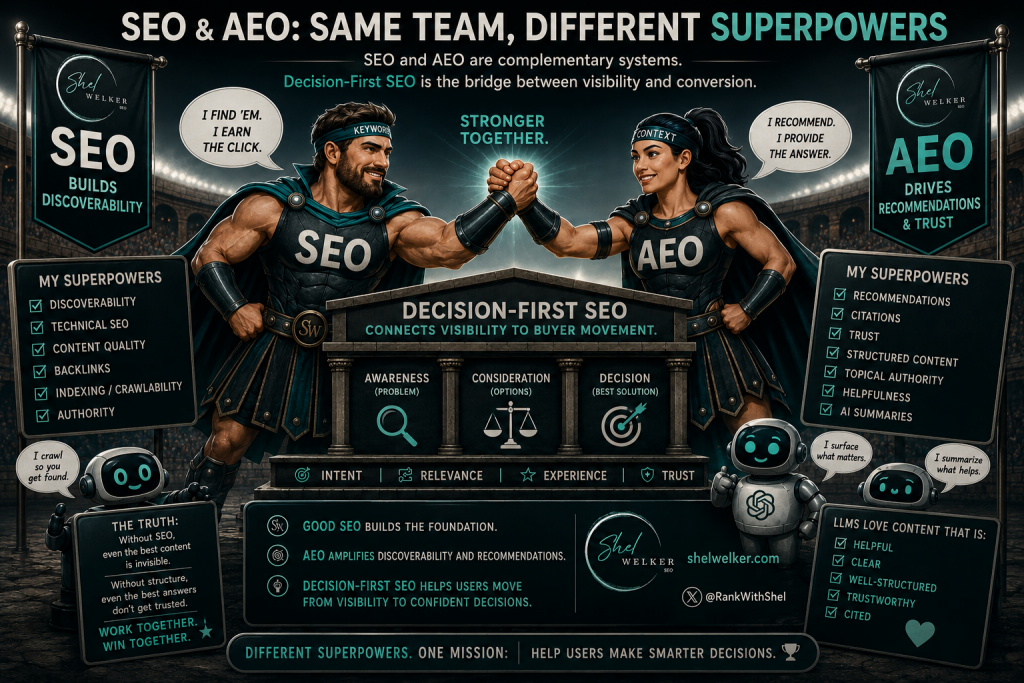
These systems work best when they function together across the buyer journey.
Traditional SEO builds discoverability.
AEO expands visibility across AI-driven search environments.
Decision-First SEO supports buyer progression after discovery occurs.
When one layer is weak, the overall system weakens too.
For example:
A SaaS company may:
- improve rankings
- increase AI Overview visibility
- expand branded search
- grow awareness
But if users cannot naturally progress toward:
- comparison
- implementation understanding
- pricing confidence
- workflow fit
- and trust-building proof
then buyer movement often slows during evaluation.
The issue is not always traffic.
Sometimes the issue is that the site was built to attract visitors without being structured to support decisions afterward.
A simple audit SaaS companies can run
If a SaaS company wants to evaluate whether this problem exists on its own site, a simple audit can usually expose the gaps quickly.
Start by reviewing the top organic landing pages in Search Console or GA4.
Ask:
Does this page help someone evaluate a decision, or does it only help them discover information?
Many SaaS companies realize most of their organic traffic lands on awareness-stage content with very few connected evaluation pathways afterward.
Next, review recent closed-lost opportunities.
What concerns repeatedly appeared during evaluation?
What uncertainty slowed decisions?
What questions forced additional sales calls?
Those questions often reveal the highest-value decision-stage content opportunities. This is also where a structured decision-stage analysis can help identify where buyer progression breaks after discovery.
Then evaluate internal linking pathways.
Can a user naturally move from:
- informational discovery
- to comparison content
- to implementation guidance
- to pricing clarification
- to trust-building proof
without friction?
If not, the issue is often structural rather than purely visibility-related.
Visibility and buyer progression are different systems
Traditional SEO, AI visibility, and Decision-First SEO are not competing strategies.
They support different stages of the same buyer journey.
SEO and AEO help buyers discover solutions.
Decision-First SEO helps buyers evaluate those solutions with enough clarity and confidence to move forward.
As AI-driven discovery continues expanding, the SaaS companies that perform best will probably not be the ones treating visibility as the finish line.
They will be the companies building connected systems that support buyers from discovery through evaluation and final decision-making.