
What a Strong B2B SaaS SEO Strategy Actually Looks Like in 2026
I keep seeing the same pattern in B2B SaaS.
Organic traffic grows. Rankings improve. The content team ships consistently. SEO dashboards look healthy. Yet demo requests barely move, pipeline stays flat, and revenue impact feels frustratingly unclear.
At that point, most teams assume they have an execution problem. They think they need more content, better backlinks, stronger rankings, or improved conversion optimization.
In my experience, that is usually the wrong diagnosis.
Most B2B SaaS SEO strategies do not fail because of poor execution. They fail because the strategy itself is built around the wrong goal. Too many SaaS companies optimize for traffic before they define buyer decisions, which creates a structural disconnect between visibility and revenue.
That worked better when search journeys were simpler.
It works much less reliably now.
Modern SaaS buyers do not move in straight lines. They research through Google, AI Overviews, ChatGPT, Reddit, review platforms like G2 and Capterra, competitor pages, peer recommendations, and internal stakeholder conversations. Visibility no longer happens in one place, and buyers rarely follow a clean path from search to demo.
That changes what a strong B2B SaaS SEO strategy needs to accomplish.
The companies seeing stronger results are not simply ranking for more keywords. They are building visibility around buyer decisions.
That is the foundation of Decision-First SEO.
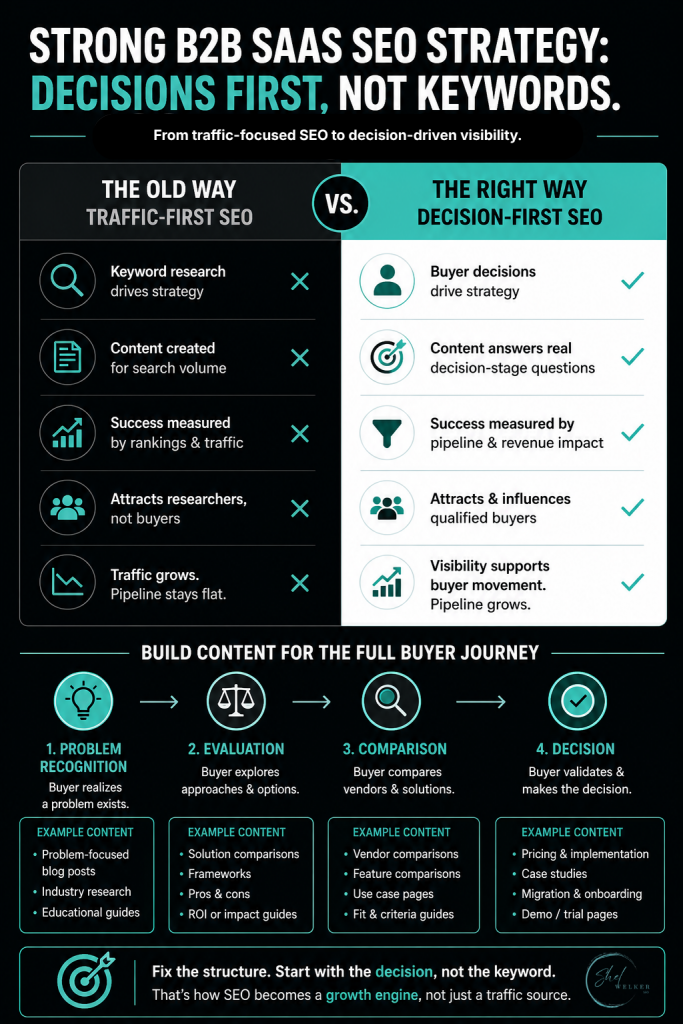
The Hidden Reason Traffic Stops Translating Into Pipeline
One of the clearest warning signs in SaaS SEO is when traffic grows but demos do not.
A company might go from 20,000 monthly organic visits to 80,000 while demo volume barely changes. Leadership starts asking uncomfortable questions. Marketing sees traffic growth as proof of success. Sales sees weak pipeline contribution and questions whether SEO is attracting the right people.
Both sides are seeing part of the truth.
The issue is usually not traffic volume. The issue is where that traffic sits in the buyer journey.
I see this pattern constantly. Organic visibility grows heavily in early-stage informational searches while evaluation and decision-stage visibility stays weak. That creates a situation where SEO performance looks healthy on paper but contributes very little to pipeline.
Take a project management SaaS ranking well for searches like:
- what is agile workflow
- scrum vs kanban
- project management methodology examples
These topics can generate substantial traffic. They also attract a broad audience that includes students, researchers, consultants, and early-stage problem-aware users who may never become buyers.
Meanwhile, the content that actually influences purchasing decisions is often missing or underdeveloped.
Pages like:
- Asana vs Monday for enterprise teams
- best project management software for distributed teams
- how to migrate from spreadsheets to project management software
Those are the searches where buyers are actively evaluating options, involving stakeholders, and thinking about budgets.
That distinction matters.
Traffic alone does not tell you whether SEO is reaching buyers at the moments that influence revenue.
Where Most B2B SaaS SEO Strategy Quietly Breaks Down
Most SaaS SEO strategies still begin with keyword research.
That sounds logical, but it creates a major blind spot. Keywords tell you what people search for. They do not tell you what buyers are trying to decide, what objections are slowing deals down, or what information would actually move someone toward a purchase.
That is where strategy often starts to weaken.
In many SaaS audits, I find that the majority of indexed content lives almost entirely in awareness or problem-recognition stages. There may be dozens or even hundreds of blog posts attracting traffic, but very little content supporting evaluation and decision-stage questions.
That imbalance creates predictable outcomes.
Traffic rises. Rankings improve. Pipeline stalls.
The issue is not usually content volume. It is strategy alignment.
Strong SEO strategy for SaaS companies needs to account for the full buyer journey. That means understanding not just what people search, but why they search and what they need next.
That is a very different approach than building around search volume alone.
Decision-First SEO Changes the Starting Point
Traditional SaaS SEO typically follows a familiar sequence.
Keyword research leads to a content calendar. The content calendar drives content production. Production drives rankings. Rankings drive traffic.
The process feels logical. The problem is that it often produces disconnected content with weak commercial value.
Decision-First SEO starts somewhere else.
It starts with buyer movement.
Before thinking about keywords, I want to understand a different set of questions:
- What decision is the buyer trying to make?
- Where do they hesitate?
- What objections slow momentum?
- What information builds confidence?
These questions reveal where visibility matters most.
Once that becomes clear, SEO strategy becomes much easier to structure because content is built around decision progression rather than keyword opportunity alone.
Most B2B SaaS buying journeys can be mapped across three major stages:
- Problem Recognition
- Evaluation
- Decision
Problem recognition content helps buyers understand what is happening.
Evaluation content helps them compare approaches, frameworks, or vendors.
Decision content helps them commit with confidence.
This changes SEO from a publishing engine into a decision support system.
That is where SEO starts becoming much more valuable to the business.
The same model also provides a practical way to set SEO priorities when a small team cannot build every part of the pathway at once.
Rankings Measure Visibility, Not Business Influence
A high-ranking page can still contribute very little to revenue.
This is one of the biggest misunderstandings in SaaS SEO.
A page ranking in position two for a high-volume keyword may look impressive in reports. But if it attracts low-intent visitors or fails to move buyers toward action, its business value can remain surprisingly low.
That gap matters even more in 2026 because search itself has fragmented.
A buyer may start with Google, skim an AI Overview, ask follow-up questions in ChatGPT, read Reddit discussions, compare vendors on G2, and only then visit a company website. Rankings may improve throughout that process while your brand remains absent during the moments that actually shape the buying decision.
This is where visibility and influence start to diverge.
What I am seeing in modern search is that contextual relevance matters increasingly more across the ecosystem. Search engines and AI systems appear to be getting better at evaluating content based on usefulness, relationships between concepts, and relevance to real decision questions.
That does not mean keywords stop mattering.
It means keyword relevance alone is no longer enough.
Content that genuinely helps buyers evaluate, compare, and decide appears to carry more strategic weight than disconnected content optimized primarily around rankings.
The Content That Actually Moves SaaS Buyers
This is where many SaaS content strategies quietly break down.
Editorial calendars often become overloaded with top-of-funnel content because it is easy to justify through search volume and relatively easy to scale. But the content buyers rely on when making actual purchasing decisions usually looks very different.
Buyers evaluating software care about questions tied to real business risk.
They want clarity around:
- implementation complexity
- switching costs
- integration requirements
- ROI expectations
- pricing tradeoffs
- vendor fit
That is where evaluation and decision-stage content becomes critical.
For a CRM SaaS company, the highest-value content often looks more like this:
- HubSpot vs Salesforce for mid-market teams
- best CRM for multi-location sales teams
- CRM migration checklist
- how long CRM implementation actually takes
- hidden costs of switching CRM platforms
This content aligns much more closely with what sales teams hear during real conversations.
That is not a coincidence.
If sales reps repeatedly hear the same objections during demos, those objections should shape SEO strategy. The strongest SaaS content strategies are the ones where SEO and sales stop operating in separate silos.
SEO Should Support Decisions Before the Sales Call
This is one of the most important mindset shifts in modern SaaS SEO.
Strong SEO should reduce buyer friction before a sales conversation ever happens.
Think about a cybersecurity SaaS company whose sales team repeatedly hears the same objections. Buyers worry implementation will be difficult. They worry switching costs will be painful. They worry ROI will take too long.
Those objections represent decision friction.
That friction creates hesitation, delays, and stalled deals.
Strong SEO turns that friction into content assets.
That may include implementation guides, migration comparisons, ROI calculators, customer transition case studies, and detailed onboarding expectations. Instead of simply generating traffic, SEO begins doing real work before the first sales call.
That is when SEO starts influencing revenue more directly.
It reduces uncertainty earlier in the buying process.
What Decision-First SEO Looks Like in Practice
Let’s make this practical.
Imagine a SaaS company selling workforce management software to healthcare organizations.
Traffic is growing steadily through informational content. They rank well for terms like:
- workforce scheduling
- staff scheduling templates
- scheduling best practices
Traffic looks strong.
Demo growth remains weak.
Once you map how buyers actually move through this decision, the problem becomes much clearer.
A healthcare operations leader typically moves through three major decision stages.
Problem Recognition:
Scheduling inefficiencies are increasing labor costs, burnout, and retention issues.
Evaluation:
Should the organization improve existing workflows, buy software, or outsource scheduling?
Decision:
Which vendor best fits compliance requirements, workflow complexity, and budget?
Now the content strategy becomes much easier to structure.
A strong content pathway might look like this:
Recognition Content
Hospital scheduling inefficiencies hurting retention
↓
Evaluation Content
Manual scheduling vs workforce management software
↓
Comparison Content
Best workforce scheduling software for healthcare organizations
↓
Decision Content
Implementation timeline, pricing expectations, migration requirements
↓
Conversion Page
Book demo
This is where internal linking becomes strategic.
Instead of publishing isolated articles competing for attention, content works as a structured pathway. Each piece supports the next step in the buyer’s decision process.
That is what strong SaaS SEO strategy increasingly looks like.
Decision-First SEO in an AI-Driven Search Ecosystem
AI-driven search has made structural clarity even more important.
Buyers increasingly ask broad, nuanced questions directly.
They ask things like:
- What is the best CRM for fast-growing B2B SaaS teams?
- Which payroll software is easiest to implement?
- What are the tradeoffs between these vendors?
AI systems synthesize answers across multiple sources.
That means visibility depends on more than ranking individual pages.
It depends on whether your company consistently contributes useful, trustworthy information across the broader ecosystem.
That ecosystem now includes:
- Google Search
- AI Overviews
- LLMs like ChatGPT
- Review platforms
- Communities like Reddit
- Competitor comparison pages
What I am seeing is that brands with stronger visibility in AI-driven search tend to do three things well.
They build content around real buyer decisions. They create depth across the full buyer journey. They maintain consistent messaging across their broader content ecosystem.
That consistency appears to help retrieval systems better understand what a company does, who it serves, and where it fits in relevant buying decisions.
I would still treat these as evolving patterns rather than fixed rules.
But the directional shift feels clear enough to act on.
What I Would Audit First
If SEO is driving traffic but not meaningfully improving pipeline, I would not start by asking how to publish more content.
I would start by asking whether the strategy is aligned with how buyers actually make decisions.
That usually reveals the real problem.
The first questions I would audit are:
- Where does most organic traffic sit in the buyer journey?
- Which evaluation-stage questions remain unanswered?
- Where does decision friction appear during sales conversations?
- Does content actively reduce that friction?
- Are internal pathways moving buyers forward or creating dead ends?
These questions expose structural gaps quickly.
The B2B SaaS companies that win with SEO in 2026 will not necessarily be the companies with the most traffic or the most rankings.
They will be the companies whose visibility consistently supports buyer movement across the full decision journey.
That means showing up when buyers are learning, evaluating, comparing, and deciding.
If your SaaS SEO strategy is generating traffic but struggling to influence pipeline, I would start with one assumption.
The problem probably is not execution.
The problem is structure.
Fix the structure. Start with the decision, not the keyword, and the rest of the strategy tends to become much clearer.
Related Information
If your SaaS SEO is getting traffic but not enough conversions, these articles can help you identify where the buyer path is breaking.