
Are We Building Content Around Keywords Instead of Decisions?
Every SaaS team eventually reaches a point where the numbers stop telling a satisfying story. Rankings improve. Organic traffic grows. More pages appear in search results. Yet pipeline growth barely changes, sales cycles remain just as long, and leadership starts asking why SEO isn’t contributing more meaningfully to revenue.
The first instinct is usually to look for execution problems. Perhaps the site needs more content. Maybe competitors have stronger authority. Perhaps another round of optimization will finally unlock the missing conversions.
Those explanations sometimes prove true, but they often overlook a more fundamental issue. Many content strategies are exceptionally good at helping buyers discover information while doing very little to help them make a purchasing decision. Many of today’s keyword focused SEO problems begin with that disconnect.
That distinction matters far more today than it did a few years ago. SaaS buyers no longer follow a predictable path from search engine to landing page to demo request. They move between Google, AI-generated answers, review platforms, Slack communities, analyst reports, and vendor websites as they gradually reduce uncertainty. Being visible is only one part of becoming the company they ultimately trust.
When Keywords Become the Strategy Instead of the Starting Point
Keyword research remains one of the most valuable planning tools in SEO. It reveals how potential customers describe problems, what information they actively seek, and where demand already exists. Ignoring that data would be difficult to justify.
The problem begins after the research is finished.
For many teams, keywords quietly become the architecture of the entire content strategy. Every article is assigned a phrase. Every page is judged independently. Success is measured by rankings, impressions, and clicks.
Most reporting frameworks make this strategy look successful because they measure visibility exceptionally well. They measure buyer progression much less effectively.
A prospect evaluating a customer support platform, for example, rarely reaches a decision because one article answered one search. They compare deployment models, investigate integrations, discuss security requirements internally, estimate implementation effort, review pricing assumptions, and evaluate vendors against each other before recommending a purchase.
Those are connected decisions.
Most keyword plans treat them as disconnected searches.
That difference explains many of the keyword-focused SEO problems SaaS companies experience. The content succeeds at attracting visitors but provides very little structure for helping those visitors move toward confidence.
Search Intent Explains Discovery. Buyer Intent Explains Progression.
Search intent and buyer intent are often treated as though they describe the same thing. They overlap, but they answer different questions.
Search intent tells us what information someone wants right now.
Buyer intent explains the decision they’re trying to move closer to.
Decision-focused content is designed around those buyer decisions, helping prospects compare options, reduce uncertainty, and confidently move to the next stage of the buying journey.
Someone searching for “CRM implementation checklist” may simply need a document to support a project already underway. Someone else entering the exact same query may be preparing recommendations for an upcoming software purchase.
The keyword is identical.
The decision behind it is not.
That distinction becomes especially important in SaaS because purchases are rarely made by one person acting alone. A department leader may care about productivity. IT may evaluate integrations and security. Finance focuses on cost and return. Executive leadership wants confidence that implementation risk is manageable.
Each stakeholder arrives with different questions, even when they encounter the same content.
This is where Decision-First SEO changes the planning process.
Instead of beginning with, “What keyword should this page rank for?” the planning conversation becomes, “What decision should this page help someone make?”
Keywords still guide discovery. They simply stop acting as the organizing principle. The organizing principle becomes buyer progression.
Why Strong Rankings Still Produce Weak Revenue
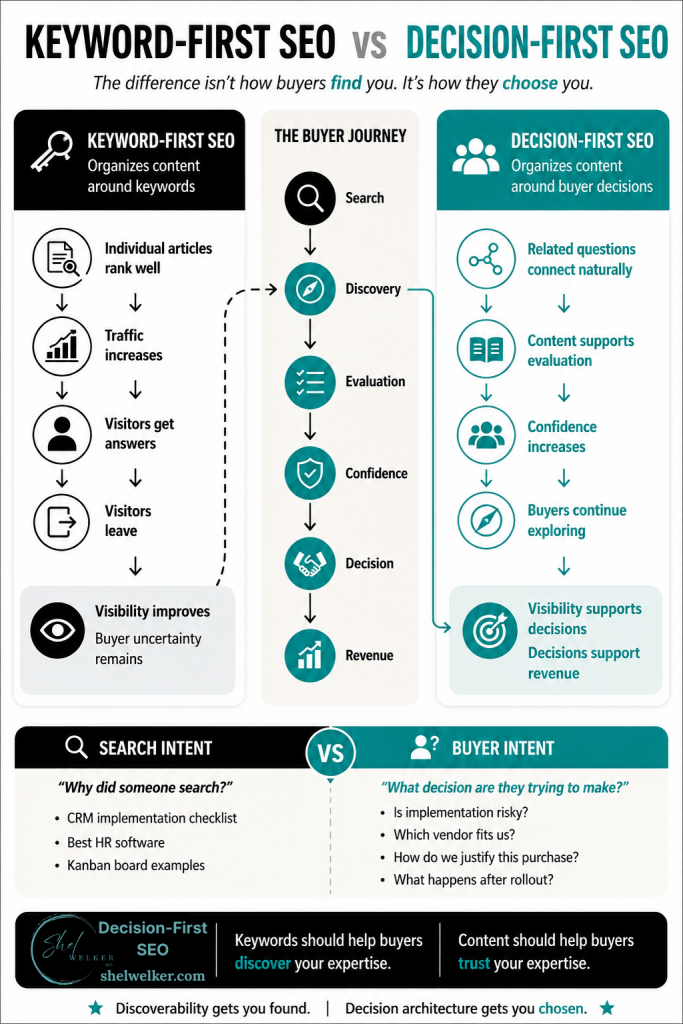
One of the most common frustrations in SaaS SEO is watching rankings improve while conversions remain largely unchanged.
That outcome becomes much easier to understand when visibility and evaluation are viewed as separate systems.
Imagine a project management software company publishing excellent resources covering Agile workflows, Kanban boards, Scrum meetings, implementation templates, and project planning frameworks. Each article performs well independently because each satisfies a specific search.
A visitor arrives, finds the information they wanted, and leaves.
The site answered the immediate question, but it never anticipated the next one.
How difficult will implementation be?
Which methodology works best for organizations like ours?
What separates competing platforms?
How should we evaluate vendors before making a recommendation?
Those questions represent movement through a buying decision. They rarely appear inside one search query, yet they strongly influence whether someone eventually becomes a customer.
Now imagine the same content organized differently.
A reader exploring Agile workflows naturally encounters comparison content explaining where different methodologies succeed or struggle. From there they move into implementation planning, migration considerations, integration requirements, pricing expectations, and vendor comparisons relevant to companies with similar operational needs.
Internal links exist because they mirror the buyer’s next question, not because two pages happen to mention similar keywords.
The content no longer functions as a collection of isolated articles. It becomes an evaluation pathway.
Modern Retrieval Systems Reward Connected Thinking
This structural difference matters for readers, but it also matters for how modern search systems interpret expertise.
Traditional SEO often encouraged thinking about individual pages in isolation. Today’s search engines and AI retrieval systems increasingly evaluate relationships between concepts, entities, and supporting information. They are becoming better at recognizing whether a website consistently develops a subject across multiple connected pages rather than simply publishing a large collection of keyword-targeted articles.
For SaaS companies, that distinction carries practical consequences.
A website that connects implementation planning with pricing strategy, integration concerns, onboarding, security evaluation, vendor comparisons, and long-term adoption presents a coherent picture of expertise. Each article reinforces the others because together they reflect how real buyers evaluate software.
A website built around isolated keyword opportunities may still rank for individual searches, but the broader picture is less convincing. The content answers questions without demonstrating how those questions relate to one another.
That relationship matters because buyers rarely encounter your company only once. They may see your content in Google, encounter it again through an AI-generated response, revisit it while comparing vendors, and return again during internal discussions. When every interaction consistently supports the same decision process, confidence grows naturally.
Modern retrieval systems increasingly recognize those conceptual relationships as well. Semantic consistency, contextual alignment, and clear entity relationships help search engines understand not only what your content discusses, but how your expertise is organized around a complete subject rather than isolated topics.
Ultimately, that benefits both discoverability and buyer confidence because the information architecture reflects the way people actually make decisions.
What Decision-Focused SEO Looks Like in Practice
Consider an HR software company offering workforce management software.
A conventional content strategy might include articles about employee scheduling, workforce forecasting, time tracking, labor cost optimization, and shift planning templates. Each topic addresses legitimate demand and deserves coverage.
The difference appears during planning.
Instead of treating those articles as independent opportunities, Decision-First SEO asks how they connect during evaluation.
A prospective customer researching employee scheduling may naturally begin asking how scheduling affects workforce forecasting. That leads into implementation complexity, integration with payroll systems, reporting capabilities, return on investment, and finally comparisons between vendors serving organizations with similar operational requirements.
Each page prepares the buyer for the next decision instead of simply answering the current search.
Internal linking becomes part of the buying journey rather than an SEO checklist.
Content clusters become decision pathways.
The objective shifts from maximizing page-level performance to reducing uncertainty across the entire evaluation process.
Questions Buyers Commonly Ask During Evaluation
| Buyer Question | Why It Matters |
|---|---|
| Can a keyword-first SEO strategy hurt conversions? | Yes. It can attract qualified visitors while leaving critical buying questions unanswered. |
| What’s the difference between search intent and buyer intent? | Search intent explains the query. Buyer intent explains the decision taking place behind that query. |
| Why don’t rankings automatically produce sales? | Rankings create visibility. Purchases require confidence built across multiple interactions and decisions. |
| How can we tell if we’re optimizing for traffic instead of decisions? | If reporting focuses primarily on rankings and sessions without understanding how buyers progress through evaluation, the strategy is likely weighted toward discovery rather than decision-making. |
| What does decision-focused SEO actually change? | It organizes content around the sequence of buyer decisions instead of treating every keyword as an independent destination. |
These questions rarely appear in isolation. A marketing leader frustrated by declining conversion rates is often trying to understand why strong rankings have not translated into stronger buying confidence. Solving that problem requires connecting the entire evaluation journey rather than optimizing each page independently.
Building Content Around Decisions Creates Stronger Businesses
Keyword research is not becoming less important.
If anything, it remains one of the clearest ways to understand how buyers begin exploring a problem.
What has changed is the environment those buyers now navigate. Discovery happens across traditional search, AI-generated responses, peer recommendations, communities, and repeated interactions with the same brand. Success depends less on answering a single query than on helping someone confidently work through a series of connected decisions.
That requires a different way of organizing content.
The strongest SaaS SEO strategies increasingly recognize two systems working together. One helps potential customers discover your expertise. The other helps them trust your expertise enough to choose your solution.
Treating those systems as interchangeable often produces impressive traffic reports alongside disappointing revenue outcomes.
Treating them as complementary creates content that supports the entire buying journey, from the first search through vendor evaluation and internal consensus.
That is the thinking behind the Decision-First SEO Blueprint. It is not an alternative to keyword research. It is a framework for organizing everything keyword research uncovers into an information architecture that reflects how SaaS buyers actually evaluate, compare, and choose software. When content is built around decisions rather than isolated searches, discoverability and commercial outcomes begin reinforcing one another instead of drifting apart.