Most SaaS Sites Don’t Have Enough Evaluation-Stage Content
How a Decision-First approach turns SEO traffic into buying momentum
Evaluation-stage content is often the missing link between growing SaaS traffic and growing pipeline because it answers the questions buyers ask before they convert. Every SaaS marketing dashboard seems to tell the same story. Organic traffic is climbing, impressions continue trending upward, and more keywords are finding their way onto the first page of Google. On paper, the SEO strategy appears to be working.
Then someone looks at the pipeline.
Demo requests haven’t increased. Sales conversations aren’t becoming easier. Organic traffic is growing, but revenue isn’t following the same trajectory.
The first instinct is usually to examine the bottom of the funnel. Maybe the landing pages need work. Maybe the calls-to-action aren’t compelling enough. Maybe the messaging isn’t resonating. Those are all worthwhile questions, but in many of the SaaS content audits I’ve done, the disconnect starts much earlier.
The site is filled with content that explains problems and introduces concepts, but it offers very little that helps a buyer choose a solution. I refer to this as the evaluation-stage gap, and closing that gap is one of the core ideas behind Decision-First SEO.
Why Traffic Grows While Demos Stay Flat
Imagine someone researching project management software.
They discover your company through an article about sprint planning or agile workflows. That content has done exactly what it was designed to do. It answered an early-stage question and introduced your brand at the right moment.
A few days later, that same person has moved beyond learning about the problem. They’re trying to make a purchasing decision.
Now the questions sound different.
Can this platform replace what we’re using today? How difficult is migration? What does implementation actually involve? How does the pricing compare once we factor in additional users or integrations? How long will it take before our team is productive?
Those questions determine whether someone schedules a demo.
If your website doesn’t answer them, buyers rarely stop researching altogether. They simply continue their evaluation somewhere else. That might be a competitor’s comparison page, a Reddit discussion, a G2 review, or even a conversation with ChatGPT.
Traffic gets your company into the conversation. Evaluation-stage content gives buyers a reason to keep listening.
What Decision-First SEO Actually Changes
Traditional SaaS SEO usually begins with keyword research. Teams identify search volume, build an editorial calendar, and publish content around topics they believe can generate visibility.
That process isn’t wrong. It simply answers a different question.
Decision-First SEO begins by asking:
What decision is this buyer trying to make right now, and what information would help them make it with confidence?
Keyword opportunity still matters, but it becomes a filter rather than the starting point.
One pattern I’ve seen repeatedly is sales teams answering the same questions week after week while marketing continues producing awareness content. Those conversations are often the best roadmap for future SEO because they reveal where buyers hesitate immediately before converting.
Suppose prospects continually ask how long implementation will take.
A keyword-first strategy might overlook that topic because search volume appears modest. A Decision-First strategy sees something different. If implementation uncertainty is preventing buyers from moving forward, then removing that uncertainty has real business value regardless of how many people search for the phrase each month.
That’s the difference.
Instead of publishing content to fill an editorial calendar, you’re publishing content to remove specific barriers between interest and action.
The Content Buyers Need Before They Convert
Comparison pages receive most of the attention whenever evaluation-stage content is discussed, and for good reason. They’re valuable resources for buyers weighing multiple options.
They’re also only one piece of the evaluation process.
As buyers move closer to a purchase, their questions shift from understanding a category to understanding risk. They’re no longer asking, “What is customer onboarding software?” They’re asking whether choosing your platform is likely to create more work, save time, justify the investment, or solve the problems that matter to their business.
That requires a broader layer of content than most SaaS websites provide.
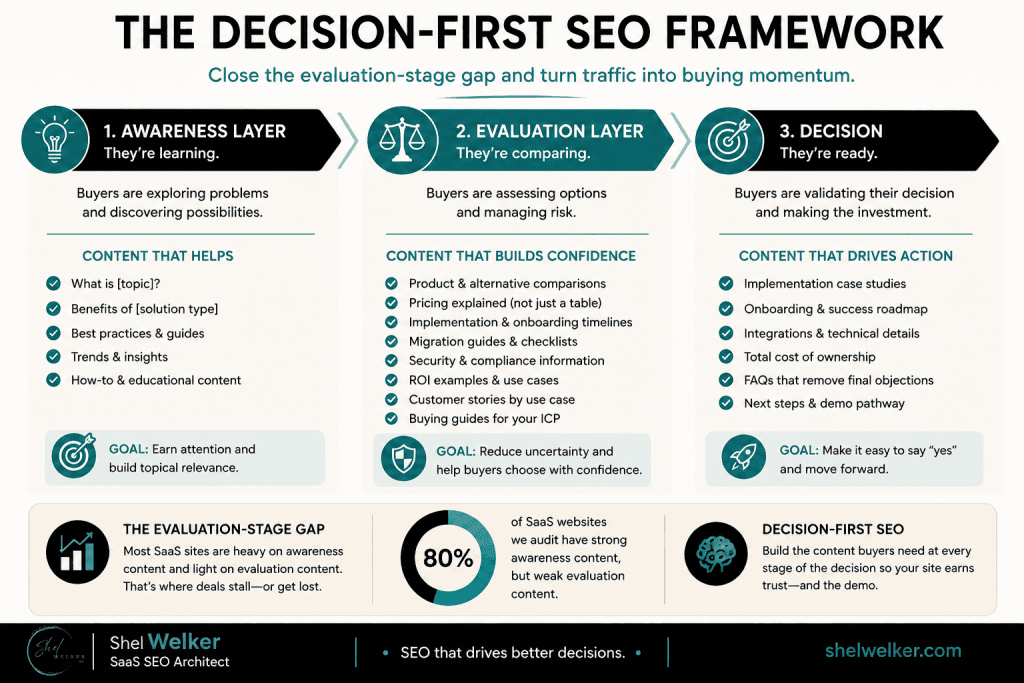
A mature evaluation-stage content strategy often includes:
- Product comparison and alternative pages
- Pricing explained in plain language, not just pricing tables
- Implementation and onboarding timelines
- Migration guides and checklists
- Security and compliance documentation
- ROI examples based on realistic business scenarios
- Customer stories tied to specific industries or use cases
- Buying guides written for different company sizes or decision makers
None of these pages exist primarily to attract traffic.
Their purpose is to reduce uncertainty.
Every unanswered question creates another reason for a buyer to delay a decision or continue researching somewhere else. Every thoughtful answer makes it easier for them to move forward with confidence.
That shift in thinking is what separates a content library from a decision-support system.
Can Too Much Awareness Content Hurt Conversions?
Awareness content isn’t the problem.
Buyers genuinely need educational articles when they’re first learning about a category, understanding terminology, or exploring possible solutions. Those resources deserve a place in every SaaS content strategy.
The problem is imbalance.
I’ve reviewed websites with hundreds of educational blog posts covering introductory topics while offering only a handful of resources that help buyers compare vendors, estimate implementation effort, or evaluate tradeoffs. The SEO reports look healthy because traffic continues to grow, but the content simply isn’t designed to support the decisions that happen later in the buying journey.
Someone searching “What is customer onboarding software?” is solving a very different problem than someone preparing to recommend three vendors during next week’s budget meeting.
Treating those buyers as though they need the same information creates a gap between visibility and conversion.
The companies that consistently generate qualified pipeline understand that awareness content starts the conversation. Evaluation content is what carries it forward.
What a Decision-First Content Plan Looks Like
To see how this works in practice, imagine a CRM company selling to growing SaaS businesses.
A traditional, keyword-driven content calendar might include topics like:
- What is CRM software?
- Benefits of CRM
- CRM best practices
- CRM trends for 2026
- How to improve customer relationships
There’s nothing inherently wrong with those articles. They’re useful educational resources, and they often perform well in search. The problem is that they primarily serve buyers who are still defining the problem. Once someone begins comparing vendors, that content becomes much less helpful.
A Decision-First content strategy keeps the awareness layer, but deliberately builds an evaluation layer alongside it.
Instead of stopping after educational content, the site begins answering the questions buyers ask once they’re seriously considering a purchase.
- HubSpot vs. Your Product
- CRM pricing explained
- CRM implementation timeline
- CRM migration checklist
- CRM security and compliance
- Common implementation mistakes
- ROI calculator
- Customer stories for specific use cases
Notice what changed.
The topics aren’t radically different. The perspective is.
Instead of asking, “What keywords should we target next?” the question becomes, “What decision is our buyer trying to make next?”
That single shift changes the entire content strategy.
Build a Decision Path, Not a Content Library
One of the biggest opportunities I see during SaaS content audits isn’t missing articles. It’s disconnected articles.
A visitor finishes reading about implementation challenges and the only recommendation is another awareness blog post. They read about pricing, and the next suggested article explains basic industry terminology. Every page exists on its own instead of contributing to a larger buying journey.
Buyers don’t research software that way.
They build confidence one question at a time.
A stronger internal linking structure mirrors that progression.
What is CRM software? │ ▼ CRM implementation challenges │ ▼ HubSpot vs. Your Product │ ▼ CRM pricing explained │ ▼ Customer implementation case study │ ▼ Schedule a demo
Each page answers the next logical question instead of forcing the buyer back to Google, ChatGPT, Reddit, or a competitor’s website.
That’s one of the biggest differences between publishing content and building a decision architecture.
Why This Matters Even More in an AI Search World
Five years ago, a buyer might have conducted nearly all of their research inside Google.
Today, the journey looks very different.
Someone may begin with a Google search, compare products on G2, read Reddit discussions, ask ChatGPT for recommendations, visit several competitor websites, and then return to Google with far more specific questions. Research has become an ecosystem rather than a single channel.
Interestingly, buyers and modern retrieval systems are beginning to reward many of the same qualities.
Buyers want complete, trustworthy information that helps them make a confident decision. AI systems increasingly surface content that demonstrates topical completeness, clear relationships between concepts, and genuine expertise. A website that explains pricing, implementation, migration, alternatives, customer outcomes, and common objections presents a much stronger picture than one with dozens of unrelated awareness articles targeting similar keywords.
That’s why I don’t think AI has fundamentally changed good SaaS SEO.
It’s reinforced it.
Decision-First SEO isn’t about optimizing for ChatGPT or AI Overviews. It’s about organizing content around the decisions buyers actually make. As retrieval systems become better at recognizing those relationships, that structure becomes valuable for both human visitors and AI-driven discovery.
Finding Your Evaluation-Stage Gaps
Most content audits begin by counting pages.
I think that’s backwards.
Start with your sales team.
Ask what questions prospects repeatedly ask before requesting a demo. Ask customer success what concerns new customers had before they signed. Review support tickets, onboarding calls, and product feedback.
Those conversations often reveal far more valuable content opportunities than another keyword report.
Then review your website with a few simple questions in mind.
- Can buyers compare your product with the alternatives they’re already considering?
- Does your pricing page explain more than monthly costs?
- Have you addressed implementation and migration expectations?
- Are common objections answered before someone speaks with sales?
- Does every awareness article naturally lead toward evaluation content?
If the answer to several of those questions is “no,” you’ve likely identified opportunities that will contribute more to pipeline than another introductory blog post ever could.
The Missing Link Between Visibility and Revenue
SEO reports are good at measuring visibility. They tell you how many people found your website, which keywords improved, and whether organic traffic is increasing.
They don’t tell you whether buyers gained enough confidence to move forward.
That confidence develops over time. Buyers compare options, validate assumptions, estimate implementation effort, discuss pricing internally, and look for proof that they’re making the right decision. Companies that consistently support those moments become trusted resources throughout the buying journey rather than simply another website that answered an early question.
If your SaaS SEO strategy is producing traffic but not generating the pipeline you expected, the missing piece may not be another awareness article. More often, it’s the content buyers need after they’ve already decided you’re worth considering.
That’s exactly what the SaaS SEO Blueprint is designed to uncover.
Rather than beginning with another keyword list, the Blueprint maps your buyers’ decision journey, identifies where evaluation-stage content is missing, and builds an SEO architecture that supports both visibility and conversion. When you understand the decisions buyers are trying to make, it becomes much easier to create content that helps them make those decisions with confidence.