
Why SaaS Users Drop Off Before Converting
Many founders searching for why users don’t convert SaaS website traffic into demos or trials are actually dealing with unresolved decision friction earlier in the journey.
A lot of SaaS companies eventually run into the same frustrating pattern.
Traffic grows. Organic visibility improves. More users are landing on the site than six months ago. Blog posts begin ranking. Search impressions climb steadily upward. But the actual business impact feels strangely disconnected from the growth.
Demo requests stay flat. Trial-to-paid conversion remains inconsistent. Users seem interested right up until the point where they are expected to move forward.
Most teams initially assume this is a traffic or conversion optimization problem. They start testing CTA copy, redesigning landing pages, shortening forms, tweaking signup flows, or trying to increase top-of-funnel volume even further. Some of those things can create incremental improvements, but they often fail to address the deeper issue because the real drop-off usually begins much earlier in the buyer journey.
In many SaaS funnels, users do not leave because they were never interested. They leave because the site stopped helping them continue evaluating confidently.
That is a very different problem than low traffic or weak conversion mechanics.
The Conversion Problem Usually Starts Before the Conversion Page
One pattern I keep noticing while reviewing SaaS sites is that teams tend to diagnose conversion issues at the very end of the funnel instead of examining the decision path leading into it.
If conversions are weak, attention immediately shifts toward:
- landing page optimization
- signup friction
- CTA placement
- checkout flow
- onboarding UX
But many users quietly disengage long before those elements ever become the deciding factor.
The buyer understood the problem your product solves. They may have even believed your solution sounded promising. But somewhere during evaluation, unresolved questions began stacking up faster than the site answered them.
That uncertainty creates friction.
And unlike technical SEO issues or obvious UX failures, decision friction is harder to spot because it accumulates gradually across multiple sessions, multiple pages, and multiple unanswered questions.
Analytics often shows the symptom:
- bounce rates
- abandonment
- weak conversion percentages
But not the underlying reason why the buyer lost confidence in continuing.
Where Buyers Actually Lose Momentum
Most users do not abandon a SaaS site because a button color failed to persuade them.
They leave because the journey stops supporting the next stage of their thinking.
A user might land on an informational article through search and immediately recognize themselves in the problem being described. The article resonates. The issue feels real. The search intent was correct.
But after reading, the site offers very little guidance for what comes next.
There may be no natural progression into:
- evaluation content
- comparison pages
- implementation expectations
- migration considerations
- onboarding clarity
- role-specific use cases
So the buyer leaves to continue researching elsewhere.
The same thing often happens on feature pages. The features themselves are not necessarily the issue. The problem is that feature pages frequently assume the buyer is already convinced the category and solution approach are correct.
But many users are still trying to answer deeper questions:
- How difficult is implementation?
- How does this compare against alternatives?
- Is this realistic for a team our size?
- What changes operationally after adoption?
- How long before value is visible?
- What risks exist during migration?
Most SaaS websites do a reasonable job supporting the first-stage question:
“What problem exists?”
And the final-stage question:
“Ready to start a demo or trial?”
The middle of the decision journey is where things often break down.
Why More Traffic Often Makes the Problem Worse
If the buyer journey itself is incomplete, adding more traffic simply increases the number of users who encounter the same unresolved friction.
This is why some SaaS companies experience a strange disconnect where rankings improve, impressions grow, and organic traffic expands while conversion rates barely move.
The issue is not necessarily visibility.
It is continuity.
The site successfully attracts attention but does not consistently support the evaluation process required before a confident decision can happen.
For years, many SEO strategies were built primarily around traffic acquisition:
- informational search targeting
- keyword expansion
- content volume
- landing page optimization
Those things still matter. Traditional SEO still matters enormously.
But traffic by itself does not create decision clarity.
Before most SaaS buyers are ready to request a demo or commit to a trial, they usually need confidence around several things:
- how the product compares against alternatives
- whether implementation is realistic
- how onboarding works
- what success looks like operationally
- whether teams like theirs have succeeded with it before
- how the transition process unfolds
If the site does not help answer those questions, users continue evaluating elsewhere even after discovering your brand.
The Missing Middle in Most SaaS Content Strategies
This is one reason many SaaS content ecosystems feel incomplete even when the site technically contains “enough content.”
A company may have:
- educational blog articles
- product pages
- pricing pages
- feature breakdowns
- signup flows
But very little exists to support the actual movement between recognition, evaluation, and decision.
That missing middle creates structural gaps throughout the buyer journey.
For example, someone might discover your article about ecommerce attribution challenges and begin understanding that their reporting problems are larger than they initially realized. But if the next step immediately pushes them toward a product page without helping them evaluate approaches, compare options, or understand implementation realities, the journey stalls.
The issue is not that the user lacked intent.
The issue is that the site stopped helping them think through the decision.
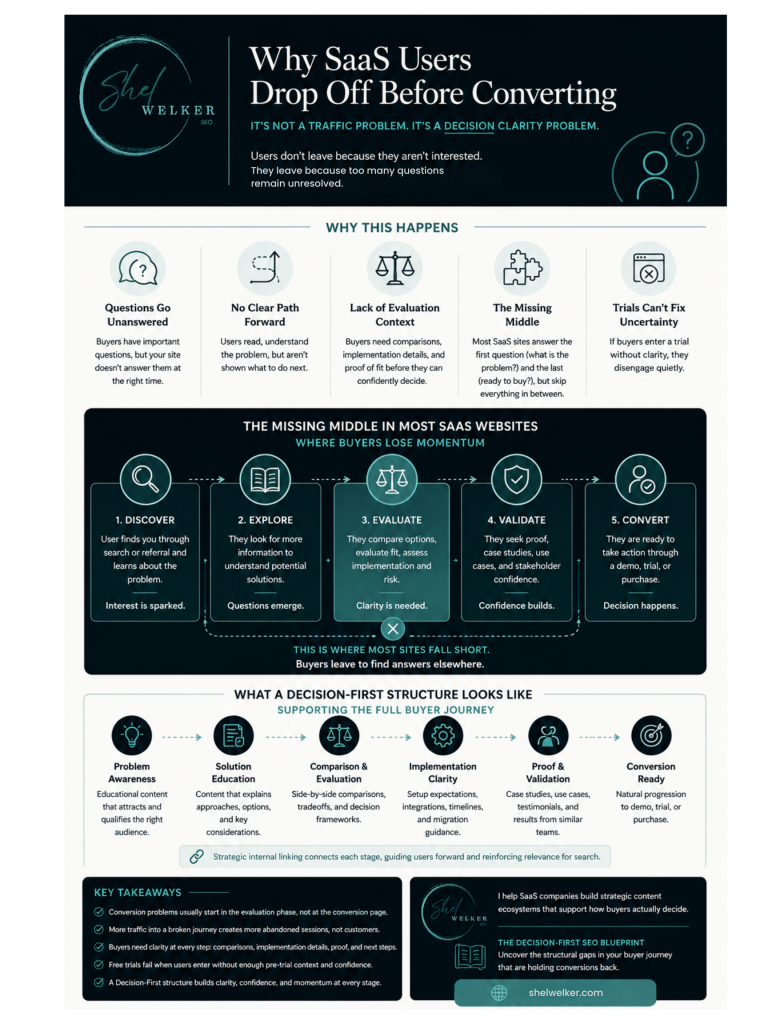
This is why comparison content, evaluation-stage content, migration guidance, onboarding expectations, and implementation clarity have become increasingly important in SaaS SEO. Buyers naturally seek those answers before moving forward, especially in higher-consideration B2B environments.
Traffic answers questions. Decision-First SEO supports buyers through the entire decision journey.
Why Free Trials Fail Even With High Intent
Free trials are often treated as the moment conversion should happen. But in many cases, the trial simply exposes unresolved friction that already existed earlier in the journey.
A signup does not automatically equal confidence.
One common pattern is that users enter a product before fully understanding:
- what successful onboarding looks like
- what setup is required
- which workflows matter first
- how implementation unfolds
- how quickly value becomes visible
They open the platform, feel uncertain, and quietly disengage.
Another issue is that many trial experiences assume users arrive with the same level of understanding and readiness. In reality, buyers enter from very different stages of evaluation. Some are still validating the category itself. Others are comparing vendors. Some are worried about migration risk or stakeholder approval. Others are evaluating operational fit.
The trial experience cannot compensate for a missing evaluation structure earlier in the buyer journey.
It is the continuation of the decision process, not a replacement for it.
What a Decision-First Structure Actually Looks Like
A Decision-First SEO structure organizes content around how buyers naturally progress through evaluation rather than treating pages as isolated ranking assets.
Imagine a SaaS platform helping mid-market accounting teams manage financial close processes.
A traditional SEO structure might include:
- an informational article
- a product page
- a pricing page
Technically, the company has “content.” But the buyer journey itself remains structurally thin.
A Decision-First structure builds progression intentionally.
A buyer may first discover:
“Why Financial Close Processes Break at Scale”
From there, the next logical step may be:
“Spreadsheet-Based Financial Close vs Dedicated Close Management Software”
That naturally progresses into:
- implementation expectations
- ERP integration considerations
- migration planning
- comparison content against realistic alternatives
- onboarding timelines
- use cases for similarly sized accounting teams
Only after those evaluation layers exist does the path naturally progress toward a demo or trial.
The important shift is that the internal linking is no longer just SEO plumbing.
Each page exists because it answers the next logical question in the buyer’s decision journey.
That structure helps both users and search systems better understand how the ecosystem fits together.
The Structural Gaps Most SEO Audits Miss
Traditional SEO audits usually focus on:
- technical SEO
- metadata
- crawlability
- backlinks
- keyword coverage
- page optimization
Those things matter. But they rarely explain why users with genuine intent still fail to convert.
Many SaaS conversion leaks are structural rather than technical.
Evaluation-stage content may be missing entirely. Comparison pathways may be weak. Implementation concerns may be buried deep in support documentation instead of integrated naturally into the buyer journey. Internal linking may connect pages topically without actually supporting buyer progression.
Those are not visibility problems alone.
They are decision-support problems.
One of the most useful exercises SaaS teams can do is map:
- where users enter the ecosystem
- what questions naturally emerge next
- where the site stops answering them
- where buyers likely leave to continue researching elsewhere
That exercise is often more revealing than traffic reports alone because it exposes where decision momentum quietly breaks.
Why This Matters Even More in AI-Assisted Search
AI-assisted search is increasing the importance of complete buyer journeys because users are arriving with more context than before.
Search experiences increasingly provide:
- summaries
- comparisons
- contextual explanations
- implementation considerations
- alternative recommendations
before the click ever happens.
That means the users who do visit your site are often evaluating more aggressively and expecting deeper continuity once they arrive.
If the journey breaks after discovery, users can pivot elsewhere almost instantly.
This is one reason connected topic ecosystems, semantic relationships, and buyer-path structure are becoming increasingly important in modern SEO strategy. Search visibility alone is no longer enough if the surrounding ecosystem fails to support evaluation.
The companies adapting best right now are not abandoning traditional SEO. They are extending it beyond traffic acquisition into structured decision support.
Finding the Real Conversion Friction
If users are reaching your site but not progressing, the problem is often not:
- weak CTAs
- low traffic
- insufficient keyword coverage
The issue is usually that the buyer journey stopped supporting the decision before confidence was fully established.
The challenge is identifying exactly where that happens.
Not where rankings fluctuate.
Not where impressions dip.
Where buyers stop receiving the clarity they need to continue moving forward confidently.
That is what the Decision-First SEO Blueprint is designed to uncover. It maps the structural gaps between discovery, evaluation, and conversion so SaaS companies can build content ecosystems that support real buyer progression instead of isolated traffic acquisition.
Related Buyer Questions
If your SaaS SEO is getting traffic but not enough conversions, these guides can help you identify where the buyer path is breaking.