
What Does Decision-Focused Content Actually Look Like?
Traffic is growing. Search Console reports more impressions every month. Your content team is consistently publishing new articles, and rankings continue to improve. On paper, the SEO program appears to be doing exactly what it was designed to do.
Then a prospect books a demo.
Within the first fifteen minutes, they ask the same questions your sales team has answered dozens of times already. How difficult is implementation? How does your platform compare to the alternatives? What happens after migration? Why should they choose you instead of another vendor? Despite all of the content you’ve published, they still arrive at the buying conversation with the same uncertainty.
The natural conclusion is that you simply need more content. More educational articles. More keyword coverage. More opportunities to attract traffic. But after auditing dozens of SaaS websites, I’ve found that’s rarely the real problem. Most companies aren’t short on content. They’re short on content that actually helps buyers make decisions.
That distinction matters because attracting visitors and moving buyers toward a purchase are fundamentally different objectives.
Educational content creates understanding. Decision-focused content creates confidence.
If your content strategy stops after answering a question, it leaves the hardest part of the buyer journey unfinished.
The Real Problem Isn’t a Lack of Content
SEO has trained most of us to think in terms of search intent.
Someone searches for an answer, lands on a page, gets what they came for, and hopefully remembers your company later. That model works well for informational searches because success is measured by whether the user’s question was answered.
Software purchases rarely work that way.
Buying a SaaS platform usually involves multiple stakeholders, competing priorities, budget discussions, security reviews, implementation planning, and internal justification. Research from Gartner has consistently shown that modern B2B buying is complex, non-linear, and involves numerous interactions before a purchase decision is made. By the time someone schedules a demo, they’ve often worked through dozens of smaller decisions long before they’re ready to evaluate vendors seriously.
That reality changes what content needs to accomplish. It isn’t enough to educate buyers. The content also has to help them navigate the decisions that move a purchase forward.
Consider a company evaluating customer support platforms.
An article explaining what omnichannel support means may attract qualified visitors and rank well for an important keyword. It educates the reader, but it doesn’t help them decide between Zendesk, Intercom, Help Scout, or another platform. It doesn’t explain migration effort, onboarding expectations, pricing tradeoffs, reporting differences, or where one solution may be a better fit than another.
The educational content succeeded.
The buying decision never progressed.
One pattern I see repeatedly during SaaS content audits is that the highest-performing articles are often the least connected to revenue. They attract traffic because they’re useful educational resources, but they leave prospects searching elsewhere for the information that actually influences purchasing decisions.
Why Traditional Content Strategies Stop Too Early
None of this suggests educational content has lost its value.
Educational content builds awareness, introduces your expertise, and often creates the first interaction between a buyer and your brand. Every healthy SEO strategy needs that foundation.
The problem begins when companies assume education is enough.
Most editorial calendars are built around keyword research. Teams identify topics with meaningful search volume, prioritize opportunities based on traffic potential, and steadily expand topical coverage. It’s a logical process, but it naturally favors questions that are easy to discover inside SEO tools.
Buyers don’t behave according to keyword research.
After reading an introductory article, they don’t stop searching because they understand the topic. They begin narrowing their options. They compare vendors. They investigate pricing models. They research implementation challenges. They validate recommendations from colleagues. They look for evidence that companies similar to theirs have succeeded.
Those searches represent a different stage of the buying journey.
Unfortunately, they’re also where many content strategies become noticeably thin.
If your website answers educational questions but leaves evaluation questions unanswered, your prospects will continue their research somewhere else. More often than not, that means a competitor’s website becomes the next step in their buying journey.
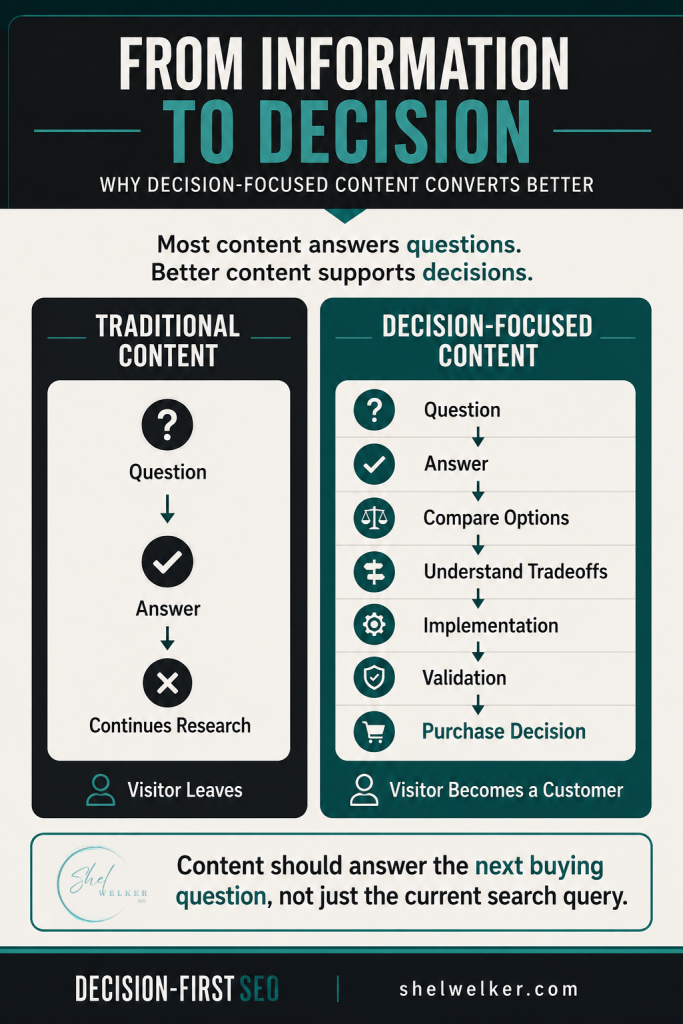
Decision-Focused Content Organizes Around Buyer Uncertainty
Decision-focused content starts with a different planning question.
Instead of asking, “What keyword should we target next?” it asks, “What uncertainty is preventing this buyer from moving forward?”
That subtle shift changes everything.
A comparison page isn’t valuable because comparison pages tend to convert well. It’s valuable because serious buyers naturally compare alternatives before making a purchase.
An implementation guide isn’t useful because it captures long-tail traffic. It’s useful because implementation risk is one of the most common reasons software purchases slow down late in the sales process.
A pricing explanation, migration checklist, integration overview, buyer’s guide, case study, or vendor comparison all serve the same purpose. Each removes a specific layer of uncertainty standing between a prospect and a confident decision.
Notice what’s happening here.
The format isn’t what matters.
The decision does.
Comparison pages, implementation guides, pricing resources, and customer stories aren’t best practices simply because they’re popular content types. They’re valuable because they answer questions educational articles cannot.
That is the difference between content that informs and content that helps buyers decide.
What Decision-Focused Content Actually Looks Like
Imagine you’re responsible for SEO at a project management SaaS company targeting mid-sized engineering organizations.
A traditional content strategy might produce articles like:
- What Is Agile Project Management?
- Scrum vs. Kanban
- Benefits of Sprint Planning
- How to Improve Team Collaboration
Those are all worthwhile educational resources. They establish expertise and attract relevant visitors.
Now imagine you’re the buyer.
You’ve read those articles.
What’s your next question?
It probably isn’t another educational article.
You’re wondering whether this software is actually right for your team.
A decision-focused content ecosystem anticipates that progression.
Instead of ending the journey, it continues naturally into content like:
- How to Compare Project Management Platforms for Engineering Teams
- Jira vs. Linear vs. Monday.com for Growing SaaS Companies
- Questions to Ask Before Migrating Your Engineering Team
- What Actually Happens During the First 90 Days After Implementation
- Five Situations Where Our Platform Probably Isn’t the Best Fit
- How Acme Software Reduced Sprint Planning Time by 38% After Implementation
Now look at what each page accomplishes.
The comparison article reduces uncertainty about available options.
The migration guide reduces uncertainty about operational disruption.
The implementation resource reduces uncertainty about adoption.
The honest “not the best fit” article builds trust by acknowledging tradeoffs instead of pretending they don’t exist.
The customer story validates that organizations with similar challenges have successfully made the transition.
None of those pages exist because a content marketing template says they should.
They exist because each one answers the next question a serious buyer naturally asks.
That’s what decision-focused content actually looks like in practice.
Building Content Ecosystems Instead of Individual Pages
One article rarely changes a buying decision.
A connected sequence of articles often does.
Think about the path a buyer might follow after discovering your company through an educational search.
They begin with an overview of customer lifecycle management.
From there, they compare CRM platforms designed for SaaS companies.
That comparison leads naturally to questions about migration effort, implementation timelines, pricing differences, integrations, and expected return on investment.
Eventually, they want proof that companies like theirs have succeeded.
A decision-focused website intentionally supports that progression.
Instead of treating every article as an independent opportunity to rank, it treats content as a connected system where each page prepares the buyer for the next decision.
That architecture also aligns remarkably well with how modern search engines and AI retrieval systems evaluate websites.
Increasingly, retrieval systems look beyond individual pages to understand the relationships between them. They evaluate semantic consistency, contextual alignment, and whether supporting resources reinforce one another around a coherent topic.
A comparison guide connected to implementation documentation, migration resources, pricing explanations, integration content, customer stories, and buyer checklists sends a much stronger signal than any of those pages could individually.
More importantly, it mirrors how real buyers think.
Modern retrieval systems increasingly reward websites that reflect real decision journeys because those websites provide more complete answers to complex evaluation-stage questions.
The technical benefit exists because the buyer benefit exists first.
Where Buyer Decisions Usually Get Stuck
| Buyer Question | Why It Matters |
|---|---|
| How do I compare my options? | Buyers need meaningful differences, not another feature checklist. |
| How do I know this solution fits my company? | Company size, technical requirements, and workflows determine whether a platform is actually appropriate. |
| What tradeoffs should I expect? | Honest discussions of strengths and weaknesses create far more trust than marketing claims. |
| What happens after implementation? | Uncertainty around onboarding often delays purchasing decisions more than product capability. |
| What questions should I ask before buying? | Buyers want confidence that they’re evaluating vendors thoroughly, not just quickly. |
| What makes one vendor different from another? | Generic positioning rarely survives a real evaluation process. |
| What would make this fail? | Understanding failure conditions helps buyers assess their own readiness before making a commitment. |
These questions rarely appear independently. A buyer comparing vendors naturally begins thinking about implementation, organizational fit, long-term success, and risk. Decision-focused content recognizes that progression and allows each answer to lead naturally into the next.
How to Find These Opportunities
One of the biggest misconceptions about decision-stage SEO is that the ideas come from keyword tools.
Usually, they don’t.
The best opportunities often come from listening.
Sales calls reveal recurring objections. Customer success teams hear implementation concerns. Support tickets expose areas where expectations weren’t clear. Product demonstrations uncover the questions buyers ask before they’re willing to move forward.
Keyword research becomes validation, not discovery.
Once you identify recurring buyer uncertainty, you’ll often find meaningful search demand behind modifiers like vs, alternative, pricing, migration, implementation, comparison, review, and cost.
Those keywords didn’t create the strategy. They confirmed that real buyers were already searching for answers. A practical exercise illustrates the difference. Open your highest-traffic educational article. Now pretend you’re a serious buyer instead of an SEO.
After reading it, ask yourself, “What would I search for next?”
Would you want to compare vendors?
Understand implementation?
See pricing explained?
Review migration challenges?
Read customer stories?
If answering those questions requires leaving your website, you’ve identified a decision gap.
Google has effectively become your site’s next navigation menu.
That’s not a traffic problem.
It’s an architecture problem.
Measuring Whether Decision-Focused Content Is Working
Traffic and impressions still matter. They tell you people are discovering your content. They don’t tell you whether buyers are becoming more confident.
Decision-focused content should influence a different set of business outcomes.
Sales teams should hear fewer repetitive evaluation questions because prospects have already explored implementation resources and comparison content. Demo requests should increasingly reference specific pages rather than generic blog articles.
Internal journeys should extend naturally from educational content into evaluation resources instead of ending after a single visit.
Over time, sales conversations become more productive because buyers arrive better informed about the decisions that actually matter.
Those are stronger indicators that your content is supporting revenue instead of simply supporting visibility.
Conclusion
The strongest SaaS content doesn’t stop when a reader understands a topic.
It continues until they understand their options, their tradeoffs, the implementation process, and whether a solution genuinely fits their organization.
Educational content remains an essential foundation because every buyer begins by learning. But businesses don’t grow because prospects become more informed. They grow because prospects become confident enough to make decisions.
That requires thinking beyond individual keywords and individual articles. It requires designing a connected content ecosystem where every important buying question naturally leads to the next one, reducing uncertainty at each stage of the journey.
Building one excellent comparison page is relatively straightforward. Designing an entire website around buyer decisions is considerably more challenging because it requires understanding how those decisions connect across the SaaS buying journey.
Decision-focused content is the execution. Decision-First SEO is the framework that determines what gets created, when it gets created, and how every piece works together.
That’s why the Decision-First SEO Blueprint exists. Rather than producing another keyword-driven content plan, it maps the decisions your buyers need to make, identifies where uncertainty still exists, and builds the content ecosystem that helps prospects move from curiosity to confidence.
When your content is organized around decisions instead of simply topics, SEO stops being a channel for attracting visitors.
It becomes a system for helping the right buyers make better decisions.