
Does Decision-First SEO Replace Traditional SEO? No. Here’s What It Actually Changes.
The debate around decision-first SEO vs traditional SEO often starts with the wrong question. One of the most common misconceptions about Decision-First SEO is that it replaces traditional SEO. I understand why people reach that conclusion. The framework begins in a different place than conventional SEO planning, so at first glance it can appear to be proposing an entirely new way of doing search optimization.
It isn’t.
Decision-First SEO is a strategic planning framework. Traditional SEO remains responsible for keyword research, technical optimization, search intent, content quality, and all of the execution required to earn visibility. Decision-First SEO simply changes the question that comes first. Instead of beginning with keywords, it begins with the decisions buyers must make before they become customers.
That distinction may sound subtle, but it changes how an entire content strategy is planned.
Why is Decision-First SEO often misunderstood?
The misunderstanding exists because most SEO methodologies begin with search opportunities.
A team identifies relevant keywords, groups them into topical clusters, prioritizes them by search volume and difficulty, and builds an editorial calendar around those opportunities. It is a proven process that has helped countless businesses grow organic traffic.
When people first encounter the Decision-First SEO framework, they often notice that keywords are no longer the starting point. From there, it’s easy to assume the framework is dismissing traditional SEO altogether.
In reality, it is changing the planning sequence, not replacing the disciplines that make SEO successful.
Think of it this way. Traditional SEO answers, “How do we help this page perform well in search?” Decision-First SEO answers, “Should this page exist in the first place, and what buyer decision is it meant to support?” One practical example of this planning philosophy is decision-focused content, where every page is designed to reduce uncertainty and help buyers move confidently toward a purchase.
Those are complementary questions, not competing ones.
What actually changes?
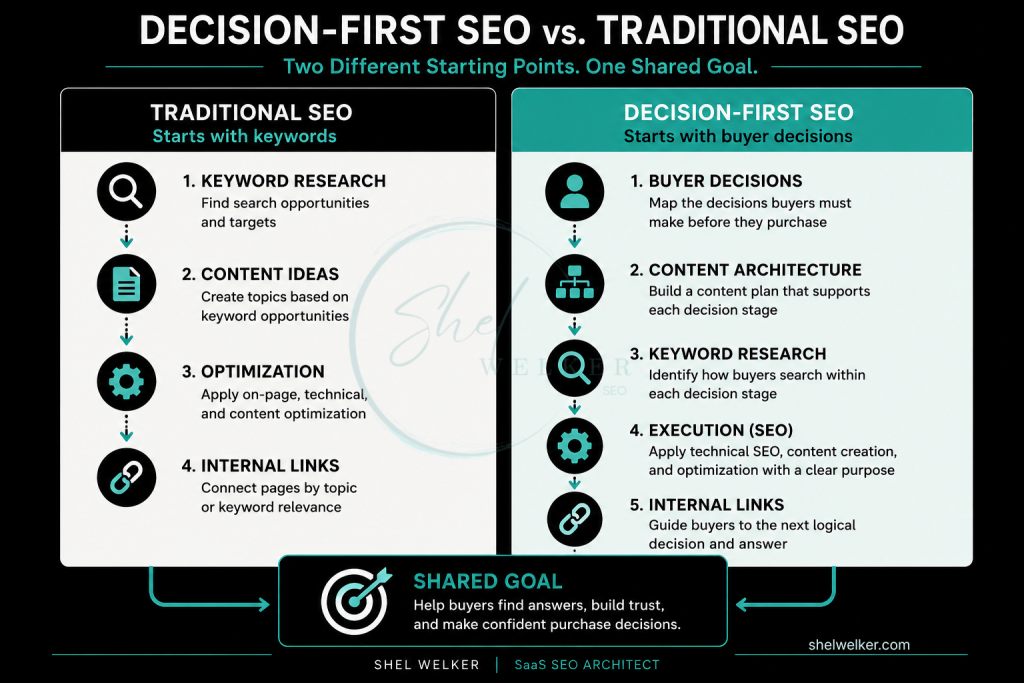
The biggest change is where strategy begins.
Instead of asking which keyword should be targeted next, Decision-First SEO asks which buyer decision is currently unsupported.
That shift influences every planning decision that follows.
Once the buyer’s decision journey has been mapped, traditional SEO becomes even more valuable because keyword research can now identify how people search while moving through each stage. Technical SEO ensures those pages are accessible. Search intent helps shape the content. On-page optimization improves relevance. None of those responsibilities disappear.
The framework simply provides clearer direction for where those efforts should be focused.
Traditional Planning
Keywords
↓
Content Ideas
↓
Optimization
↓
Internal Links
Decision-First Planning
Buyer Decisions
↓
Content Architecture
↓
Keyword Research
↓
Technical SEO
↓
Content Creation
↓
Internal Linking
Rather than replacing traditional SEO, Decision-First SEO determines what traditional SEO should support, because it’s not decision-first seo vs traditional seo. They’re meant to complement each other.
A practical SaaS example
Imagine a SaaS company that sells employee scheduling software.
A keyword-first planning session might produce an editorial calendar that includes topics like “employee scheduling software,” “staff scheduling app,” “shift scheduling software,” and dozens of supporting long-tail keywords. Those articles may rank well because they target meaningful search demand.
Now consider the same company through a Decision-First lens.
The planning conversation begins with sales, customer success, and product teams instead of a keyword tool. They discover that prospects consistently hesitate over the same questions.
This mirrors broader B2B buying behavior. Research from Forrester’s Buying Group Journey Map shows that business purchases unfold through multiple stages involving different stakeholders, each bringing their own questions and concerns. Decision-First SEO applies that same thinking to content strategy by ensuring each stage of the buying process has the information buyers need before they are ready to move forward.
First, companies wonder whether manual scheduling is actually costing enough time and money to justify new software. Next, they debate whether they should build an internal solution or purchase an existing platform. Once they’ve decided to buy, they compare features, estimate implementation effort, evaluate pricing, involve finance and operations stakeholders, and finally compare vendors before requesting a demo.
Only after those decisions are mapped does keyword research begin.
At that point, traditional SEO identifies the searches buyers use while working through each question. Instead of publishing articles simply because they have search volume, every page has a defined purpose within the buying journey. The keywords become evidence that supports the content plan rather than the force driving it. Remember, it really isn’t decision-first SEO vs traditional SEO. They’re meant to work together.
The result is an editorial strategy built around buyer progression instead of isolated search opportunities.
Keyword-First
employee scheduling software
↓
best scheduling software
↓
staff scheduling app
↓
shift scheduling software
Decision-First
Current scheduling process isn’t scaling
↓
Build vs Buy?
↓
Required Features
↓
Implementation Questions
↓
Vendor Comparison
↓
Request Demo
Is Decision-First SEO different from keyword research?
Yes, because the two answer different questions.
Keyword research reveals how people search.
Decision-First SEO explains why they are searching and which purchasing decision that search represents.
Those ideas are closely related to search intent, but they are not identical. Search intent helps us understand what someone hopes to accomplish with a query. Buyer decisions explain where that query fits within the broader evaluation process. Traditional SEO interprets intent so content can satisfy the search. Decision-First SEO organizes content so that each answered question naturally leads to the next decision.
Businesses evaluating decision-first SEO vs traditional SEO are often asking the wrong question.
For example, two companies may both publish an article targeting implementation-related keywords. One simply explains how implementation works. The other helps buyers determine whether implementation complexity should influence their vendor selection, what internal resources will be required, which stakeholders should be involved, and what success looks like after deployment.
The keywords may overlap.
The business value does not.
Modern search and AI retrieval systems increasingly evaluate content through its relationships to surrounding topics rather than isolated keyword usage alone. A page that naturally connects implementation, feature evaluation, pricing considerations, and vendor comparisons creates stronger contextual signals than one that exists independently within a content library.
The objective is not just topical coverage. It is complete decision coverage.
Can Decision-First SEO work alongside traditional SEO?
Absolutely. In fact, that is how the framework is intended to be used. The comparison between decision-first SEO vs traditional SEO is often misunderstood because people assume the two approaches compete rather than complement one another.
Decision-First SEO does not replace technical SEO, keyword research, content optimization, or authority building. It gives those activities a clearer strategic direction by determining what should be prioritized before implementation begins.
Think of Decision-First SEO as the planning layer and traditional SEO as the execution layer. One determines where the business should invest its effort. The other ensures those decisions become discoverable through search.
Organizations with mature SEO programs often find that this approach strengthens existing work rather than replacing it. Instead of asking what to publish next based solely on keyword opportunities, they begin asking which buyer decision remains unsupported and use traditional SEO to execute against that priority.
What does Decision-First SEO look like on a website?
Planning around buyer decisions naturally changes how pages connect.
Using the scheduling software example, a visitor might first arrive on an article explaining the hidden costs of manual scheduling. From there, the next logical question is whether software is actually the right solution. That naturally leads to a comparison of building versus buying, followed by implementation planning, feature comparisons, vendor evaluations, pricing, and ultimately a product demonstration.
Problem Recognition
Is Manual Scheduling Holding Us Back?
│
▼
Evaluation
Build vs Buy
Implementation Guide
Feature Comparison
ROI Expectations
│
▼
Decision
Vendor Comparison
Pricing
Case Studies
Request a Demo
The internal linking supports the buyer’s next question rather than simply connecting pages that share similar keywords.
That distinction matters for people as much as it does for search engines. Visitors encounter a logical learning path instead of a collection of disconnected articles, while search engines and AI systems gain clearer signals about how the content relates conceptually and how each page contributes to the overall topic.
When does Decision-First SEO make the biggest difference?
Not every business needs to rethink its planning process.
If your existing SEO strategy consistently generates qualified pipeline, supports sales conversations, and answers the questions buyers ask before purchasing, your current approach may already be working well.
Decision-First SEO becomes most valuable when those things are not happening. Companies often reach a point where they are publishing regularly, ranking for relevant keywords, and steadily increasing traffic, yet sales teams continue answering the same questions on calls and marketing struggles to connect content performance with revenue.
That disconnect is usually a planning problem rather than an execution problem. The issue is not that keyword research or technical SEO failed. It is that the content architecture was never intentionally built around buyer progression in the first place.
How does the Blueprint fit into this process?
The Blueprint exists because planning comes before implementation.
Rather than functioning as a technical SEO audit, the Blueprint maps buyer decisions, identifies missing decision-stage content, prioritizes opportunities, and builds the content architecture before any optimization work begins. It establishes what needs to be created, how those pages should connect, and which business questions deserve priority.
Once that foundation exists, traditional SEO becomes significantly more focused. Keyword research aligns each page with the language buyers actually use. Technical SEO ensures those pages perform well. Internal linking reinforces buyer progression. Content optimization strengthens visibility.
Instead of guessing what to publish next, every optimization effort supports a clearly defined strategy.
Decision-First SEO changes where strategy begins
The comparison between decision-first SEO vs traditional SEO is often framed as though businesses must choose one approach or the other.
They do not.
Traditional SEO remains essential because it helps great content become discoverable. Decision-First SEO provides the planning framework that determines which content should exist, how it supports buyer decisions, and how those pages work together as a complete system.
For SaaS companies, that shift often produces a content strategy that feels fundamentally different. Articles are no longer isolated assets competing for rankings. They become connected parts of a decision journey that helps prospective customers move from recognizing a problem to confidently choosing a solution.
That is what Decision-First SEO actually changes. It does not replace traditional SEO. It gives traditional SEO a clearer strategic direction.