SEO Agency vs SEO Strategy: What SaaS Companies Actually Need
You’ve done the work…but something’s off
SaaS companies often reach a point where they know something in SEO is not working, but they are not sure what kind of help they actually need.
Traffic may be growing without producing meaningful pipeline. Rankings may look better on paper while conversions remain flat. In some cases, SEO simply feels busy without creating clear business impact.
That’s where SEO agency vs SEO strategy for SaaS becomes the real decision.
It sounds like a simple comparison, but the real answer depends on what problem you are trying to solve.
An agency can be extremely valuable when you need execution support. But if the real issue is poor alignment between SEO, buyer intent, and revenue goals, more execution may not fix the underlying problem.
Before choosing between an SEO agency and SEO strategy, it helps to understand what each one actually solves.
Why this keeps happening
Most SaaS SEO efforts are built around activity, not decisions.
More content, more keywords, more pages. On paper, it all looks right. It feels like progress.
But SEO isn’t just about getting found. It’s about showing up at the exact moment someone is trying to decide something and helping them move forward.
Most content doesn’t do that.
It answers questions, but it doesn’t guide a decision. So you end up with traffic that reads and leaves, or traffic that was never close to buying in the first place.
That’s why this feels so frustrating.
Because the issue isn’t visibility. It’s that your SEO isn’t aligned with how your buyers actually move from problem to purchase, which is exactly why most SaaS SEO fails before publishing.
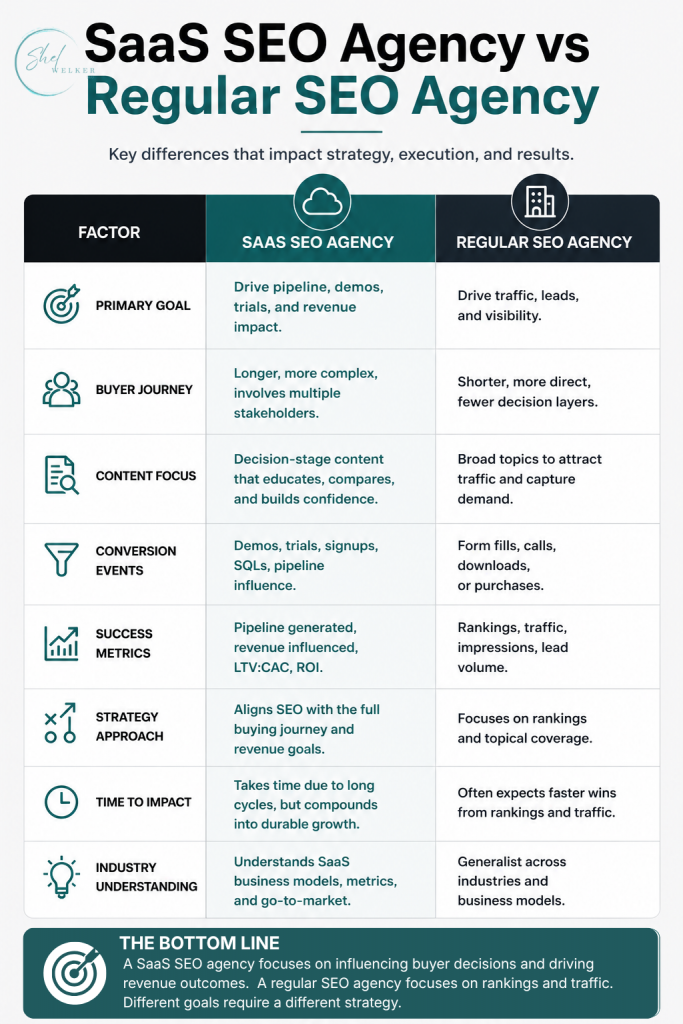
How Does a SaaS SEO Agency Differ From a Regular SEO Agency?
A SaaS SEO agency differs from a regular SEO agency because the business model, buyer journey, and conversion goals are fundamentally different.
Most traditional SEO agencies are built to improve rankings, traffic, and lead volume. For many businesses, that works well. Local businesses may want more calls or form submissions. E-commerce brands may want more product page traffic and purchases.
SaaS businesses operate differently.
SaaS buyers usually move through longer decision cycles. They often involve multiple stakeholders, larger budgets, product demos, internal approvals, and ongoing evaluation before a purchase happens. In many cases, the search journey begins long before someone is ready to book a demo or start a trial.
That changes what effective SEO looks like.
A strong SaaS SEO agency should focus less on raw traffic growth and more on influencing the decisions that move buyers toward revenue.
That means understanding questions like:
- What problem is the buyer trying to solve?
- What alternatives are they comparing?
- What objections are slowing down the decision?
- What information builds confidence before purchase?
This is where many general SEO agencies struggle.
They may succeed at increasing traffic, publishing more content, or improving rankings without improving business outcomes. More visibility does not automatically lead to more demos, more pipeline, or more revenue.
A SaaS SEO strategy should support the full buying journey, including problem recognition, solution evaluation, vendor comparison, and purchase confidence.
The goal is not just to attract visitors.
The goal is to help the right buyers make confident decisions.
The real decision you’re actually making
Most SaaS companies think the decision is:
“Do we hire an SEO agency or not?”
That’s not the real decision. The real decision is whether you’re fixing execution or fixing direction.
Once you frame the decision correctly, the differences become much easier to see.
| Factor | SEO Agency | SEO Strategy |
|---|---|---|
| Primary focus | Execution and implementation | Direction and prioritization |
| Best when | You know what needs to be done but need help doing it | You are not sure what is broken or what to prioritize |
| Common deliverables | Content, audits, technical fixes, link building | Research, diagnosis, roadmap, prioritization |
| Main goal | Improve visibility and execution | Improve business outcomes from SEO |
| Biggest risk | Doing more of the wrong work | Spending too long planning without acting |
Option 1: Hire or switch to a new SEO agency
This makes sense if you already have clarity.
You know what pages need to exist. You understand your buyer journey. You can point to gaps and say, “we need this built.”
At that point, an agency can accelerate things. They execute faster, produce more, and help scale what already works.
But most SaaS companies aren’t here.
Without that clarity, the agency is forced to guess. That usually turns into more blog posts, more keyword targeting, and more activity that looks good but doesn’t change outcomes.
You don’t have an execution problem. You’re asking someone to execute on something that hasn’t been fully defined.
Option 2: What most SaaS teams default to without realizing it
This is what Option 2 actually looks like in practice.
You keep publishing. You tweak topics. You try different keywords. You wait for something to click.
It’s not a conscious strategy. It’s what happens when there isn’t a clear structure to follow.
Over time, content builds up, but it doesn’t connect. You end up with a lot of pages that answer isolated questions, but no clear path that moves someone toward a decision.
So traffic grows in pockets, but conversions don’t follow.
Option 3: Step back and fix the strategy first
This is the option most teams avoid, mostly because it feels like slowing down.
It forces you to answer harder questions.
What decisions does our buyer actually need to make before they purchase?
Where are we missing coverage in that journey?
What pages should exist but don’t?
Which pages exist but don’t help move someone forward?
This isn’t about doing more. It’s about making sure what you do actually connects.
And once this is clear, everything else becomes easier. Content has a purpose. Pages connect. Execution becomes focused instead of reactive.
What actually works
What works is building SEO around the decision path, not just search volume.
That means thinking in terms of how someone moves from:
problem → solution → evaluation → choice
and making sure your site supports each step.
For example, a SaaS analytics tool might have strong blog content around topics like tracking metrics or improving reporting. That content can bring in traffic.
But when someone starts evaluating tools, what do they find?
If there are no comparison pages, no “best tools” positioning, no clear breakdown of how your product stacks up, the journey breaks.
The buyer has to leave your site to continue their decision.
That’s where most SaaS SEO fails.
Not because it didn’t attract attention, but because it didn’t support the decision that follows.
When you build around the full decision path, things change. Content connects, traffic has direction, and conversion becomes a natural extension of the experience instead of a separate problem to solve, something reflected in Google’s guidance on helpful content.
Where Decision-First SEO fits
This is where Decision-First SEO comes in.
It doesn’t start with keywords. It starts by mapping the decisions your buyer needs to make, then building the pages and structure that support each step of that path.
Traffic answers questions.
Decision-First meets buyers at every stage of the decision journey, from problem recognition through evaluation and final purchase.
It turns SEO from a collection of individual pieces into a connected system.
So instead of asking “what content should we create next,” you’re asking “what decision are we helping someone make, and what needs to exist to support it.”
That shift is what changes outcomes.
What to do next
If you’re in that place where SEO feels like it should be working but isn’t, hiring another agency won’t fix it yet.
You need to understand what decisions your buyers are trying to make, where your current site breaks that path, and what needs to exist to support it.
That’s exactly what the SaaS SEO Blueprint maps out.
It’s a $500 strategy that shows you what to build, what to fix, and how everything connects before you spend another dollar on execution.
Because once direction is clear, execution stops being the problem.