
SEO Structure vs More Content: Why SaaS Sites Struggle
SEO structure vs more content is a common debate in SaaS SEO, especially for companies publishing heavily without seeing meaningful buyer progression.
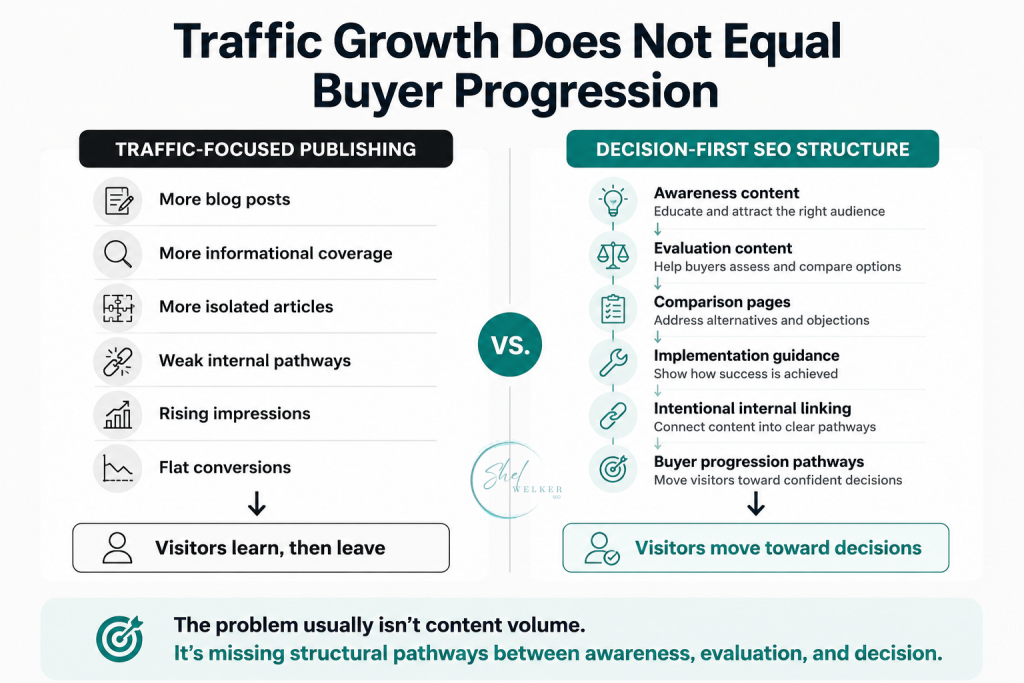
Let me describe a situation that’s probably familiar.
You’ve been publishing consistently for a year or two. Traffic is growing. New articles get indexed quickly. Rankings improve for long-tail terms. Search Console impressions trend upward month after month.
On paper, the SEO program looks healthy.
But demo requests barely move. Trial quality stays inconsistent. And when prospects finally get on a sales call, they still seem disconnected from the actual product. They’ve read your content, but they haven’t meaningfully progressed toward a buying decision.
The instinct at that point is usually to scale publishing indiscriminately.
More informational articles. More loosely connected cluster expansion. More top-of-funnel coverage. More velocity.
If content is helping a little, then scaling content should help more. Right?
Sometimes, yes.
If a SaaS company has strong architecture and obvious topical gaps, expanding content coverage absolutely makes sense. There are situations where more content is the correct answer.
But most SaaS sites I audit have the opposite problem.
They already have plenty of content. What they lack is structure.
And scaling a structurally weak SEO system usually creates more pages that attract attention without helping buyers move forward. It’s the missing layer in traditional SEO.
The difference between visibility and buyer progression
One of the most common patterns I see looks something like this:
- 100+ published blog posts
- strong informational coverage
- decent rankings
- growing search impressions
- very little commercial movement
When you dig into the site itself, the issue becomes easier to see.
The content exists in isolation.
Someone lands on an article about reducing SaaS churn. The article is genuinely useful. They finish reading it.
Then what?
Usually, the internal links point to more educational content. Maybe a few loosely related blog posts. Maybe the homepage. Occasionally, a generic “book a demo” CTA.
But there’s no intentional path between learning about the problem and evaluating whether the product solves it.
That gap matters more than most SaaS teams realize.
A project management SaaS might rank well for topics around remote team productivity, async workflows, or collaboration bottlenecks. From a visibility standpoint, things look healthy.
But if the site lacks:
- comparison pages against tools buyers are actively considering
- workflow-specific solution pages
- implementation guidance
- migration content
- decision-stage internal linking
- use-case evaluation pathways
…then the content ecosystem becomes informational only.
From a search perspective, the site can still appear authoritative.
From a buyer’s perspective, it becomes a dead end.
This is the core shift behind how I approach Decision-First SEO: structuring content around buyer decisions instead of publishing velocity.
Because traffic alone does not create progression.
Where SaaS SEO structure usually breaks down
Most conversations around SaaS conversions focus on landing pages, pricing pages, and CTAs.
Those things matter.
But weak structure usually creates friction long before a buyer ever reaches a sales-oriented page.
Informational dead ends
A visitor reads a strong article, gets value from it, and has nowhere logical to go next.
The site educates them, but it does not guide them.
That’s a structural problem, not a traffic problem.
Mixed-intent architecture
Another issue is when beginner educational content sits beside highly technical enterprise material without clear organizational separation.
The site ends up speaking to multiple audiences at once without helping any of them move confidently through the decision process.
That creates confusion for users, but it also weakens contextual clarity for modern search systems.
Search engines and AI retrieval systems increasingly evaluate whether content exists inside a coherent topical and decision environment. A site with disconnected educational articles may still rank, but a site with connected awareness, evaluation, and implementation pathways creates much stronger signals around expertise, buyer relevance, and topical consistency.
In plain language: structure helps search systems understand not just what your pages say, but how your expertise connects together.
The “read article → book a demo” cliff
This is probably the most damaging structural mistake I see on SaaS websites.
A buyer reads an educational article and the next step is immediately “Schedule a Demo.”
But most buyers are not ready for a sales conversation after reading one awareness-stage article.
They still have unresolved questions.
They’re trying to figure out things like:
- Will implementation disrupt the team?
- Does this integrate with our existing systems?
- How does this compare to the alternatives we’re already evaluating?
- What does onboarding actually look like?
- Will this work for a company our size?
Without content that bridges awareness into evaluation, the buyer is being asked to make a leap before enough trust or clarity exists.
Most won’t.
Why publishing more content often makes this worse
Content scale amplifies the strengths and weaknesses of the underlying system.
If the structure is strong, additional content expands authority and fills meaningful gaps.
If the structure is weak, additional content usually creates more fragmentation.
More entry points.
More isolated articles.
More disconnected traffic.
This is one reason why some SaaS companies continue growing visibility while seeing very little improvement in pipeline quality.
The site keeps accumulating educational content, but very little of that content connects buyers toward evaluation or implementation.
And modern retrieval systems are getting increasingly good at recognizing this distinction.
Search visibility is no longer only about whether an individual page answers a question.
It’s also about contextual alignment.
Do the pages reinforce each other?
Do they support a coherent journey?
Do they demonstrate depth around the actual decision process?
Or do they simply exist as separate informational assets?
The goal of informational SEO content is not just ranking.
It’s creating an entry point into a structured buying journey.
Without that structure, the content is only doing half the job.
This aligns with Google’s broader guidance around creating helpful, people-first content that genuinely helps users accomplish their goals rather than simply attracting search traffic.
What strong SEO structure actually looks like
Let’s make this more practical.
Imagine a CRM SaaS targeting growing mid-market sales teams.
Instead of publishing disconnected articles endlessly, the site is intentionally structured around how buyers naturally progress.
Awareness Layer
At the top, the company publishes articles like:
- “Why CRM adoption fails in growing sales teams”
- “Signs your sales process has become fragmented”
- “Why spreadsheet pipeline tracking breaks at scale”
These pages attract organic traffic and establish topical relevance.
But the important part is what happens next.
Inside those articles, the internal linking introduces evaluation-oriented questions naturally.
For example, an article about fragmented sales processes might transition into:
“How do growing teams usually evaluate CRM workflows once scaling problems start appearing?”
That link leads into the next layer.
Evaluation Layer
Now the buyer is comparing approaches, reducing uncertainty, and trying to understand fit.
This layer might include pages like:
- “HubSpot vs custom CRM workflows”
- “Best CRM setups for multi-team organizations”
- “How to migrate CRM systems without disrupting your pipeline”
These are often some of the highest-value pages on a SaaS site because they align directly with active decision behavior.
And importantly, the internal linking changes here too.
Instead of linking broadly across related topics, the structure now moves buyers toward implementation confidence.
An evaluation page comparing CRM setups might internally link toward:
- onboarding walkthroughs
- implementation timelines
- integration architecture
- ROI scenarios
- team-specific workflow examples
Now the buyer is no longer researching the existence of the problem.
They’re picturing operational adoption.
That is progression.
Decision Layer
At this stage, buyers want confirmation and risk reduction.
This is where implementation documentation, workflow examples, onboarding systems, integrations, pricing fit explanations, and operational detail become incredibly important.
Not because they rank well individually.
Because they remove uncertainty.
And when the entire structure connects intentionally from awareness to evaluation to decision, the website starts functioning less like a content library and more like a guided buying environment.
How to know if content volume is the wrong fix
You likely have a structural SEO problem instead of a content volume problem if:
- impressions continue growing while evaluation pages stay weak
- blog traffic expands without improving pipeline quality
- visitors rarely move deeper into product-specific pages
- comparison and alternative pages are missing or thin
- internal links mostly connect keyword-similar pages
- nearly all content targets informational discovery
- prospects still arrive at calls with little understanding of the product
If several of those are true, publishing more content may delay the real fix.
Not because content is bad.
Because the system underneath it was never designed around buyer movement in the first place.
Where to start this week
If this resonates, here’s the simplest place to start.
Open your top 10 traffic-driving articles and ask one question:
Where does the buyer logically go next?
Not “what article is related?”
Not “what keyword cluster fits?”
What does the buyer need next to move closer to a decision?
If the answer is “another educational article” or “the homepage,” you’ve probably identified a structural gap.
And in many cases, the fix is smaller than people expect.
Sometimes adding a single strong evaluation-stage page and contextually linking relevant awareness articles into it creates more movement than publishing 20 new blog posts.
The goal is not to publish less content.
It’s to make sure every piece of content strengthens a system intentionally built around how buyers actually make decisions, because once content, internal linking, evaluation pathways, and buyer progression all start overlapping, fixing the issue piecemeal becomes difficult without a clear structural plan.
That’s also why structured SEO planning typically produces better long-term results than continuing to publish reactively. Before scaling content further, most SaaS companies need a clearer map of where decision gaps actually exist.
Related Buyer Questions
If your SaaS SEO is getting traffic but not enough conversions, these guides can help you identify where the buyer path is breaking.