
Should SEO Strategy Change Because of AI Search and Summaries?
Over the past several months, a lot of SaaS teams have started feeling a strange kind of instability in organic search.
Not necessarily catastrophic ranking drops. Not instant collapse. Something subtler than that.
Pages that used to steadily contribute to pipeline started feeling less dependable. Informational content that once brought qualified users into the ecosystem began attracting visitors who never progressed further. Some companies saw impressions rise while conversion intent felt weaker. Others noticed AI-generated search experiences surfacing broader contextual answers before users ever reached their site.
For many teams, the immediate reaction has been:
“Should seo strategy change because of AI search?”
I do not think that is the right question.
What I think is happening is that AI-assisted search is exposing structural weaknesses that already existed in many SaaS SEO strategies long before AI summaries appeared.
The companies struggling most are often not the ones with bad SEO. They are the ones with incomplete decision support.
That distinction matters.
AI Search Is Changing Discovery, Not Eliminating SEO
A lot of recent discussion around AI search has become strangely binary.
Either:
- “traditional SEO is dead”
or - “nothing changed at all”
Neither explanation really matches what many SaaS teams are actually observing.
Traditional SEO still matters enormously:
- technical SEO
- crawlability
- site performance
- search intent alignment
- keyword targeting
- backlinks
- content quality
None of those suddenly stopped mattering.
What changed is how users move through discovery and evaluation.
In traditional search, users often built understanding gradually. They searched multiple queries, opened multiple tabs, compared solutions manually, and assembled their own evaluation journey over time.
AI-assisted search compresses portions of that process.
A user can now ask:
“What’s the best CRM for a 20-person SaaS sales team?”
And immediately receive:
- summarized comparisons
- implementation considerations
- pricing context
- feature tradeoffs
- competitor names
- category explanations
before clicking anything.
That changes what a click means.
The users still arriving on your site are often entering later in the decision process with more context already formed. They are evaluating faster and tolerating less friction.
That is why many SaaS sites are discovering that visibility alone is no longer enough.
The Real Problem Is Usually Structural
Many SaaS SEO strategies were built around traffic acquisition rather than buyer progression.
That approach worked reasonably well for years because search behavior itself was slower and more fragmented. If someone landed on an informational article, they were often willing to continue researching independently.
But AI search changes the economics of incomplete journeys.
If your content answers a question but fails to support the next stage of evaluation, users now have significantly more ways to leave and continue elsewhere.
This is the structural problem many companies are actually experiencing.
A SaaS site might successfully rank for:
- sales pipeline management
- customer onboarding automation
- ecommerce attribution challenges
- project management workflows
…but still fail to help buyers answer the next questions that naturally emerge during evaluation.
Questions like:
- How difficult is implementation?
- What are the tradeoffs between approaches?
- Which solution fits our team size?
- What breaks during migration?
- What does onboarding actually look like?
- How does this compare against alternatives?
Many sites have visibility without progression.
That is increasingly where the breakdown happens.
Are Keywords Becoming Less Important?
Not exactly.
Keywords still matter because search behavior still matters. Users still communicate intent through queries, and search engines still rely heavily on relevance signals to understand content alignment.
But isolated keyword targeting is becoming a weaker organizing system by itself.
What seems to be strengthening instead is contextual reinforcement.
In practice, many teams are observing that AI visibility improves when:
- related concepts are consistently reinforced
- pages connect naturally through internal linking
- topic relationships are structurally clear
- evaluation content exists alongside informational content
- semantic overlap across the ecosystem becomes stronger
This is one reason topical authority and AI search conversations have accelerated recently.
The strongest-performing sites increasingly behave less like collections of articles and more like connected knowledge ecosystems.
That does not mean publishing endless content clusters for the sake of volume.
It means building enough interconnected depth that search systems can understand:
- what your site is about
- how concepts relate
- what problems you solve
- who you help
- where buyers should logically continue next
That is a very different strategic goal than simply ranking individual pages.
Why Buyer-Path Structure Matters More in AI Search
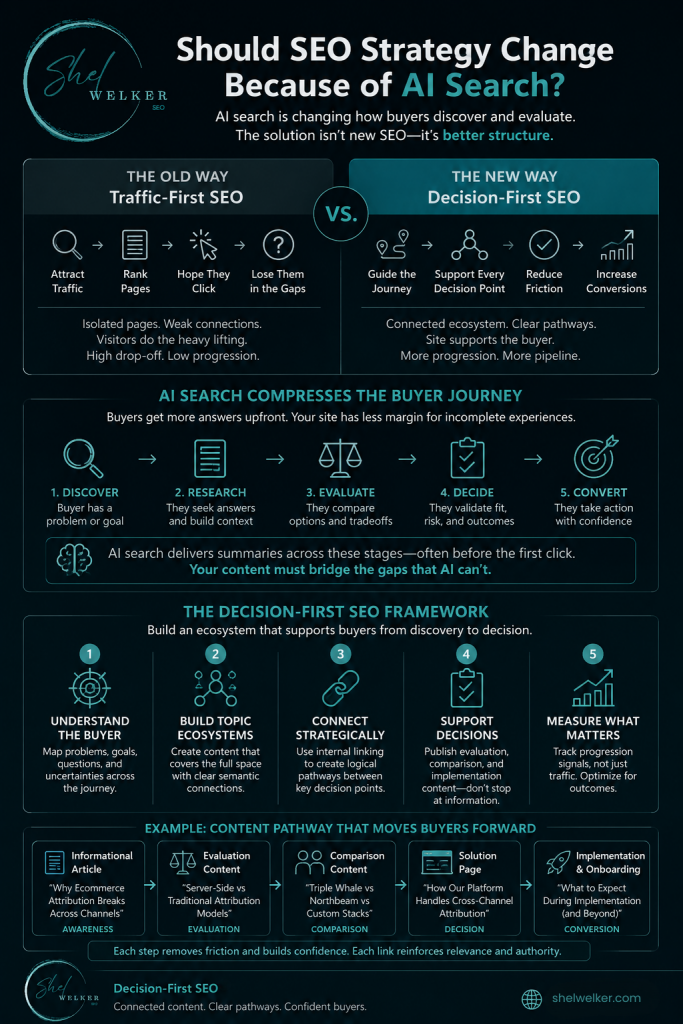
One of the biggest shifts happening right now is that informational content and evaluation content are starting to blend together.
Historically, SEO strategies often treated these as separate worlds.
Top-of-funnel content existed to attract traffic.
Bottom-of-funnel pages existed to convert.
The middle was frequently underdeveloped.
That gap becomes much more visible in AI-assisted search environments because users arrive with more preloaded context and move through evaluation faster.
For example, imagine a SaaS analytics platform targeting ecommerce brands.
A traditional traffic-focused SEO plan might include:
- an attribution guide
- a reporting features page
- a “best analytics tools” comparison article
Each page can individually rank.
But the ecosystem may still fail structurally if the buyer cannot move naturally from:
problem recognition → evaluation → implementation confidence → decision.
A Decision-First structure looks different.
Someone might first land on:
“Why Ecommerce Attribution Breaks Across Multiple Channels”
That article naturally links into:
“Server-Side Tracking vs Traditional Attribution Models”
Which then connects to:
“Triple Whale vs Northbeam vs Custom Attribution Stacks”
Which then leads into:
“How Our Platform Handles Cross-Channel Attribution”
Followed by:
- onboarding expectations
- integration requirements
- implementation timelines
- migration considerations
Now the ecosystem is not just generating traffic.
It is supporting an actual buyer journey.
And importantly, every connection reinforces semantic relationships that AI-assisted search systems appear increasingly capable of interpreting.
The internal linking is not random SEO plumbing anymore.
It becomes part of the decision architecture itself.
What I’ve Personally Observed While Building Decision-First SEO
One reason I’ve become increasingly convinced this shift is structural rather than purely algorithmic is that I’ve watched it happen in real time while building the Decision-First SEO ecosystem itself.
As the site expanded from isolated pages into a more connected framework structure, several things started happening simultaneously:
- query diversity in Google Search Console expanded beyond a small handful of branded searches
- multiple related pages began appearing for overlapping conceptual searches
- AI-generated search experiences started associating the site with broader Decision-First SEO concepts
- visibility improved not just on individual pages, but across connected topic relationships
What stood out most was that the greatest improvements often came after strengthening structural relationships:
- clearer internal linking
- stronger conceptual reinforcement
- better alignment between informational and evaluation-stage content
- more complete buyer-path coverage
Not after chasing more keywords.
That does not mean AI systems explicitly “reward” Decision-First SEO as a framework.
But it does suggest that connected, semantically reinforced ecosystems are becoming increasingly important in how modern search systems interpret authority and relevance.
This Is Why Many SaaS Teams Misdiagnose the Problem
When organic performance becomes less predictable, the instinct is usually to increase output.
More articles.
More keywords.
More volume.
More publishing velocity.
But many SaaS companies do not actually have a traffic acquisition problem right now.
They have a continuity problem.
Users enter the ecosystem but cannot continue evaluating confidently because the structural relationships between pages, concepts, and decisions are incomplete.
That is why simply publishing more informational content often stops compounding after a certain point.
The missing leverage is usually:
- evaluation-stage content
- comparison pathways
- implementation clarity
- decision support
- progression mapping
- semantic reinforcement across the ecosystem
Before creating another batch of top-of-funnel articles, it is worth asking:
“Where does our current buyer journey structurally break?”
That answer is often far more valuable than another keyword list.
So Should SEO Strategy Change Because of AI Search?
Yes, but probably not in the way most people think. This is not a shift away from SEO fundamentals.
It is a shift toward more connected, buyer-aware content ecosystems that support decisions across the entire journey instead of treating visibility as the finish line. The companies adapting best right now are not abandoning traditional SEO. They are extending it.
They are building:
- stronger topic relationships
- clearer internal pathways
- better evaluation support
- more complete comparison ecosystems
- structurally connected buyer journeys
In other words, they are moving from traffic-first publishing toward decision-support architecture.
That is ultimately what Decision-First SEO is trying to solve.
Not replacing SEO.
Not inventing a new channel.
Not chasing AI trends.
Structuring search visibility in a way that helps buyers continue moving forward after discovery happens.
The challenge for many SaaS companies is identifying where those journeys currently break.
Not where rankings drop.
Not where impressions fluctuate.
Where buyers stop getting the information they need to confidently continue evaluating.
That is what the Decision-First SEO Blueprint is designed to uncover: the structural gaps between visibility, evaluation, and conversion in modern AI-assisted search environments.
Explore the Decision-First SEO Blueprint
Related Buyer Questions
If your SaaS SEO is getting traffic but not enough conversions, these guides can help you identify where the buyer path is breaking.