Google’s AI Search Guidance Reveals a Bigger Shift Than Most SEO Discussions Are Having
Recently, Google’s AI search guidance sparked a predictable reaction across the SEO industry:
“How do we get included in AI answers?”
That question matters. Visibility is clearly expanding beyond traditional rankings.
AI Overviews, conversational search experiences, synthesized comparisons, and AI-driven discovery are changing how users encounter brands online. Google AI search guidance is ultimately pointing toward a broader shift in how discovery and evaluation work together.
But most of the conversation stops too early.
It is what happens after discovery.
Because AI visibility can increase exposure without improving buyer progression. And many SaaS companies are about to discover that visibility alone still does not help users make confident purchasing decisions.
What Google’s AI search guidance actually changes
Reading through Google’s guidance around AI search features, a few themes become clear.
First, websites still act as the source layer behind AI-generated responses. AI Overviews do not create information from nothing. They synthesize content from the web.
Second, the underlying foundations of SEO still matter:
- topical relevance
- content depth
- semantic relationships
- crawlability
- internal linking
- structured information
- helpful content
Third, visibility is becoming more distributed.
A page can now influence discovery through:
- AI Overviews
- conversational AI responses
- follow-up search suggestions
- synthesized comparisons
- traditional rankings
- featured snippets
- video results
- community discussions
In some cases, pages may contribute to AI visibility even without ranking in the traditional top 10 results.
That is a meaningful shift.
But it also creates a new risk. Businesses may focus heavily on AI inclusion while neglecting the part of the journey that actually drives decisions.
AI search is accelerating discovery, not replacing evaluation
AI search features are very good at compressing the information-gathering phase of search.
A SaaS founder searching:
“Why is our SEO traffic not converting?”
might immediately receive:
- common causes
- strategic explanations
- comparison summaries
- implementation considerations
- potential solutions
before clicking a single website.
That changes how users enter the evaluation process.
They often arrive with basic awareness questions already answered.
The remaining questions are harder:
- Is this solution right for our workflow?
- How difficult is migration?
- What does onboarding actually involve?
- How does this compare to alternatives we are already evaluating?
- Will this still fit our business in two years?
- Can we trust this company long term?
These are decision-stage questions.
And many SaaS websites are not structured to answer them well.
Instead, they are heavily weighted toward discovery-stage content:
- informational blog posts
- high-volume keyword targeting
- general awareness articles
- surface-level educational content
That content still matters.
But if discovery increases while evaluation support stays weak, the site creates attention without helping buyers move forward confidently.
Traditional SEO vs AI visibility is the wrong conversation
One of the biggest misconceptions right now is the idea that AI search optimization is replacing traditional SEO.
It is not.
AI visibility SEO still depends heavily on strong SEO foundations because AI systems continue pulling from the web itself.
If a site lacks:
- topical authority
- content relationships
- technical accessibility
- contextual depth
- strong information architecture
Its AI visibility will usually be weak too.
What has changed is the surface area of visibility.
Discovery can now happen without requiring a traditional organic click.
A page may influence:
- an AI-generated summary
- a conversational response
- a synthesized recommendation
- or an AI-assisted comparison
even if the user never directly lands on that page first.
That means search visibility beyond rankings is becoming more important.
But visibility alone still does not create trust, reduce uncertainty, or support evaluation.
Why increased visibility does not always improve conversions
This is the problem many SaaS companies are beginning to experience.
Traffic grows.
AI mentions increase.
Brand discovery expands.
But pipeline movement stays relatively flat.
At first glance, it looks like an SEO success story.
In reality, it often exposes a structural gap that already existed.
AI search did not create the problem. It accelerated the part of the journey that was already functioning while exposing weaknesses further downstream.
For example, a project management SaaS might have:
- strong informational SEO content
- growing AI Overview visibility
- increasing branded searches
- rising impressions
But very little content helping buyers evaluate:
- implementation complexity
- migration concerns
- workflow fit
- onboarding expectations
- operational tradeoffs
- pricing alignment
- alternatives
So users continue researching elsewhere.
Discovery succeeded.
Evaluation stalled.
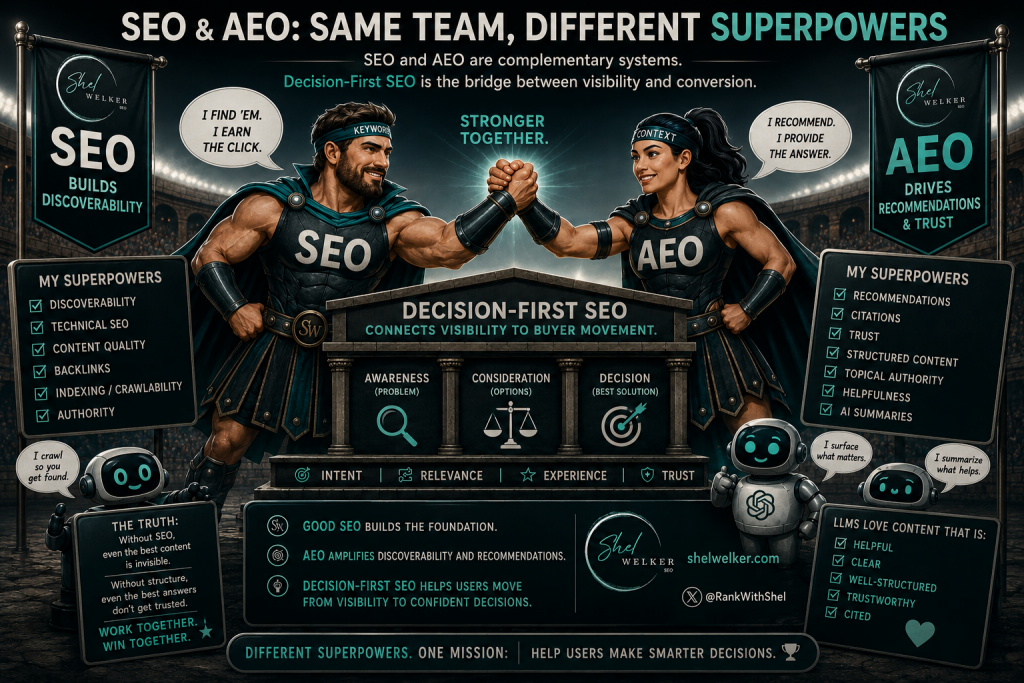
What Decision-First SEO actually means
This is where Decision-First SEO becomes important.
Decision-First SEO is the practice of structuring SEO around how buyers evaluate and make purchasing decisions, not just how they discover information.
Traditional SEO helps users find answers.
Decision-First SEO helps users move through:
- problem recognition
- evaluation
- final decision-making
inside a connected content and site structure.
The goal is not to replace traditional SEO.
It is to organize visibility around buyer progression.
That usually means building stronger pathways between:
- informational content
- comparison content
- implementation guidance
- use-case pages
- pricing clarity
- proof and trust-building content
Instead of treating SEO as disconnected traffic acquisition, Decision-First SEO treats search visibility as part of a larger decision journey.
What decision-stage content actually looks like
One reason many SaaS companies struggle after discovery is because decision-stage content is often missing entirely.
Some of the highest-leverage content types include:
Genuine comparison pages
Not competitor attack pages.
Real comparison content that helps buyers understand:
- tradeoffs
- strengths
- limitations
- workflow differences
- implementation considerations
Buyers are already comparing options. The question is whether they can do that on your site or somewhere else.
Migration and onboarding content
Switching friction is one of the biggest blockers in SaaS purchasing decisions.
Pages explaining:
- migration timelines
- onboarding ownership
- implementation support
- setup expectations
- common transition problems
can significantly reduce evaluation hesitation.
Workflow and use-case pages
Generic product pages explain features.
Use-case pages explain fit.
A CRM platform used by agencies has different operational concerns than one used by enterprise sales teams. Decision-stage content helps buyers understand whether the product matches their real environment.
Pricing clarity content
Buyers do not always need exact pricing immediately.
But they do need enough context to determine whether they are evaluating a realistic option.
Forcing high-intent buyers into a sales call just to understand basic pricing fit often increases friction during evaluation.
Proof that addresses real hesitation
Generic testimonials rarely resolve meaningful concerns.
Case studies become more powerful when they address:
- similar workflows
- similar company sizes
- similar migration fears
- similar operational constraints
The closer the proof matches the buyer’s actual hesitation, the more effective it becomes.
A simple way to audit this on your own site
If your SaaS company is seeing increased visibility but limited movement deeper into the funnel, a quick audit can usually expose where progression is breaking.
Start by reviewing your top organic landing pages.
Ask:
Does this page help someone evaluate a decision, or does it only help them discover information?
Many SaaS sites realize most of their traffic lands on awareness-stage content with very few connected evaluation pathways.
Next, map the most common questions from recent closed-won and closed-lost deals.
What nearly stopped the purchase?
What uncertainty appeared late in the process?
What concerns repeatedly surfaced during evaluation?
Those questions often reveal the highest-value decision-stage content gaps.
This is also where a structured decision-stage analysis can help identify where buyer progression is breaking after discovery.
Then review your internal linking structure.
Can a user move naturally from:
- informational discovery
- to comparison content
- to implementation guidance
- to pricing clarity
- to proof
without friction?
If not, the problem is often structural rather than purely traffic-related.
The bigger shift behind AI search discovery
Google’s AI search guidance matters because it confirms that search visibility is expanding beyond traditional rankings alone.
But discovery is still only one part of the buyer journey.
The companies that benefit most from AI-driven discovery will probably not be the ones chasing AI mentions the hardest.
They will be the companies that combine:
- strong traditional SEO
- growing AI visibility
- clear decision-stage pathways
- structured evaluation support
- trust-building content
into a connected system that helps buyers move forward confidently.
AI search changes how users discover brands.
It does not eliminate the need for decision structure after discovery.
And for many SaaS companies, that is still the missing layer between visibility and conversion.