
The Problem With Traffic-First SEO
Most SaaS SEO advice starts with traffic.
More traffic. Faster traffic. Higher traffic.
But traffic is not a strategy. And when traffic becomes the starting point, the entire SEO motion tilts in the wrong direction.
Traffic Is a Metric. Not a Decision.
Traffic-first SEO asks:
- What keywords have volume?
- What can we rank for quickly?
- What will drive clicks this quarter?
Those are optimization questions. They are not positioning questions.
When traffic leads, decisions follow the data instead of shaping it. And that’s where alignment starts to fracture.
What Happens When Traffic Leads Strategy
When traffic is the starting point, SaaS companies tend to:
- Publish content disconnected from product depth
- Build topical breadth instead of authority
- Chase keywords that attract the wrong audience
- Inflate metrics without improving pipeline
The dashboard improves.
The business does not.
This is why so many companies report “SEO growth” while revenue impact remains flat.
This misalignment usually starts before a single article is published — during the initial strategy decisions. I broke that down in why most SaaS SEO fails before content is published.
Understanding why traffic-first SEO fractures execution leads directly into how structural depth makes strategy durable. Our piece on SEO infrastructure vs content production in SaaS explains how architectural components like topic architecture, internal linking, and conversion pathways determine whether an SEO strategy compounds or collapses.
The Hidden Cost of Traffic-First SEO
The difference isn’t tactical. It’s structural:
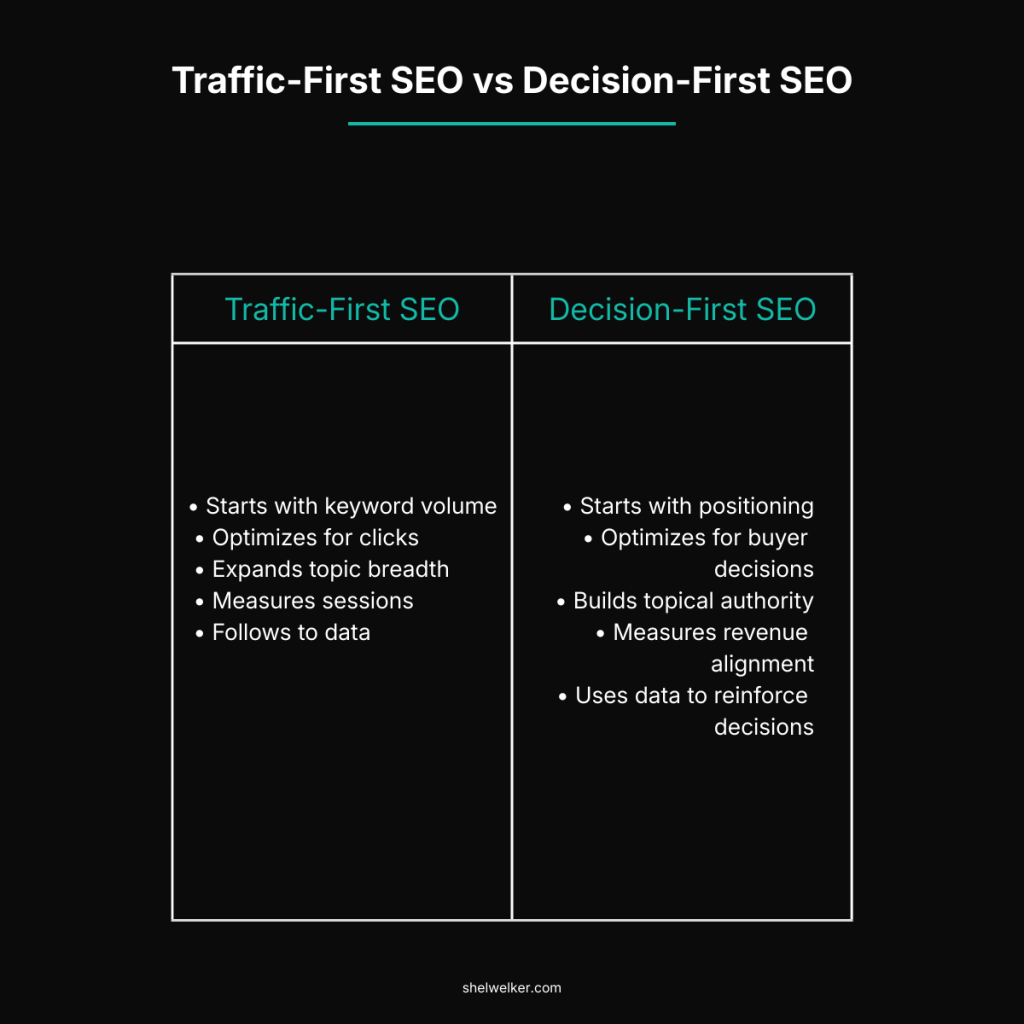
Traffic-first SEO often feels productive because dashboards improve. Rankings rise. Sessions increase. But without decision context, those gains rarely translate into qualified demand. A SaaS SEO strategy that begins with traffic instead of buyer alignment optimizes visibility, not momentum.
The result is activity that looks healthy but lacks strategic direction.
Traffic-first SEO creates activity without clarity.
You might see:
- What category you compete in
- What problems you own
- What decisions your buyer is trying to make
Traffic becomes noise.
And noise compounds.
Strategy Should Precede Scale
The right starting questions are different:
- What must we be known for?
- What topics reinforce our category?
- What buyer decisions matter most?
- What content strengthens product perception?
These decisions constrain your SEO in a good way.
They narrow focus.
They increase authority.
They align content with revenue.
Then traffic grows as a byproduct of clarity.
The Alternative: Decision-First SEO
Traffic-first SEO optimizes for reach.
Decision-First SEO optimizes for:
- Positioning
- Category authority
- Buyer alignment
- Strategic depth
Traffic still matters.
But it becomes a trailing indicator, not the compass.
Who Traffic-First SEO Appeals To
It’s important to say this clearly: Traffic-first SEO isn’t irrational.
It appeals to:
- Teams under quarterly pressure
- Founders who need visible momentum
- Marketing departments measured on sessions
Traffic feels measurable.
Clarity feels slower.
But clarity compounds.
When Traffic Actually Works
Traffic-first strategies can work when:
- You already have strong category positioning
- Your product is widely understood
- Your content aligns tightly with buyer intent
But most SaaS companies skip the foundational decisions that make that alignment possible. And traffic magnifies the gaps.
The Real Question
The question isn’t:
“How do we get more traffic?”
It’s:
“What are we trying to be known for and does our content reinforce that?”
Traffic without a decision framework scales confusion.
Traffic with strategic clarity scales authority.
If You’re Seeing This Pattern
If your company has:
- Growing traffic but stagnant pipeline
- Content volume without topical cohesion
- Rankings that don’t reflect your positioning
You don’t need more keywords.
You need strategic constraint.
That’s exactly what the SaaS SEO Blueprint is designed to diagnose and correct before more content is produced.
If your SaaS SEO strategy feels busy but misaligned, the issue likely isn’t effort. It’s missing structure.
The SaaS SEO Blueprint clarifies those decisions first, so traffic becomes an outcome, not a gamble.