
How Do We Prioritize SEO When Resources Are Limited?
Small SaaS teams usually have more SEO opportunities than they have time to pursue them.
There are product pages that could be stronger, comparison pages competitors already have, technical issues waiting in the backlog, dozens of possible articles, and a keyword list that grows every time someone opens an SEO tool. The problem is not finding something worthwhile to do. It is deciding which worthwhile thing deserves limited resources first.
That is where many approaches to SaaS SEO priorities with a small team fall short. They help teams identify opportunities, then leave them with an even larger list of work competing for the same limited budget and attention.
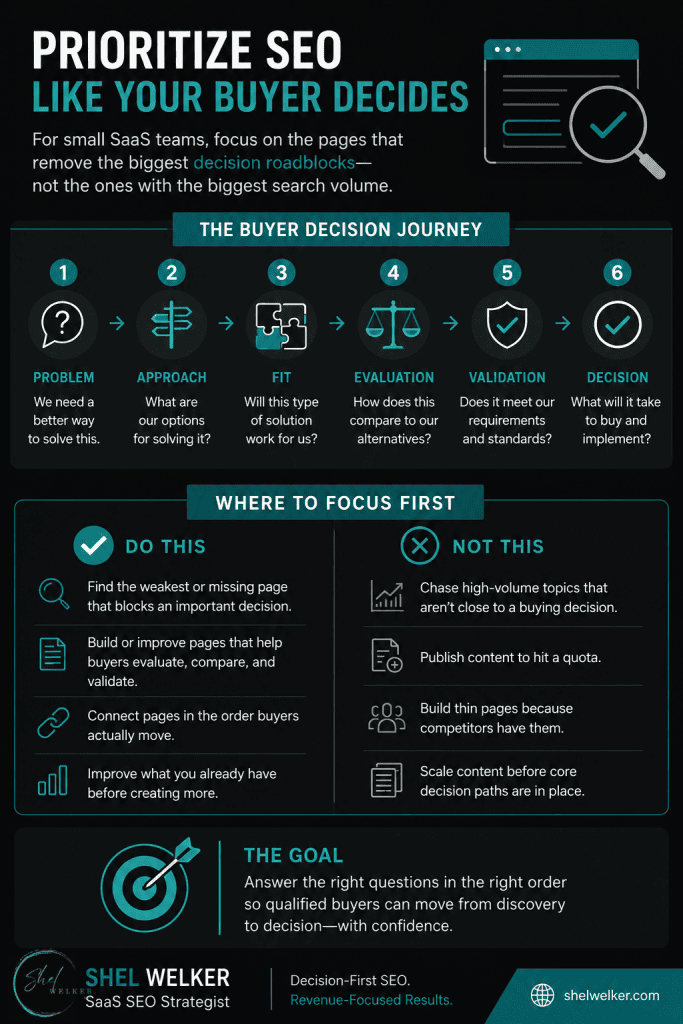
A better starting point is the buyer. Specifically: What does a potential customer still need to understand, compare, believe, or verify before choosing your product?
Decision-First SEO uses those decisions to establish priority. Instead of trying to maintain every part of an SEO program at once, a lean SaaS team can concentrate on the pages and connections most likely to help qualified buyers move forward.
SEO Priority Is Really a Resource Allocation Problem
Most SEO roadmaps divide work into familiar categories. Technical SEO gets a list. Content gets another. Product pages, links, keywords, and optimization opportunities each get their own set of tasks.
That makes sense operationally, especially once a company has enough people to work across several areas simultaneously. For a small team, however, it creates a problem. Tasks from completely different parts of SEO end up competing against one another without a useful way to compare their business value.
Consider a project management SaaS company that can realistically create four substantial pages this quarter. Keyword research identifies plenty of informational topics with attractive search volume, so choosing four of them seems reasonable.
But suppose the company already attracts visitors who understand project management software and are actively evaluating products. Those buyers are trying to determine whether the platform works well for agencies, whether it can replace their current spreadsheet workflow, how it compares with Asana, and whether its pricing makes sense for a 20-person team.
Four broad articles might increase traffic. Four pages addressing those questions could help people who are already considering a purchase.
For a lean team, that difference matters more than which keyword has the larger number beside it.
A lean SaaS SEO strategy should not be a miniature version of a mature company’s SEO operation. It should concentrate resources where search demand, buyer uncertainty, and commercial value intersect.
SaaS SEO Priorities With a Small Team Should Start With the Missing Decision
One of the most common prioritization questions is whether a SaaS company should build blog content, product pages, or comparison pages first.
There is no page type that automatically deserves first place.
Product and use-case pages become urgent when prospective customers cannot clearly determine what the software does, who it serves, or whether it fits their situation. Comparison pages become more important when buyers understand the category but need to distinguish between competing solutions. Educational content deserves more attention when the market is earlier in its journey and buyers are still trying to understand the problem or possible approaches.
Take two companies selling employee onboarding software.
The first has established product pages and receives searches from people already familiar with the category. Prospects frequently compare the company with a larger competitor. Building another broad guide to employee onboarding may bring traffic, but a detailed comparison could address a decision buyers are already making.
The second company serves a market where many potential customers are still managing onboarding through email, documents, and spreadsheets. Those buyers may not be ready for vendor comparisons. Content showing the operational difference between a manual onboarding process and a dedicated platform could move them toward the category itself.
Same product category. Different buyer problem. Different SEO priority.
This is why deciding what pages to build first for SaaS should begin with the weakest important decision in the current buyer journey, not a predetermined ratio of blog posts, landing pages, and comparison content.
Decision-Stage Gaps Can Matter More Than Traffic Gaps
Broad informational content is appealing because its opportunity is easy to see. Search volume provides a number. Competitor rankings provide a benchmark. Content tools can quickly produce a long list of topics that appear to represent growth.
The cost of missing decision-stage content is harder to see.
A buyer may already know the category and understand the problem. What they cannot determine is whether the product works with their existing tools, supports a particular use case, offers the capability they need, or compares favorably with the solution they already use.
If the site does not answer those questions, another 2,000-word informational guide does not fix the gap.
Imagine an accounting platform that already receives meaningful organic traffic around the month-end close process. The obvious startup content priority might be to keep expanding that topic because it has demonstrated search demand.
Now assume prospective customers repeatedly want to know whether the platform can replace the spreadsheet workflow their finance team already uses.
A page that thoroughly addresses that question may never become the site’s highest-traffic asset. It can still be more commercially useful than another broad accounting article because it supports people who have already progressed further toward a purchase.
It may also help more than organic search. Sales can send prospects to it. Branded searchers can discover it. Existing visitors can reach it through internal links. AI systems can retrieve it when someone asks whether this type of platform can replace spreadsheets.
That is a different way to think about conversion lift. Sometimes the fastest improvement does not come from acquiring another audience. It comes from doing a better job with the qualified audience already arriving.
Build the Roadmap Around Buyer Progression
Once decisions become visible, the roadmap becomes easier to sequence.
Suppose a cybersecurity SaaS company sells vendor risk management software. A prospective buyer might move through a series of questions:
- Problem: We need a better way to manage vendor security reviews.
- Approach: Should we improve our manual process or adopt vendor risk management software?
- Fit: Will this type of platform work for a company our size and workflow?
- Evaluation: How does this product compare with the alternatives we are considering?
- Validation: Does it support the integrations, reporting, and security requirements we need?
- Decision: What will implementation involve, and what will it cost?
Now the content plan has a job beyond generating traffic.
A strong educational resource can introduce the problem and available approaches. From there, an internal link can lead to the appropriate use-case page. That page can connect to relevant product capabilities and comparisons. Comparison content can lead naturally to integrations, security documentation, implementation information, and pricing.
The resulting pathway might look like:
Vendor risk management guide → Use case → Product capabilities → Comparison → Security and integrations → Implementation and pricing
Not every buyer will follow that sequence neatly. Buyers jump between questions, return later, enter through different pages, and arrive with different levels of awareness.
That content architecture still matters because the necessary information exists and the relationships between it are clear.
For a limited budget SEO roadmap, five or six strategically connected assets can therefore be more useful than twelve articles selected independently from a keyword list.
Connected Content Gives Search and AI Systems More Context
Buyer-oriented architecture also changes what a site communicates to search and AI retrieval systems.
Search engines have long used more than exact keyword matching to understand content. Google also uses links to understand page relevance and recommends connecting relevant pages with descriptive internal links. Modern search and retrieval systems add another layer by interpreting content within a broader context.
That makes the connections within a SaaS site increasingly important.
A company might publish 150 articles related broadly to its industry while providing surprisingly little clear information about how its product relates to particular use cases, competitors, integrations, implementation concerns, or buyer requirements.
Another company might have a much smaller content library, but its information is tightly connected. Category content establishes what the solution is. Use-case pages establish who needs it and why. Product pages explain capabilities. Comparisons establish alternatives and differences. Integration and implementation content answer validation questions.
Those relationships provide context.
If an AI system is trying to answer a question about whether a product fits a particular use case, it has more useful information to work with when the site consistently connects that use case with the product, its relevant capabilities, supporting integrations, and evaluation criteria.
The business benefit is not simply “AI visibility.” The same structure that helps a retrieval system understand the relationship between these concepts also helps a prospective customer understand them.
This is one reason content volume alone is a poor measure of topical strength. A large library can create broad coverage without creating much conceptual clarity.
What Should a Startup Ignore Early?
A useful SEO strategy does not just identify what deserves resources. It creates permission to leave lower-value work alone.
That can be difficult because many of those tasks are legitimate.
A technical audit may contain 80 recommendations. A competitor may rank for 300 keywords you do not. A content tool may identify 50 topical gaps. None of that means all of those opportunities belong in this quarter’s roadmap.
For a small SaaS company, several things can usually wait:
- Adjacent high-volume topics while important buyer questions remain unanswered
- Publishing simply to maintain a predetermined content frequency
- Thin industry or use-case pages created because competitors have them
- Minor technical cleanup that does not materially affect crawling, indexing, usability, or important pages
- Large-scale content expansion before core product and evaluation pathways are established
Ignoring those tasks does not mean they have no value. It means their value is lower right now than the work ahead of them.
The same principle should influence the first SEO hires for SaaS.
If a company does not know what its highest-priority content should be, hiring more writers will not solve the problem. It increases production capacity before the company knows what that capacity should produce.
If the strategy is sound but implementation is slow, a writer or technical specialist may be exactly what is needed. If prioritization itself is weak, strategic SEO or product marketing capability may need to come first.
Hire for the constraint you actually have.
How Much Content Is Enough Before You Scale?
There is no useful minimum number of pages that tells a SaaS company it is ready to scale content.
The better question is whether the important buyer decisions have meaningful support.
Can a potential customer understand the problem you solve? Can they determine whether your product fits their situation? Can they evaluate it against realistic alternatives? Can they verify important requirements? Can they understand what adopting it will involve?
Then look at the architecture connecting those answers.
A site with 30 strong, interconnected pages can support those decisions better than a site with 200 articles built around unrelated keyword opportunities. Once the core pathways exist, additional content has something to strengthen rather than something to compensate for.
Performance measurement changes as well.
A comparison page receiving 150 qualified visits may be far more valuable than an informational article receiving 5,000 visits if the comparison page regularly contributes to product evaluation and sales opportunities. Traffic still matters. Its value depends on what the visitor can do next.
Where Buyer Decisions Usually Get Stuck
| Question | What to inspect | Likely priority |
|---|---|---|
| What SEO work should we do first? | Which important buyer decisions have weak or nonexistent support | Build around the most commercially relevant gap |
| Blogs or product pages first? | Whether buyers understand the category, product, and fit | Strengthen product/use-case content when fit is unclear |
| Do we need comparison pages yet? | Whether buyers are already evaluating named alternatives | Build comparisons when competitor-aware demand exists |
| More content or improve existing pages? | Whether the current decision pathway has missing or weak steps | Repair the pathway before expanding into new topics |
| Technical SEO or content? | Whether technical problems materially interfere with discovery or use | Fix genuine blockers, then return resources to buyer-facing gaps |
| Writer or SEO strategist first? | Whether the constraint is production or deciding what should be produced | Hire against the actual bottleneck |
| How much content is enough? | Whether buyers can move from understanding the problem through evaluating the solution | Scale once core decision pathways have meaningful coverage |
These questions look like separate SEO decisions because they usually appear at different moments in planning. They are really variations of the same resource problem. Each asks where the next unit of time, money, or attention can remove the most important obstacle between search demand and a buying decision.
The Goal Is Not a Longer SEO Backlog
SEO tools are very good at finding more SEO work.
For a resource-constrained SaaS company, that is not necessarily helpful. The company does not need an exhaustive inventory of everything that could improve. It needs a defensible order of operations.
Decision-First SEO creates that order by treating the buyer journey as the organizing structure. Search opportunities still matter. Technical foundations still matter. Informational content still matters. But those activities are evaluated according to the role they play in helping the right buyer understand, evaluate, and ultimately choose the product.
That is also the purpose of the SaaS SEO Blueprint.
The Blueprint maps buyer stages, revenue-relevant search opportunities, decision-stage content gaps, internal linking relationships, and the work that should be prioritized over the next 90 days. It exists because a list of SEO opportunities is relatively easy to produce. Deciding which opportunities deserve limited resources is the harder strategic problem.
A small SaaS team cannot build everything at once, and it does not need to.
It needs to build the right things in the right order.