
Why SaaS Comparison Pages Often Matter More Than Another Blog Post
Most SaaS marketing teams have the same reflex when growth stalls: publish more.
Add another article. Target a few more keywords. Increase publishing frequency. Give the site more opportunities to rank.
Sometimes that is exactly the right move. But for many SaaS companies, traffic is no longer the only problem. The larger gap appears after someone has already found the site and started deciding whether the product is right for them.
At that point, the buyer is no longer looking for another explanation of the problem. They are trying to figure out how your product compares with the two or three others on their shortlist, whether it fits a company their size, what implementation involves, and what they might give up by switching.
If your site does not answer those questions, buyers do not stop comparing. They simply leave your site to do it.
That is the gap SaaS comparison pages for SEO can close. Not as another landing page to check off a list, but as content that helps buyers finish a decision they have already started..
More Traffic Doesn’t Fix a Missing Decision
Informational content earns its place in a SaaS SEO strategy. It can introduce buyers to a problem, help them understand a category, and bring qualified prospects to a product they may not have known existed.
The problem is assuming that more discovery automatically improves what happens next.
A buyer may arrive through an article about an operational problem, read several related resources, and understand that they need a software solution. But once that happens, their questions change.
They start asking:
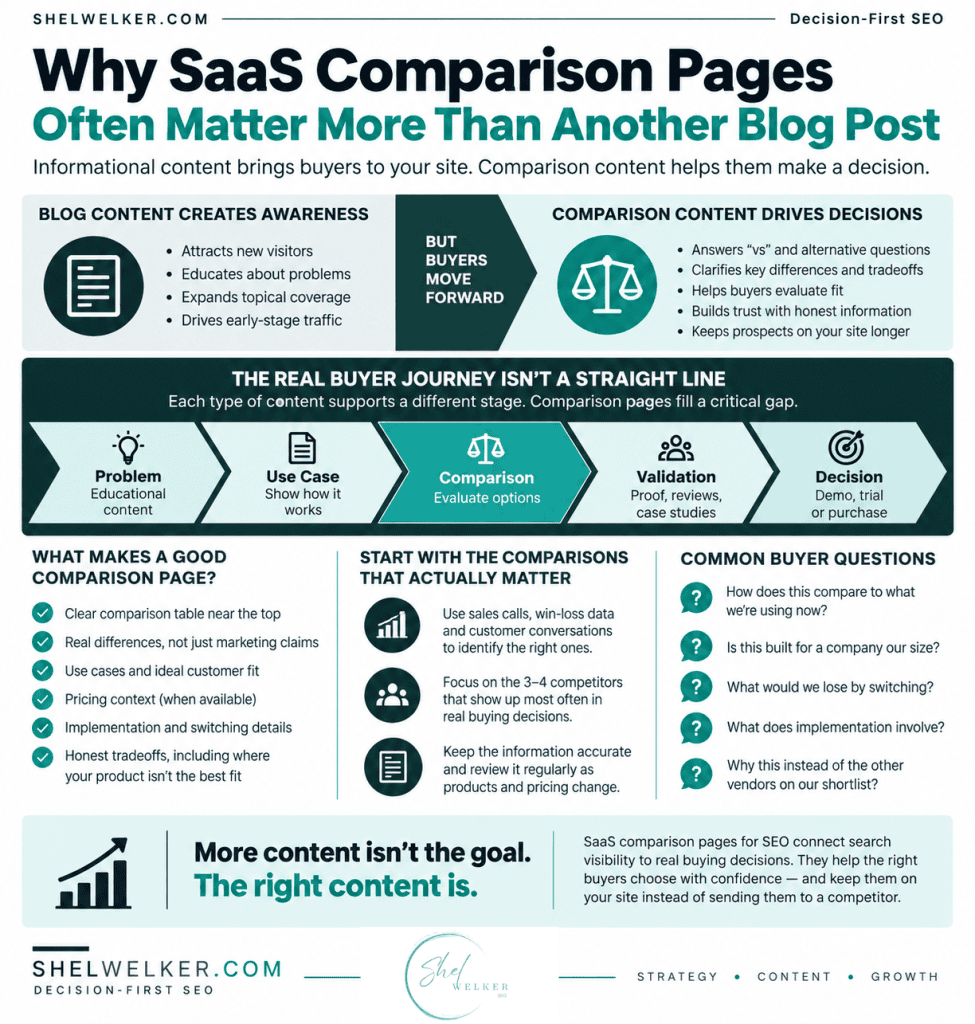
- How does this compare with what we’re using now?
- Is this designed for a company our size?
- What would we lose by switching?
- What does implementation actually involve?
- Why would we choose this instead of the other vendors on our shortlist?
Another informational article about the original problem does not answer any of those questions.
You have already done the difficult work of attracting a relevant buyer. Then the site becomes least helpful at the exact point when that buyer needs more specific information.
This is one of the distinctions that matters in Decision-First SEO. Content planning should not stop at asking what else the site could rank for. It should also ask what decision the buyer needs to make next and whether the site gives them enough information to make it.
Sometimes the most important content gap is not another blog topic. It is a missing comparison page. That is especially common on SaaS sites with thin evaluation-stage content.
Buyers Are Comparing You Whether You Help or Not
Founders and marketers are often hesitant to publish content that names a competitor. It can feel like giving the reader a reason to leave or drawing attention to an alternative that might otherwise have gone unnoticed.
That concern is understandable, but it overlooks what buyers are already doing.
Someone seriously evaluating software will search “[Product A] vs [Product B].” They will read software review sites, look through community discussions, ask colleagues, compare vendor websites, and increasingly ask AI assistants to summarize the differences between products.
For a larger purchase, someone on the buying team may already be building a spreadsheet comparing the finalists.
None of that requires your participation.
The real choice is whether your own site contributes anything useful to a comparison that is happening anyway.
That does not mean publishing a page where your product conveniently wins every category. Those pages are easy to recognize for what they are.
A useful comparison might acknowledge that one product offers deeper customization while another is easier for a smaller team to implement. One may offer broader enterprise functionality while another has a simpler pricing structure. One may be the better choice for a particular type of customer even when that product is not yours.
Honest tradeoffs make comparison content more credible because the purpose is not to prove that your software is universally better. It is to help the right buyer determine which option fits.
What Actually Belongs on SaaS Comparison Pages for SEO?
A comparison page should be built around the decision the buyer is trying to make, not around a feature checklist designed to produce a predetermined winner.
The exact structure will depend on the products and market, but useful B2B SaaS comparison content usually needs to clarify several things:
- Where the products genuinely differ in capabilities
- Which teams, company sizes, or use cases each product tends to suit
- How pricing models differ when reliable public information is available
- Which important features or integrations are included, limited, or gated
- What onboarding, migration, or implementation may involve
- Where meaningful tradeoffs exist between the products
The same principle applies to SaaS alternative pages.
Someone searching for an alternative to a particular tool usually has a reason. Perhaps the pricing became difficult to justify. Maybe the product became too complicated as the company grew. A needed integration is missing. The team needs functionality that was not important when they originally purchased the software.
A generic list of five alternatives does little to help that buyer.
A stronger page understands why someone is looking for an alternative and compares the available choices according to that need.
That is the difference between creating content around a keyword and creating content around the decision behind the keyword.
Structure the Page for the Way Buyers Actually Compare
Comparison searches are unusually direct.
Someone searching “[Product A] vs [Product B]” or “[Product] alternatives” has already moved beyond general category research. They want differences they can evaluate quickly.
Making them work through a long introduction before seeing the comparison adds unnecessary friction.
A concise summary or comparison table near the beginning of the page can establish the major differences quickly. The rest of the page can then provide the nuance that a table cannot: why a feature matters, which customer benefits from it, what the tradeoff looks like in practice, and where the products serve different needs.
That structure also makes the relationships between products and features clearer.
Search engines and AI retrieval systems increasingly need to interpret those relationships across content. Clear descriptions of products, capabilities, use cases, alternatives, and tradeoffs provide more explicit context than vague claims that one platform is simply “powerful,” “flexible,” or “best in class.”
A comparison page should also connect to the rest of the site’s decision-stage content.
A useful buyer path might look something like:
Problem → Use case → Comparison → Validation → Decision
An educational article introduces the problem. A use-case page helps the buyer recognize fit. A comparison page helps evaluate options. Customer evidence, implementation information, pricing, or product content then helps resolve the remaining uncertainty.
That is a much more realistic SaaS buying path than expecting every blog visitor to jump directly from an informational article to a demo request.
Comparison Pages Have Real Risks and Maintenance Costs
Comparison content is useful precisely because it is specific. That specificity also creates responsibilities that ordinary evergreen blog content may not have.
Pricing changes. Features are added or removed. Packaging changes. Competitors reposition products.
A comparison page that is accurate when published can become quietly inaccurate six months later. Once that happens, the page can damage trust rather than build it.
Comparison content therefore needs an owner and a review process. High-priority pages should be revisited periodically and whenever known product or pricing changes affect the claims being made.
Naming competitors also requires care.
Claims about another company’s features, pricing, integrations, or limitations should be accurate and supportable. If information is not publicly available or cannot be verified, the page should not pretend otherwise. Trademark usage, screenshots, and other brand assets can introduce additional considerations depending on how they are used.
None of this is an argument against comparison pages. It is an argument for treating them as serious decision-stage assets rather than disposable SEO pages.
Accuracy is part of what makes them useful.
You Don’t Need Every Comparison Page at Once
Once a team decides comparison content matters, it is easy to create a new problem: building a page for every competitor in the market.
Most SaaS companies do not need that.
Start with the comparisons that already happen during real buying conversations.
Sales calls, win-loss notes, CRM data, customer interviews, branded search queries, and conversations with customer-facing teams can reveal which competitors repeatedly appear on shortlists.
If the same three names keep showing up, those comparisons probably deserve attention before fifteen pages built around competitors that rarely affect an actual sale.
The same kind of SEO prioritization when resources are limited applies across decision-stage content more broadly.. Comparison pages may matter, but so might alternative pages, pricing information, implementation guidance, use cases, or customer proof.
The question is not simply, “What could we publish?”
It is, “Where are buyers currently getting stuck?”
That changes content prioritization considerably. A SaaS company with strong informational traffic but weak evaluation-stage coverage may get more business value from three carefully built comparison pages than another month of blog production.
The Questions Buyers Are Actually Asking
Comparison searches are only the visible part of a larger decision. Underneath them are questions about fit, risk, cost, and confidence.
| Buyer concern | What the page needs to answer |
|---|---|
| Won’t comparison content just help our competitors too? | Whether giving buyers useful, specific information creates more value than staying out of a comparison they are already making |
| Is this worth building for a smaller SaaS company? | Which comparisons actually appear in sales conversations and customer research |
| What makes a comparison page useful? | Honest fit, meaningful tradeoffs, reliable product information, pricing context where available, and a clear next step |
| Why are buyers leaving our site to compare us? | Which evaluation questions the current site leaves unanswered |
| Which comparison should we build first? | Which competitor or alternative appears most often in real buying decisions |
| Does a comparison page need aggressive link building to rank? | Whether the page genuinely satisfies comparison intent and is supported by relevant internal content and site architecture |
Buyers are rarely looking for one isolated answer. They are assembling enough information to become confident in a decision.
The better your site supports that process, the less often a qualified buyer has to leave simply because the information they need is missing.
Build for the Decision That’s Missing
This is not an argument for abandoning blog content in favor of competitor pages. That would simply replace one narrow content strategy with another.
It is an argument for being more deliberate about what each type of content is supposed to accomplish.
Educational content can create discovery and help buyers understand a problem. Use-case content can establish fit. Comparison and alternative pages can help evaluate specific options. Pricing, implementation, product, and proof content can reduce the remaining uncertainty before a purchase.
When one stage is thin or missing, publishing more content somewhere else in the journey does not necessarily fix it.
For some SaaS companies, awareness genuinely is the bottleneck and more informational content is the right investment. For others, the higher-value move may be three well-built comparison pages that finally answer questions prospective customers have been leaving the site to resolve.
Identifying those gaps is also part of what I look for in a SaaS SEO Blueprint. The goal is not simply to find more searches a site could rank for. It is to understand where search, content, and the buyer’s decision process stop lining up, then determine what should be built next.
Because the measure of a useful SaaS content strategy is not how many pages it produces.
It is whether the right page exists when the buyer needs it.