Why Most SaaS SEO Fails Before Content Is Published
Most SaaS SEO strategy fails because the company optimized around ranking instead of the buyer’s decision process. Before a single word is written, the strategic lens is already wrong. And once that happens, no amount of publishing fixes it.
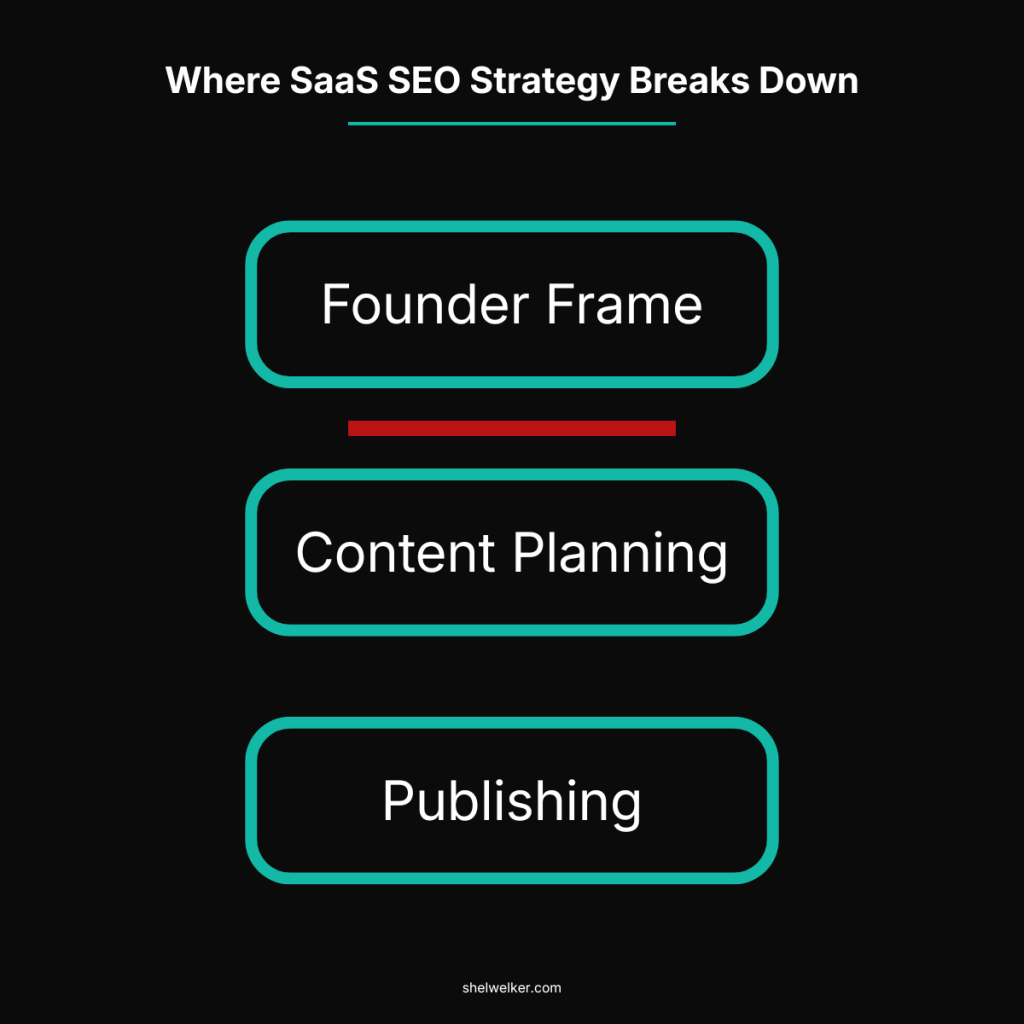
The Founder’s Frame Is Where SaaS SEO Strategy Breaks Down
The breakdown typically happens at the strategic layer, long before publishing begins.
Most SaaS SEO planning starts here:
- What features should we highlight?
- What keywords have volume?
- What product terms do we want to rank for?
- What competitors are writing about?
Notice what is missing.
The buyer.
More specifically:
Where is the buyer in their decision-making process?
Not what do we want to rank for.
Instead, ask:
- Are they problem-aware?
- Comparing categories?
- Evaluating vendors?
- Justifying a purchase internally?
SEO that ignores this fails quietly.
It generates activity. Sometimes traffic. Rarely revenue.
Traffic Without Decision Context Is Noise
When SaaS companies publish without mapping content to decision stages, you get:
- Educational posts attracting early-stage researchers
- Product pages targeting high-intent terms
- No bridge between the two
Traffic comes in. It reads. It leaves.
When SaaS SEO strategy is built on founder assumptions instead of buyer intent, misalignment compounds over time.
Because the content was not built to move someone forward in a decision. It was built to exist.
This is the structural flaw behind traffic-first SEO in SaaS, where keyword volume is prioritized before positioning decisions are made.
The Buy Is Not About You
This is the shift most teams never make. SEO is not about broadcasting your positioning. It is about entering the buyer’s internal decision timeline at the right moment.
If someone is still defining the problem, they need clarity. If someone is comparing solutions, they need differentiation. If someone is evaluating vendors, they need proof. If someone is preparing to purchase, they need certainty.
If you serve the wrong layer at the wrong time, you lose them. Not because your content is bad. Because it is misaligned.
Most SaaS SEO Fails Before Publishing Because
The team never decided:
- Which stage of the decision process they are targeting
- Which problems they truly want to own
- How content should move someone toward a purchase
- What role each page plays in advancing the buy
Instead, they create content calendars. Calendars are not strategy. Decision alignment is.
That distinction becomes especially important when resources are limited, because the team still has to decide which SEO work deserves to happen first.
Decision-First SEO Changes the Order
Instead of: Traffic-First SEO
Keywords to content to hope.
It becomes: Decision-First SEO
Buyer decision state to strategic topic ownership to structured content to compounding authority.
Now content has a job. Now internal links have purpose. Now the homepage supports the buy instead of introducing itself. Now traffic aligns with revenue.
The Bottom Line
Most SaaS SEO fails before content is published because the company never decided: Where are we entering the buyer’s decision process?
Without that clarity:
- Content attracts the wrong audience
- Traffic does not convert
- Sales blames marketing
- Marketing blames SEO
With it:
- Topics compound
- Messaging tightens
- Authority builds intentionally
- Revenue follows alignment
SEO does not fail from lack of effort. It fails from lack of decision alignment.
Positioning is the starting point. But clarity alone does not create durability. Without defined topic architecture, internal linking logic, and intentional conversion pathways, even well-aligned content eventually fractures. The structural layer of SEO infrastructure determines whether strategy compounds or stalls.
If You Want SEO That Aligns With Revenue
Publishing more content will not fix structural misalignment.
Clarity, defined before execution begins, will.
The SaaS SEO Blueprint is a strategy document built around your buyer’s decision process. If you’re planning to scale content this year, this prevents you from scaling the wrong structure.
It defines:
- What you should own
- What you should ignore
- How your site should be structured to support revenue
- How content should move buyers toward purchase
Delivered in 5 to 7 business days.
No retainers.
No ongoing dependency.
Just clarity.