
SaaS SEO Mistakes That Kill Revenue Before Content Is Published
Most SaaS SEO mistakes don’t happen after publishing. They happen before strategy is defined.
Teams assume the issue is execution.
They assume traffic is the goal.
They assume content volume solves the problem.
But when revenue alignment isn’t defined first, every SEO action becomes guesswork.
This article isn’t a list of surface-level errors.
It’s a breakdown of the strategic mistakes that quietly kill ROI before a single article goes live. I explored this dynamic further in Why SaaS SEO Fails Before Content Is Published, where I explain why most execution problems are actually strategic misalignment.
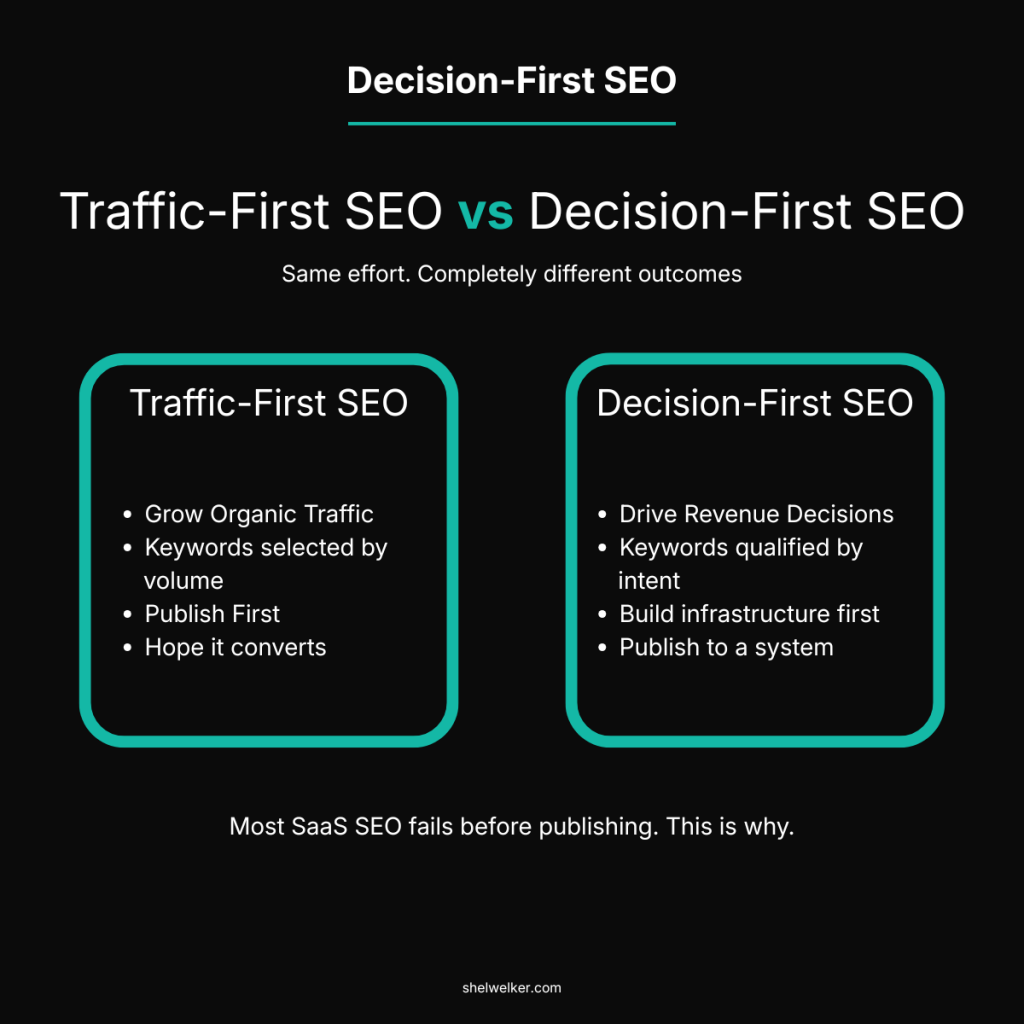
Mistake #1: Starting With Traffic Goals Instead of Revenue Goals
“Let’s grow organic traffic.”
It sounds reasonable.
It even sounds strategic.
But traffic is an output — not an objective.
Without defining:
- Which buyer decisions search should influence
- Which stage of the funnel SEO supports
- Which revenue outcome matters
Traffic becomes a vanity metric.
If you don’t define which customer decisions organic search is meant to influence, traffic becomes noise.
Mistake #2: Building Keyword Lists Without Decision Criteria
Many SaaS teams start with tools.
They export 100–300 keywords.
They sort by volume.
They build a content calendar.
But keywords are inputs — not strategy.
High search volume does not equal strategic value.
And not every keyword supports revenue.
Without filtering keywords by:
- Buyer stage
- Revenue proximity
- Authority positioning
- Conversion pathway
You end up publishing content that ranks… but doesn’t move the business forward.
Keywords are data.
Decision alignment is strategy.
The harder question is what happens after those criteria are applied: how should a small SaaS team prioritize SEO when it still cannot pursue every worthwhile opportunity?
Mistake #3: Publishing Content Before Infrastructure Exists
Content doesn’t operate in isolation.
It requires:
- Internal linking logic
- Clear authority structure
- Defined conversion pathways
- Offer alignment
Without infrastructure, content has no leverage.
You may publish consistently.
You may even rank.
But rankings without system architecture rarely compound.
Content without infrastructure is content without strategic impact.
Mistake #4: Prioritizing Production Over Positioning
Velocity feels productive.
More blog posts.
More keywords.
More publishing deadlines.
But volume does not fix misalignment.
If positioning is unclear, more content only amplifies confusion. Strong SaaS SEO isn’t built on output. It’s built on clarity. Publishing more does not solve strategic gaps. It often hides them.
The Root Cause: Traffic-First Thinking
Every mistake above traces back to the same foundation.
Traffic-first thinking.
When SEO begins with traffic goals instead of business outcomes, everything downstream becomes reactive.
There’s another way to structure SaaS SEO.
Instead of asking:
“How do we grow traffic?”
You ask:
“What decisions must organic search influence to drive revenue?”
From there, keywords, content, and infrastructure are built intentionally. That’s the difference between traffic-driven SEO and decision-driven SEO. It’s the foundation of what I call Decision-First SEO.
A More Strategic Alternative
When strategy starts with decisions:
- Revenue alignment is defined first
- Keywords are filtered by commercial intent
- Content maps to buyer progression
- Infrastructure is designed before publishing
Execution becomes focused.
Authority compounds.
And traffic becomes a byproduct — not the goal.
Why Most SaaS SEO Mistakes Feel Productive But Fail
Most SaaS SEO mistakes aren’t tactical errors. They’re strategic misalignment.
They have a keyword list.
They have a content calendar.
They publish consistently.
On the surface, it looks productive. But productivity without decision alignment rarely compounds.
Strong SaaS SEO strategy doesn’t start with traffic targets.
It starts with clarity around which business outcomes search is meant to influence.
Without that clarity, content becomes activity — not leverage.
And leverage is what turns SEO into an asset instead of a cost center.
If You Want to Build SaaS SEO That Compounds
If you’re building SaaS SEO and want clarity before execution, the Decision-First SEO Blueprint outlines the full system.
It defines:
- Revenue alignment
- Keyword qualification
- Authority structuring
- Content sequencing
Before publishing begins. Before revenue is left to chance.
Related Information
If your SaaS SEO is getting traffic but not enough conversions, these articles can help you identify where the buyer path is breaking.