
SEO Infrastructure vs Content Production in SaaS
In SaaS, SEO conversations often revolve around output.
How many posts per month.
How many keywords targeted.
How quickly content can be published.
Execution matters. But execution without structure creates long-term fragility.
Many SaaS companies do not struggle because they produce too little content. They struggle because they build on unstable foundations. When growth slows or rankings fluctuate, the problem is rarely effort. It is infrastructure.
If your SaaS SEO strategy prioritizes production before structure, you are building volume without resilience.
This article explains the difference.
A strong SaaS SEO strategy is not defined by how much content is published. It is defined by how clearly the system behind that content is designed. Infrastructure determines whether SEO planning for SaaS companies compounds over time or collapses under its own weight.
The Production-First Pattern
A typical content-first motion looks like this:
- Identify keywords with traffic
- Assign briefs
- Publish consistently
- Repeat
On the surface, it appears disciplined. There is a calendar. There are rankings. Traffic begins to move.
But over time, cracks appear:
- Blog topics drift away from product positioning
- Multiple articles compete for the same intent
- Internal links are inconsistent or reactive
- High-traffic pages convert poorly
- Sales teams say the leads are misaligned
The content is not wrong. It is simply disconnected. Production without infrastructure creates surface growth. It does not create strategic depth.
What SEO Infrastructure Means in a SaaS SEO Strategy
SEO infrastructure is not technical configuration. It is strategic architecture. In a SaaS environment, infrastructure includes five core layers.
The layers below illustrate how a SaaS SEO strategy moves from positioning clarity to conversion alignment.
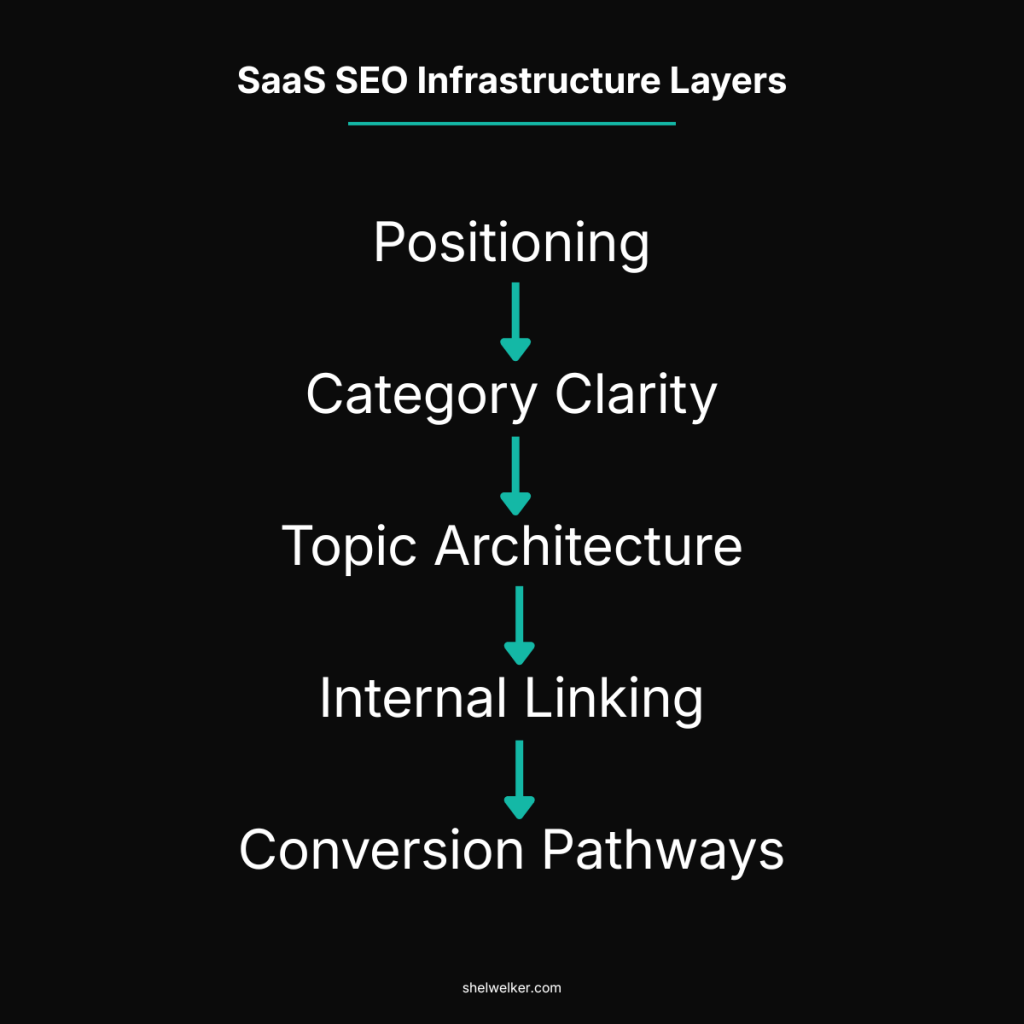
1. Positioning Clarity
Before content, you must define:
- Who the product is for
- What category it belongs to
- What problem it owns
- What it is not
If positioning is ambiguous, content will reflect that ambiguity. Writers fill the gap with broad topics. Broad topics attract broad audiences. Broad audiences dilute conversion. A strong SaaS SEO strategy begins with a clear market identity.
2. Category and Messaging Alignment
Search engines reward clarity. If your homepage signals one category while your blog targets another, the system becomes incoherent.
For example, a workflow automation platform that publishes extensively on general productivity creates a gap between traffic and product.
Infrastructure ensures that:
- Core commercial pages define the category clearly
- Supporting content reinforces that category
- Messaging remains consistent across navigation, blog, and product pages
This alignment strengthens topical authority and conversion quality.
3. Topic Architecture
Topic architecture defines how content clusters around strategic themes.
It answers questions such as:
- What are our core pillars?
- Which queries support those pillars?
- How do informational pages connect to commercial intent?
Without architecture, content becomes a collection of isolated pages. With architecture, each article strengthens a larger system.
Topic architecture turns publishing into compounding equity.
4. Internal Linking Logic
Internal linking is often treated as a checklist task. Add a few links. Move on.
In a mature SaaS SEO strategy, internal linking reflects intent pathways.
- Informational pages link to relevant commercial pages
- Commercial pages link back to supporting educational resources
- Related cluster content links laterally to reinforce topical depth
This structure guides both users and search engines.
When internal linking is reactive, authority fragments. When it is intentional, authority consolidates.
5. Conversion Pathways
Traffic alone does not create revenue. Infrastructure connects attention to action.
This includes:
- Clear contextual calls to action
- Logical next steps from educational content
- Alignment between search intent and landing page experience
If a high-ranking article has no defined conversion pathway, it becomes an isolated asset.
Infrastructure ensures every meaningful page participates in a larger revenue system.
Execution Volume vs Structural Depth in SaaS SEO
Execution volume focuses on quantity. Structural depth focuses on coherence. Here is the difference in practice.
A production-driven team might publish 50 articles in six months. Rankings increase across a wide keyword set. Organic sessions grow.
A structurally driven team might publish 20 articles in the same period. Each article strengthens defined pillars. Internal linking reinforces authority. Commercial pages are intentionally supported.
In year one, the volume model may appear faster.
In year two, the structural model is more stable.
Why?
Because search engines evaluate systems, not just pages. Topical authority, internal coherence, and category alignment compound over time. When updates occur, well-structured sites tend to absorb volatility more effectively than fragmented ones.
Volume can amplify infrastructure. It cannot replace it.
For smaller teams, that creates another problem: deciding which parts of the infrastructure deserve limited resources first. Prioritizing SaaS SEO with a small team means sequencing those investments around the buyer decisions they support.
The Cost of Skipping Infrastructure in SaaS SEO
Skipping infrastructure has long-term consequences.
- Rewrites become frequent because early positioning was unclear.
- Cannibalization increases as similar topics accumulate.
- Conversion rates stagnate despite rising traffic.
- Scaling becomes harder because no clear expansion map exists.
At some point, leadership asks whether SEO is working. Often, it is working exactly as designed. The system was optimized for output, not alignment.
Retrofitting infrastructure after hundreds of articles is expensive. It requires consolidation, redirects, re-mapping clusters, and redefining commercial priorities.
Building infrastructure first avoids that cost.
Infrastructure as a Strategic Advantage
For SaaS companies, SEO is rarely a short-term channel. It is an asset class.
When infrastructure is in place:
- New content fits into predefined pillars
- Writers operate with strategic constraints
- Internal links are mapped intentionally
- Product updates integrate naturally into existing clusters
- Commercial pages accumulate authority over time
Infrastructure reduces randomness. It also increases confidence. Teams know why they are publishing a piece and how it strengthens the overall strategy. This is the difference between activity and architecture.
How to Evaluate Your Current State
If you want to assess whether your SEO motion is production-led or infrastructure-led, ask:
- Can we clearly articulate our category in one sentence?
- Do our top traffic pages support our core commercial goals?
- Are our topic clusters documented and intentional?
- Is internal linking mapped or improvised?
- Do we know how each major article contributes to revenue?
If these answers are unclear, your SaaS SEO strategy may be volume-dependent.
That does not mean starting over. It means pausing to define structure before accelerating further.
For leadership teams, documenting these answers before scaling production is often the highest-leverage step in SEO planning.
Infrastructure Is the Turning Point
Content production is not the problem. It becomes powerful when built on deliberate foundations.
We have already examined how SaaS SEO fails before content is published and how traffic-first thinking creates strategic drift. Infrastructure is where those insights become operational.
Strategy defines direction.
Infrastructure defines structure.
Content executes within that structure.
When those layers align, SEO becomes durable instead of reactive.
Without infrastructure, production creates noise.
With infrastructure, production compounds.
That distinction is the turning point between activity and strategy.