
Are You Showing Up When Buyers Are Actually Choosing Software?
What SaaS teams should measure in AI search visibility, and what to skip.
On October 15, Google announced changes to how links appear in AI Overviews and AI Mode. Inline links will appear higher in answers more frequently, Google is testing a dedicated section highlighting one or two important links at the top of some responses, and links to related articles are getting a more prominent presentation. Google hasn’t published click-through figures for these changes, so we don’t know yet how much additional traffic they’ll generate or which sites will benefit.
For SaaS teams, that news will probably restart a familiar conversation about tracking AI citations, brand mentions, and visibility scores. Fair enough. But I think a more basic question gets skipped: when your brand appears in an AI answer, what was the person trying to do?
I approach this through Decision-First SEO. You start with the decisions a buyer has to make before choosing software, work out which questions they ask along the way, and check whether your site answers them well. You also need to understand how your product is represented elsewhere on the web. Visibility is useful when it connects to those decisions. Without that context, it’s difficult to know what the numbers on your dashboard are worth.
Two Searches That Look Similar and Aren’t
Say you sell CRM software. One person searches “What is CRM software?” That could be a student, someone curious about the category, or a manager who has just started thinking about a problem. There’s no clear sign they’re comparing products.
Another person searches “Best CRM for a 20-person B2B sales team moving off spreadsheets.” They’ve told you their team size, their current setup, and that they’re looking for an alternative. If your product shows up in that answer, you have an opportunity to reach someone researching a potential purchase.
Both appearances have value. The first can build familiarity, and some of those early researchers will eventually become buyers. But if a report adds them together, you can’t tell which kind of visibility you actually have. A hundred mentions on definition queries and ten on comparison queries is a very different situation from the reverse, and a single total hides that.
What AI Search Visibility Tools Can and Can’t Tell You
AI visibility tools generally monitor selected prompts, record whether your brand or domain appears, and compare those results against competitors. That’s useful information, but there are a few limitations worth understanding before relying on the reports.
- The score reflects the prompt list. If most of your tracked questions are broad and educational, your visibility score may look healthy while telling you very little about how often you appear during product evaluations.
- AI answers aren’t consistent. Results can change with phrasing, platform, context, and time. One run gives you a sample. Repeated checks are more useful for identifying patterns, although they still won’t represent every possible buyer search.
- Competitor scores need context. A competitor with a lower overall visibility score might appear more frequently for the evaluation questions that matter to your market. Unless you’re comparing the same prompts and methodology, the scores don’t tell you much about relative performance.
Before paying for a tool or trusting a report, look at the prompt list. Can you explain which buying situation each question represents? If you can’t, that’s where I’d start.
Build the Prompt List From Real Buyer Questions
Some of the best research material is already inside your company. Sales call recordings, free-text responses on demo and trial forms, support tickets from trial users, and notes about why deals were won or lost can reveal the questions buyers actually ask.
Competitor comparison pages can also provide useful clues about common objections, although I’d validate those against your own customer research before making them a priority.
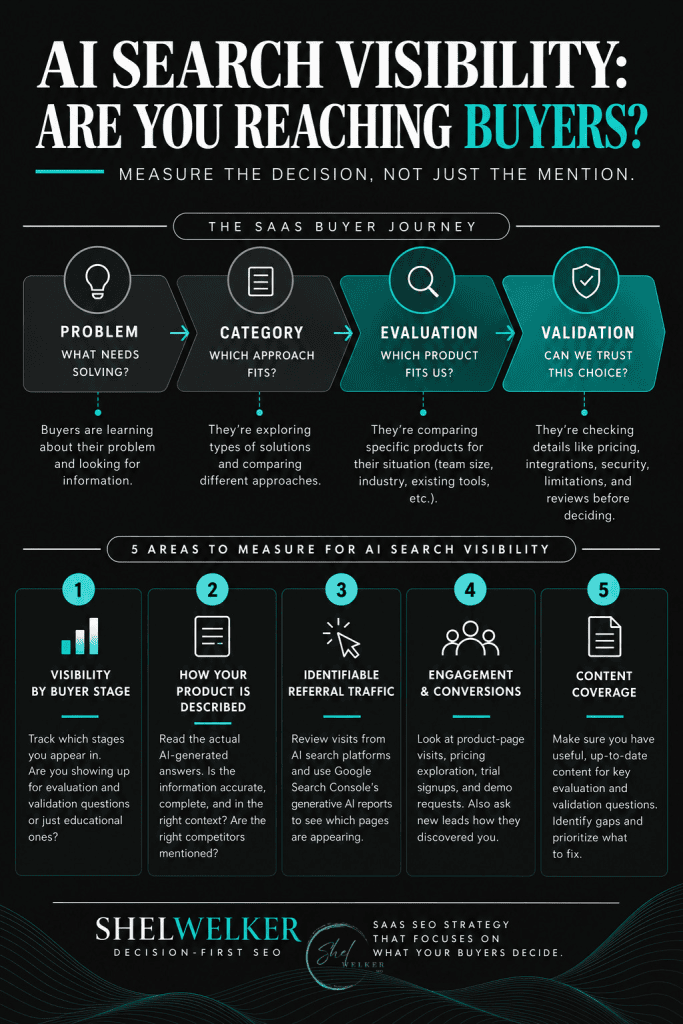
Once you’ve collected the questions, group them according to the decisions they support. A simple structure works:
- Problem: What is the issue, and how can it be solved?
- Category: What types of solutions exist, and which approach makes sense?
- Evaluation: Which products fit a particular situation? How does one option compare with another?
- Validation: What will it cost? Will it integrate with existing systems? What are the limitations, security requirements, and migration considerations?
For a SaaS company focused on generating qualified leads, I’d give evaluation and validation questions particular attention while keeping enough earlier-stage questions to understand the broader journey.
Include the details that make real buying situations specific: team size, industry, existing tools, requirements, and what the buyer is trying to replace.
These details matter because a buyer looking for project management software for a five-person creative agency may have very different requirements from an enterprise team evaluating the same category.
Remember That Many Answers Come From Pages You Don’t Own
AI-generated answers can draw on third-party content, including review sites, roundup articles, community discussions, and competitors’ comparison pages. For evaluation questions, those outside sources can influence how your product is described and whether it appears among the options being considered.
That means some of your research needs to happen beyond your own website.
Look at which sources are cited for important buyer questions and examine what they say about your software. Incorrect pricing, outdated feature descriptions, or placement in the wrong product category are worth investigating.
Keep relevant review profiles accurate and current. Where appropriate, contact publishers to correct factual errors in articles that prospective customers are likely to encounter.
You won’t control every third-party recommendation, nor should you expect to. But you can make sure the information you publish about your own product is accurate, accessible, and detailed enough to support meaningful comparisons.
What SaaS Companies Should Actually Measure
I’d focus on five areas, using them together rather than relying on one overall visibility score.
1. Visibility by Buyer Stage
Group your tracked prompts by stage and report the results separately. This shows whether your company appears primarily in educational responses or also surfaces when buyers are comparing and validating software options.
A blended visibility score can hide important gaps, especially if the prompt list contains substantially more informational questions than evaluation questions.
2. How Your Product Is Described
Read the actual AI-generated answers. Is your software placed in the correct category? Is the pricing model accurate? Are important capabilities missing or outdated? Are the competitors mentioned the ones your sales team actually encounters?
Keep a record of inaccuracies and investigate the sources behind them where possible. This can reveal problems with your own product information as well as third-party content.
3. Referral Traffic and Search Visibility You Can Identify
Some AI platforms send visits that can be identified through referral information in analytics. Google Search requires a slightly different approach.
Google includes AI Overviews and AI Mode activity in its overall Search Console reporting, and in 2026 introduced dedicated Generative AI performance reports that provide additional visibility information, including impressions and the pages appearing in these experiences.
Those reports help you understand where your website is appearing, but they don’t establish the commercial value of every AI interaction.
Use the available Search Console and analytics data together. Examine which pages receive identifiable visits, how those pages perform, and whether they help visitors evaluate your product.
4. What Visitors and Leads Actually Do
Look at relevant engagement and conversion activity, including product-page visits, pricing exploration, trial signups, and demo requests.
You can also ask new leads how they discovered your company. A simple free-text field or a question during an initial sales conversation may reveal AI-assisted research that your analytics doesn’t capture.
Treat those answers as additional evidence rather than precise attribution. Buyers often interact with multiple sources before contacting a vendor, and small samples can be misleading.
5. Content Coverage
For each important evaluation or validation question, determine whether your website has a page that answers it. Then assess how useful that answer is.
Does the page provide enough detail for someone to evaluate the product? Is the information current? Are important limitations explained? Can visitors find related information without digging through unrelated articles?
A spreadsheet with the buyer question, decision stage, relevant page, identified gap, and recommended action is enough to begin.
None of these measurements provides perfect attribution. Not every AI interaction produces a visit, and buyers may discover your product in one place before returning through another channel.
Still, examining these signals together gives you a much more useful picture of where your SEO strategy may be falling short.
Where the Content Gaps Usually Are
When reviewing SaaS websites through a Decision-First SEO lens, these are some of the areas I’d investigate first:
- Comparison pages that describe features but never explain who the product is or isn’t a good fit for.
- Pricing pages that leave important questions unanswered about tiers, usage limits, overages, or contract terms.
- Integration pages that display partner logos without explaining what the integrations actually do.
- Missing use-case content for relevant industries, team sizes, or business requirements.
- Implementation and onboarding information that’s difficult to find or buried in documentation.
- Educational articles that attract visitors but provide no useful path toward evaluating the product.
These gaps aren’t always obvious in keyword reports. A page can rank well and attract traffic while leaving potential customers with unanswered questions.
Before producing another batch of articles, I’d examine the pages that already serve evaluation-stage searches. Can they be improved? Are important questions missing? Do your educational articles link naturally to relevant product, comparison, and use-case pages?
For example, a visitor reading an introductory CRM article may not be ready to purchase, but if they decide to investigate solutions, the website should make that next step easy.
Content should help people progress through their research without forcing them into a sales conversation before they’re ready.
There’s no guarantee that improving these pages will earn additional AI citations. Google’s October announcement concerns how links are displayed, not a new method for selecting which websites appear.
What you can address is whether your content provides the information buyers need when they encounter it.
Do You Need a Paid AI Visibility Tool Yet?
If you’re early in your AI search measurement efforts or your website has relatively modest traffic, you may not need one.
Start with 20 to 30 real buyer questions. Check them periodically across the AI search experiences relevant to your audience, recording whether your company appears, how it’s described, and which sources are cited.
A spreadsheet can handle the initial work.
As your requirements grow, paid tracking may become useful for monitoring larger prompt sets, different markets, competitors, and changes over time. By then, you’ll have a better understanding of which questions deserve the investment.
I’d rather see a SaaS company track 25 carefully selected buyer questions than pay for a dashboard monitoring hundreds of prompts with no clear connection to its customers.
A Short Audit You Can Run This Week
If you’re not sure whether your current AI visibility reflects meaningful buying opportunities, here’s where I’d begin:
- Pull 20 real buyer questions from sales conversations, demo forms, customer feedback, and support tickets.
- Tag each question by buyer stage: problem, category, evaluation, or validation.
- Check those questions in relevant AI search experiences. Record whether your product appears, how it’s described, and which sources are cited.
- Review your website to see whether you have useful content answering each question.
- Prioritize the gaps according to their relevance to purchasing decisions, the importance of the buyer need, and the work required to address them.
This won’t replace a complete SEO strategy, but it can help identify where your current visibility and content may be disconnected from the questions prospective customers are asking.
Turning Those Findings Into an SEO Strategy
A short audit can show you where some of the problems are. Deciding what to fix first, which keywords deserve investment, how pages should connect, and what to build over the next 90 days requires a more complete look at your website and the buying process.
That’s the purpose of my $500 SaaS SEO Blueprint, built around Decision-First SEO.
The Blueprint reviews your existing SaaS website through the decisions potential customers need to make. It includes a buyer-stage map, revenue-focused keyword mapping, content priorities, internal linking recommendations, and a 90-day roadmap.
It’s a one-time, asynchronous strategy deliverable designed to give you clear priorities before committing to additional content production, expensive tools, or a larger SEO engagement.
You can use the plan with your existing team, implement it yourself, or use it to guide future work. The point is to understand what deserves attention before spending more money.
Get the SaaS SEO Blueprint — $500
Final Thoughts
Google’s changes may make links easier to find within AI-generated answers, and that’s worth monitoring. But improved link placement doesn’t tell you whether your company is reaching people who are seriously evaluating software.
If your brand appears frequently in broad educational responses but rarely during comparisons, that’s worth investigating. The same goes for a website that attracts steady organic traffic but provides limited information about pri