
Are AI Summaries Reducing the Need for Traditional SaaS Content?
Why traffic and value are not the same metric, and what to do about it
If you run a SaaS company and organic search has started behaving strangely, the numbers can be difficult to interpret. Impressions may hold steady while clicks decline. Rankings can remain relatively stable while the traffic those rankings used to produce quietly disappears. Google AI Overviews and other AI-assisted search experiences can now answer many questions before a searcher ever reaches a website. Pew Research Center found that users clicked a traditional search result on 8% of visits when an AI summary appeared, compared with 15% when one did not.
That makes AI summaries reducing website traffic a legitimate business concern. Content takes time and money to produce, and founders reasonably want to know whether that investment still makes sense when AI answers are reducing clicks that previously went to publishers.
The tempting conclusion is that content itself is becoming less valuable. But traffic loss and content value are not the same thing.
AI is particularly effective at satisfying questions that can be answered with broadly available information. It is much less capable of eliminating the need for specific evidence, product context, implementation detail, meaningful comparisons, and the other information buyers need as they move closer to a decision. And even when AI does deliver that information directly, it still has to retrieve it from somewhere.
The more useful question, then, is not whether AI search will reduce the value of SaaS content. It is which content still deserves to exist when the click can no longer be assumed.
AI Overviews Are Changing Which Clicks Reach Your Website
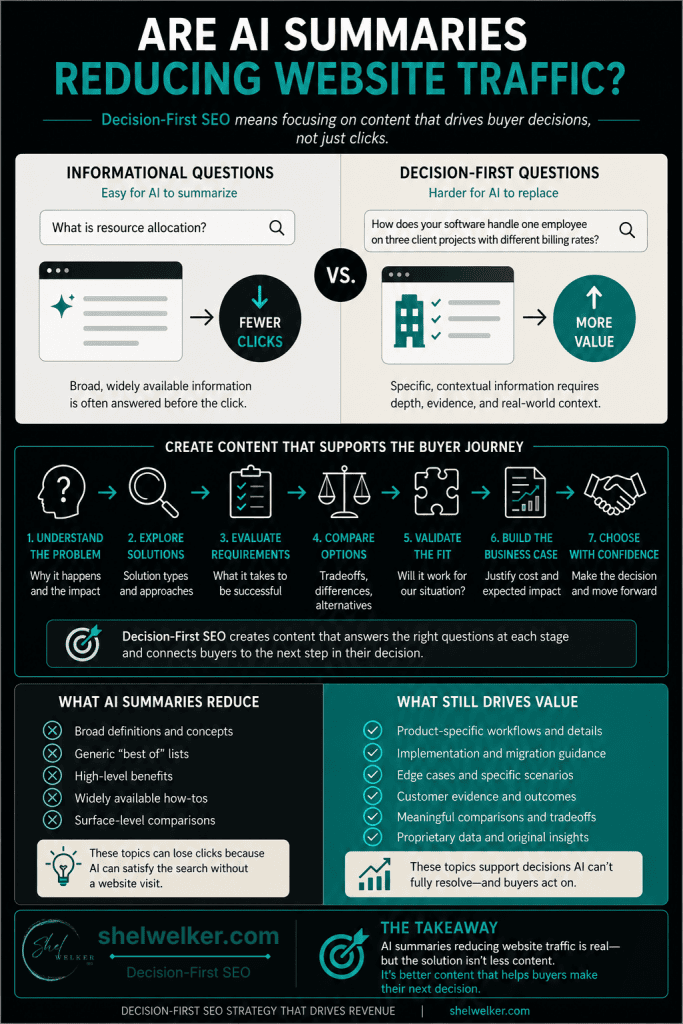
Consider a project management platform with an article targeting “what is resource allocation.”
A searcher asking that question may simply need a definition, a few examples, and an explanation of why resource allocation matters. An AI summary can satisfy much of that informational need without requiring a visit to the original article.
That represents a genuine loss of a search entrance. It does not necessarily represent an equivalent loss of business value.
Now consider a different query:
“How does resource allocation software handle one employee working across three client projects with different billing rates?”
The buyer has moved considerably further into evaluation. They are no longer trying to understand the category. They are testing whether a solution will survive contact with their actual operating environment.
AI can certainly attempt to answer that question, particularly if it can retrieve detailed documentation from relevant vendors. But that actually strengthens the case for producing the content. Whether the buyer encounters the answer on your website or through an AI-assisted interface, the underlying information still needs to exist.
The strategic distinction is therefore not simply informational content versus commercial content. It is compressible information versus decision-critical information.
Broad explanations built from generally available knowledge are relatively easy to summarize. Product-specific workflows, implementation constraints, customer evidence, migration details, edge cases, meaningful comparisons, and proprietary data are harder to replace because the answer depends on the business or product itself.
That is where SaaS content becomes more defensible.
Traditional SEO Still Matters, but It Is No Longer the Whole Strategy
None of this makes SEO fundamentals irrelevant. Search engines and AI retrieval systems still need to discover, interpret, and contextualize information.
A site that is difficult to crawl, poorly structured, internally disconnected, or unclear about what its pages actually address is unlikely to benefit simply because AI search exists. Technical accessibility, search intent, information architecture, internal linking, and clear topical relevance remain important.
What has weakened is the old assumption that ranking and generating the click are sufficient evidence that a page is doing useful work.
For years, SaaS content programs could justify large informational libraries through volume. More indexed pages created more ranking opportunities. More rankings generated more sessions. Some percentage of those sessions eventually became pipeline.
That model becomes less reliable when AI-assisted search absorbs more of the easy, high-volume questions.
A payroll SaaS company writing another generic article about the benefits of payroll software is competing to provide information an AI system can summarize fairly easily. The same company publishing a detailed explanation of what happens when a growing employer adds employees in multiple states mid-quarter is addressing a different kind of need.
The buyer may need to understand tax registrations, employee records, payroll timing, reporting differences, implementation responsibilities, and whether the software actually supports that transition.
The second piece does not need enormous search volume to be strategically useful. It needs to appear when the right buyer is trying to resolve the right uncertainty.
Decision-First SEO Starts With the Buying Process
Most SaaS content calendars still begin with keywords.
A team gathers a large keyword set, sorts it by volume, difficulty, relevance, or some combination of the three, and decides what to publish. That approach can identify legitimate search opportunities, but it does not necessarily tell you which content the business actually needs.
Decision-First SEO reverses the order.
Start with the decisions a buyer has to make before purchasing. Then determine which searches, pages, evidence, and content relationships support those decisions.
Take an analytics platform designed for multi-location businesses. A realistic buyer progression might look like this:
Reporting inconsistency → solution category → implementation requirements → platform comparison → integration fit → internal business case → vendor selection
Each stage creates different questions.
Early in the process, the buyer may be trying to understand why reporting across locations keeps producing conflicting numbers. Later, they need to know whether data can be consolidated without replacing existing systems. During the evaluation stage, they may compare two platforms, investigate integrations with their current stack, determine implementation requirements, and justify the cost internally.
The content architecture should follow that progression.
An article about fragmented multi-location reporting can lead into a guide to consolidating reporting across locations. That guide can connect to integration requirements. Integration content can lead to implementation approaches, product capabilities, platform comparisons, customer evidence, and eventually pricing.
The internal links are not there merely because two pages contain related keywords. They exist because one answer creates the next decision.
That is a very different content ecosystem from a blog containing 200 independently optimized articles.
AI Retrieval Makes Those Relationships More Important
The same structure that helps buyers navigate a complicated purchase also helps modern retrieval systems interpret what a company knows.
Search engines and AI systems increasingly work with relationships between concepts rather than treating every page as an isolated collection of phrases. They encounter entities, topics, products, problems, capabilities, industries, and supporting evidence across multiple documents.
In plain English, context accumulates.
Imagine two cybersecurity SaaS websites.
The first has forty articles loosely related to security. One discusses vendor risk. Another discusses compliance. Several cover third-party access, monitoring, audits, and reporting, but the relationships between those concepts are weak and the connection to the product is inconsistent.
The second site deliberately connects vendor risk assessment to third-party access, compliance requirements, continuous monitoring, remediation workflows, reporting, integrations, and specific product capabilities. Supporting pages reinforce those relationships through consistent terminology and intentional internal links.
For a buyer, the second site provides a clearer path through the evaluation.
For a retrieval system, it provides a clearer conceptual model of the company.
When an AI system needs information about vendor risk monitoring, it has more contextual evidence for understanding whether the company is relevant, what the product does, which problems it addresses, and how those concepts relate.
This is where AI search and SaaS SEO begin to converge. An effective AI search visibility strategy is not simply a matter of inserting more phrases into individual pages. It requires a coherent topical ecosystem in which the site’s semantic relationships reflect the actual buyer journey.
Decision-stage relevance matters because specificity creates context. A page explaining how a capability works during migration, for example, connects the product, the capability, the migration process, the buyer’s risk, and the conditions under which that capability matters.
That is useful information for a human evaluating the product. It is also much richer retrieval material than another generic definition.
A Practical Audit for an AI-Assisted Search Environment
If your SaaS company has been publishing for several years, the first response to declining informational traffic probably should not be producing more content.
Audit what you already have.
Start with your highest-traffic pages over a meaningful historical period. Fifty pages is usually enough to expose the pattern. For each page, identify the buyer decision it supports.
Do not assign a stage merely because the keyword sounds informational or commercial. Ask what uncertainty the page actually resolves.
Then evaluate four things:
- Decision supported: What can the buyer understand, compare, validate, or decide after reading this page that they could not before?
- Next logical question: Once that uncertainty is resolved, what does the buyer need to know next, and do you have content for it?
- Evidence required: Does the page rely primarily on information available everywhere, or does it contain product knowledge, customer evidence, proprietary insight, implementation detail, or meaningful analysis?
- Path forward: Does the page lead naturally toward another relevant decision, or does the buyer reach the end and have nowhere useful to go?
Then map the major gaps in the evaluation process.
This is where SaaS content libraries often become lopsided. A company may have twelve articles explaining the problem and nothing addressing migration risk. It may have substantial traffic around a category while offering no useful comparison of implementation approaches. Its feature pages may explain what the software does without helping a buyer determine when those capabilities matter.
Those are more serious gaps than losing traffic to a broad definition.
For pages already affected by Google AI Overview traffic loss, look at what happened beyond the click decline. Did the page historically send visitors deeper into evaluation content? Are the remaining visitors still progressing? Was the page generating meaningful assisted conversions, or did it produce thousands of sessions that rarely went anywhere?
A traffic decline tells you something changed. It does not tell you what the page was worth.
Where Buyer Decisions Usually Get Stuck
The questions that matter most often appear when a buyer moves from understanding the category to determining whether a particular solution will work for them.
| When the buyer asks… | What they are actually trying to resolve | Content that can support the decision |
|---|---|---|
| “Will this integrate with our existing stack?” | Compatibility risk | Integration guides, technical requirements, implementation examples |
| “How difficult is migration?” | Operational risk | Migration processes, timelines, data mapping guidance, customer examples |
| “How is this different from the alternative?” | Tradeoff clarity | Direct comparisons, approach comparisons, use-case distinctions |
| “Will this work for a company structured like ours?” | Fit validation | Industry examples, edge cases, workflow documentation, case studies |
| “Why does this cost more?” | Economic justification | Pricing context, operational impact, cost comparisons, ROI evidence |
| “What happens after we buy?” | Implementation confidence | Onboarding detail, timelines, responsibilities, support expectations |
These questions are related because buyer uncertainty changes as the purchase progresses. Early questions establish understanding. Evaluation questions test fit and risk. Decision-stage questions help the buyer justify a choice.
A useful AI summaries and content strategy approach accounts for that progression rather than treating each query as an independent publishing opportunity.
Measure Buyer Progression Alongside Traffic
If some informational clicks are disappearing permanently, judging the entire content program by sessions will create an increasingly distorted picture.
A buyer may encounter your company in an AI answer without visiting the site. Three days later, they search your brand alongside a competitor. They read a comparison page, return later through a branded search, visit pricing, and eventually request a demo.
Traditional analytics can observe parts of that journey. It cannot reliably reconstruct the entire influence chain.
That means traffic should remain a metric, but not the only one.
Watch branded search demand over time. Examine direct traffic and visits to evaluation-stage pages. Track which pages visitors view before demos or trials. Look at movement from informational pages into comparison, integration, implementation, pricing, and product content.
Sales conversations can provide useful evidence too. If prospects repeatedly mention a migration guide, comparison page, benchmark, or implementation article, that content is influencing decisions whether or not it has impressive traffic numbers.
The reverse matters just as much.
If an article historically generated 20,000 annual visits but almost nobody progressed into meaningful evaluation content, declining traffic may be exposing a weakness that was already there.
That is one of the more useful consequences of zero-click SaaS SEO. It forces content teams to distinguish visibility from business contribution.
What SaaS Companies Should Do Differently
Do not respond to AI search by trying to make every old informational article longer, more comprehensive, or more aggressively optimized in an attempt to recover every lost click.
Some of those clicks may not return.
Instead, protect the SEO fundamentals that make your information discoverable and prioritize SEO resources around the content that supports consequential decisions.
Build comparisons that explain genuine tradeoffs rather than manufacturing a winner. Document migration and implementation realities. Address the edge cases prospects repeatedly bring to sales. Connect features to the circumstances in which they matter. Publish evidence competitors and AI systems cannot manufacture on your behalf, including customer outcomes, original benchmarks, operational data, and specific product knowledge.
Then connect those assets according to buyer progression.
That work eventually becomes larger than a content calendar. Once you have identified the decisions buyers need to make, mapped the content that supports them, found the gaps, and designed the pathways between those pages, you are building a buyer-stage search architecture.
That is the strategic work the SaaS SEO Blueprint formalizes, rather than treating keyword selection as the strategy itself.
AI Search Is Exposing a Problem Traffic Used to Hide
AI summaries are not making SaaS content irrelevant. They are making certain kinds of content easier to consume without visiting the publisher.
That distinction matters.
For years, a large amount of organic traffic could make a content program appear successful even when the relationship between those visits and actual buyer decisions was weak. AI-assisted search is removing some of that cover.
The appropriate response is not to chase every disappearing click. It is to become much clearer about what each piece of content is supposed to accomplish.
Some pages should create discovery. Some should establish context. Others should reduce risk, explain tradeoffs, demonstrate fit, provide evidence, or help a buyer defend the purchase internally. Together, they should form a coherent path through the decisions that stand between initial interest and a confident choice.
AI search is making that distinction harder for SaaS companies to ignore.
The value of SaaS content was never really the click itself. The click was simply the easiest part to measure. What matters now is whether the information continues to shape the decisions that eventually produce the business outcome.