The Internet Is Starting to Remember Who Helped
I’ve been watching how people move through information online for a long time now. And over the last year or two, something has quietly shifted. Not loudly. Not dramatically. But unmistakably if you know what to look for.
For most of SEO’s history, success meant rankings. Position one. Click-through rate. Traffic growth. Publishing velocity. More pages, more impressions, more reach. Those things still matter. Visibility always will.
But visibility alone feels less complete than it used to. Because the way people interact with information has fundamentally changed.
This isn’t just about AI Overviews or ChatGPT or conversational search interfaces, though those are part of it. The bigger change is behavioral.
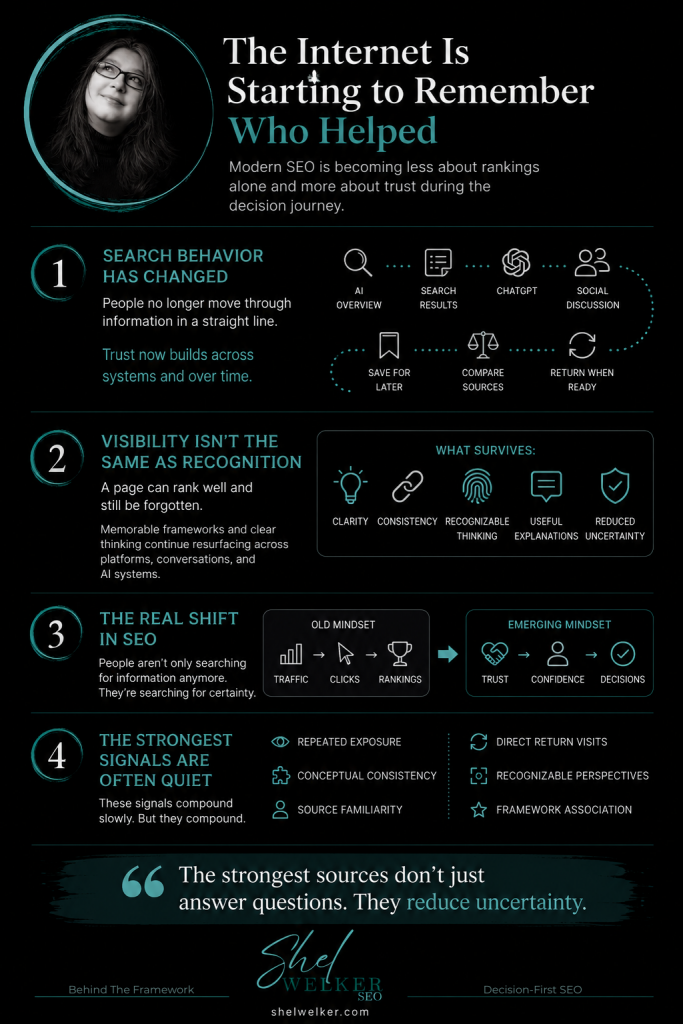
People no longer move through the internet in a straight line.
They circle ideas. They revisit concepts across different sessions and different platforms. They compare perspectives, validate sources, and cross-check interpretations. They save things for later and come back days afterward once a problem becomes urgent enough to act on.
Sometimes they don’t even click immediately. They simply remember.
I don’t think the industry has fully reckoned with how much that last part matters.
Search Has Become Recursive
Traditional search behavior was transactional. Type a query, open results, find answer, and leave. Clean and linear.
That’s not how it works anymore.
A person might first encounter an idea through an AI Overview. Then search the topic directly later. Then ask ChatGPT a related question. Then see someone discussing the same concept on LinkedIn or X. Then revisit the original source days later once the problem becomes pressing enough to act on.
The decision journey now stretches across systems, platforms, and time.
Which means trust no longer forms from a single interaction. It accumulates quietly.
Repeated exposure to the same ideas, the same framing, the same source, the same underlying perspective builds a kind of conceptual familiarity. People notice coherence even when they can’t fully articulate why they trust something.
I think AI systems are starting to notice it too.
From Information Retrieval to Source Evaluation
Something I keep observing is that users are becoming less focused on finding information and more focused on determining whether information can be trusted. Those are not the same problem.
The internet has never struggled to produce content. There’s more of it than anyone could possibly consume. What people struggle with now is certainty.
Who actually understands this problem? Who has thought deeply about it instead of simply repeating the trending take? Who remains structurally consistent over time instead of shapeshifting with every news cycle?
This changes the role of SEO in subtle but important ways.
The old model treated content like isolated ranking assets. One page, one keyword, one query.
Modern search behavior is ecosystem-driven. People evaluate clusters of thinking now, not just individual pages.
They look for consistency between articles, between explanations, between frameworks.
The strongest sources don’t just answer questions. They reduce uncertainty.
The Future Belongs to Recognizable Thinking
I’ve been thinking about this a lot because of how often I see certain ideas resurface across AI systems and search experiences, sometimes with attribution, often without.
But the patterns spread regardless.
Certain framings start appearing repeatedly. Certain distinctions become normalized. Certain explanations begin surfacing independently across systems.
The interesting part is that many of these ideas don’t spread because they were aggressively marketed. They spread because they continue matching what people are actually experiencing.
There’s a real difference between a catchy marketing phrase and a framework that consistently explains behavior people are already seeing firsthand.
One fades when the trend cycle ends.
The other keeps resurfacing because it continues helping people make sense of what they’re seeing.
Clear thinking tends to compound.
There’s a real difference between a catchy marketing phrase and a framework that consistently explains behavior people are already seeing firsthand. I explored some of that tension more personally in this reflection on feeling too simple for the industry.
When someone consistently explains problems through the same underlying lens, people begin associating them with that perspective. Over time, the framework itself becomes recognizable. Not because it was forced, but because it remained coherent.
Where the Industry Still Gets Stuck
A lot of SEO conversations still orbit traffic as the primary measurement of success. And traffic matters. Of course it does.
But traffic without buyer confidence is increasingly incomplete, especially in B2B and SaaS.
I’ve seen plenty of situations where a company succeeds at SEO from a visibility standpoint while still struggling to generate meaningful decisions. Users arrive, consume content, and leave unconvinced. I wrote about this more directly in why SaaS blog traffic often fails to generate demos.
Because information alone does not automatically create movement.
People need confidence. They need clarity. They need comparison and reinforcement. They need to understand where a solution fits within their actual problem. Many of the structural reasons behind that disconnect show up repeatedly in why users don’t convert on SaaS websites.
Most buying decisions involve uncertainty long before they involve conversion. That’s the part most SEO strategies still underweight.
This observation is actually where my thinking around Decision-First SEO came from.
Not from trying to invent a methodology. Not from trying to create a buzzword.
It emerged from watching how people behaved on SaaS sites.
The same pattern kept appearing. Companies were solving for traffic while users were trying to solve for confidence. That distinction eventually became the foundation for the difference between traffic-first and decision-first SEO.
Those are related problems, but they are not identical.
And once you start viewing search behavior through the lens of decision-making instead of pageviews, the entire structure of content starts looking different.
Visible Is Different From Remembered
One of the stranger things AI search is exposing is how fragile pure visibility can be.
A page can rank well and still leave no lasting impression.
Meanwhile, another source may not dominate every SERP, but people remember its explanations, frameworks, comparisons, or language patterns.
AI-assisted search compresses informational redundancy. If ten articles all say roughly the same thing, users often consume the summary instead of visiting all ten sources individually.
So what survives?
Usually, the clearest framing. The most structurally useful explanation. The most internally consistent perspective.
In other words, memorable thinking. Not louder thinking.
The strongest authority signals today are often subtle. A framework appearing across multiple contexts. A source repeatedly associated with a concept. Users returning directly by name. Conceptual alignment across articles instead of isolated keyword targeting.
These signals compound slowly.
But they compound.
And unlike short-term ranking tricks, they’re resilient because they’re rooted in recognition rather than exploitation.
AI Search Amplifies the Need for Trust
There’s a lot of dramatic discussion about AI replacing search entirely. Maybe parts of search will change radically over time. Some already have.
But I don’t think the deeper shift is really about replacement.
I think it’s about filtration.
AI systems are becoming intermediaries between users and information overload, which means source quality matters more, not less.
Because every system eventually runs into the same core problem. How do you determine which information deserves confidence?
That question doesn’t disappear in an AI environment.
It intensifies.
Ironically, I think this may push SEO closer to what it probably should have been emphasizing all along. Clarity. Consistency. Useful thinking. Recognizable expertise. Reducing uncertainty for real people making real decisions.
What Quiet Signals Actually Look Like
Some of the most meaningful signals barely look impressive in isolation.
A framework showing up in AI summaries repeatedly. A search engine associating certain concepts with your name consistently. People searching for an idea by name instead of descriptively. Users returning directly after earlier exposure. Conversations slowly shifting toward distinctions you’ve been making privately for months.
None of those create viral screenshots.
But together they form something.
Recognition.
Recognition is interesting because it’s difficult to fake sustainably.
You can force attention temporarily. You can buy reach. You can manufacture engagement.
But genuine recognition tends to emerge from accumulated consistency over time, especially in environments increasingly shaped by retrieval systems, recommendation algorithms, and AI interpretation layers.
The internet is becoming less about who shouted the loudest and more about whose thinking keeps reappearing because it continues helping people navigate uncertainty.
That feels like a healthier direction.
Slower, perhaps. Less glamorous.
But healthier.
Where This Leaves Me
Rankings aren’t disappearing. SEO fundamentals still matter. Technical health, clear site structure, and relevance all still matter.
But I do think the center of gravity is shifting.
From isolated rankings toward remembered sources. From information production toward decision support. From keyword coverage toward conceptual consistency.
And honestly, I find that shift encouraging.
Not because it makes the work easier. It doesn’t.
But it rewards something harder to automate.
Actually thinking deeply about the problems people are trying to solve.
Not just how to attract them.
But how to help them feel certain enough to move forward.
That feels slower than old-school SEO.
But it also feels more real.
If you’re trying to understand where buyer confidence breaks down across your own SaaS website or content ecosystem, the Decision-First SEO Blueprint explores those structural gaps in detail.