
Your SEO Reports Look Fine. So Why Is Organic Pipeline Softening?
Your SEO reports look healthy, but something feels off.
Rankings are stable. Organic traffic looks fine. Search Console shows healthy impressions and average positions. Yet pipeline feels softer, lead quality feels less consistent, and the connection between SEO performance and revenue feels harder to explain than it used to. Many modern SEO reporting problems stem from the growing gap between rankings, traffic, and actual buyer visibility.
This is becoming a common frustration for SaaS marketing teams. On paper, SEO appears to be doing its job. In practice, business outcomes feel increasingly disconnected from the metrics used to measure performance. This often looks similar to situations where companies experience traffic without revenue.
The immediate instinct is often to blame conversion rate optimization, attribution, or content quality. Sometimes those are real problems. But more often, the root issue starts earlier. The way most teams measure SEO has not kept pace with how buyers actually search.
Traditional SEO reporting was built around a fairly clean journey. A user searches, sees rankings, clicks a result, lands on your site, and eventually converts. That model made sense when it closely reflected how search behavior worked. It no longer describes most SaaS buying journeys.
Today, visibility happens across far more surfaces than a traditional SEO report can capture. Buyers move through Google results, AI Overviews, LLMs, Reddit threads, review sites, comparison pages, communities, and peer recommendations. In many cases, meaningful evaluation begins before a single click happens.
That creates a strange but increasingly common contradiction. SEO reports can look healthy while business signals feel weaker. Both can be true at the same time.
Rankings Are Up. Visibility Feels Worse.
This is one of the most confusing patterns in modern search. A SaaS company can improve rankings for important commercial queries while simultaneously seeing click-through rates decline and pipeline quality soften. At first glance, that feels contradictory. It makes more sense once you separate ranking position from actual search visibility.
Those two things are no longer interchangeable.
A ranking report may show position three for an important keyword. Search Console may show a strong average position over time. But neither metric fully reflects what buyers actually see in live search environments.
Take a query like “best CRM for small sales teams.” A few years ago, ranking well for that query would reliably generate clicks and traffic. Today, that same buyer may encounter an AI-generated summary, paid placements, comparison modules, review platform results, featured snippets, and Reddit discussions before reaching traditional organic listings.
By the time they scroll to your result, a meaningful portion of the evaluation process is already underway. They may already have a shortlist forming in their mind. They may already be comparing features, risks, and pricing expectations before ever visiting a vendor website.
Your brand may still influence that decision. Your content may even help shape the information being surfaced inside AI-generated experiences. But if your reporting only tracks rankings, clicks, and sessions, much of that visibility becomes difficult to see. This growing disconnect is becoming more visible as search platforms increasingly surface direct answers and synthesized results, a shift reflected in updates from Google Search Central.
This is one of the clearest SEO reporting problems in the AI era. Ranking position still matters, but rankings alone no longer tell you whether buyers are actually encountering your brand during decision-shaping moments.
Why SEO Reports Feel Disconnected From Pipeline
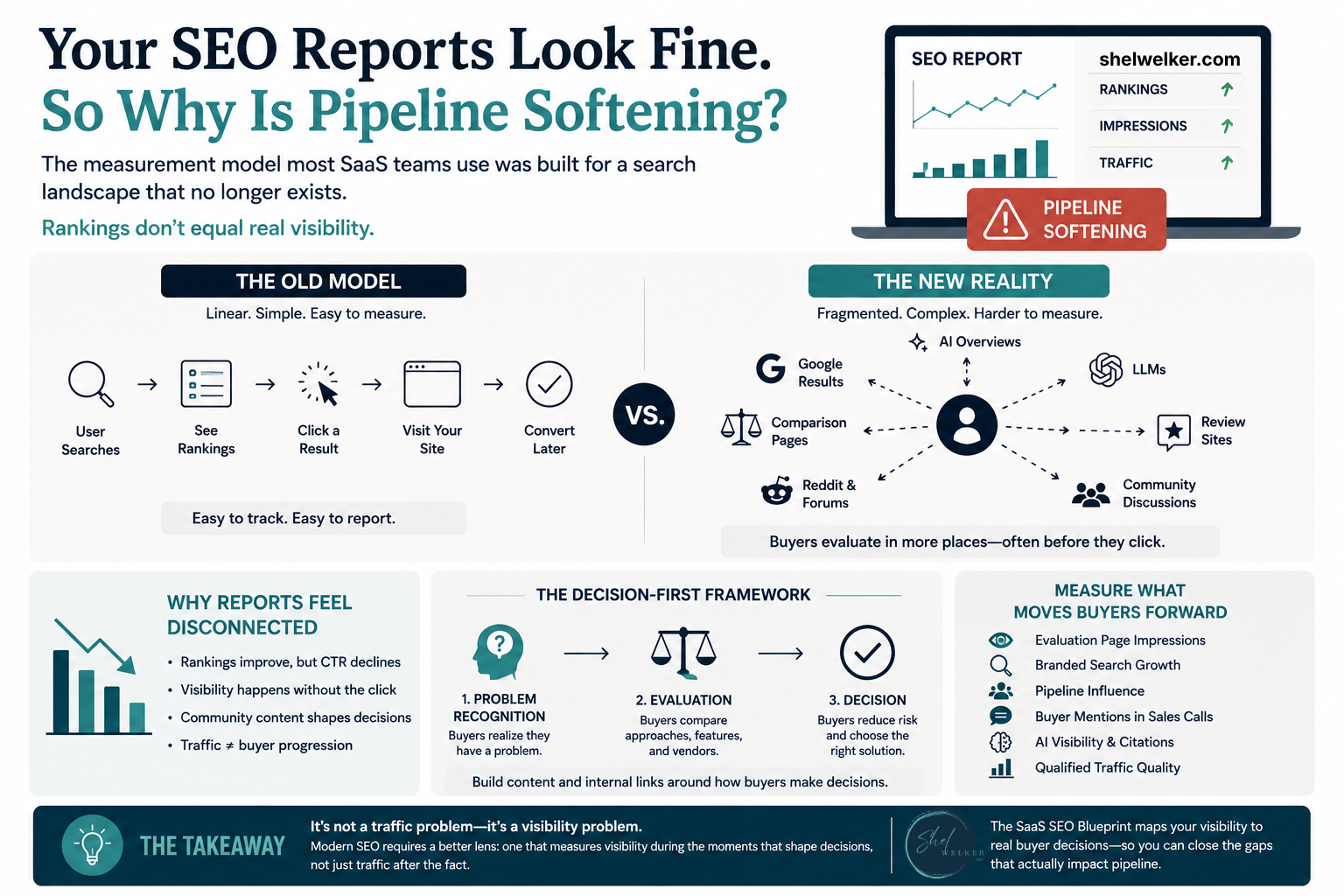
Most SEO reporting is designed to answer a simple question: how is organic traffic performing?
That remains useful, but it is no longer enough. The more important question is whether search visibility is translating into buyer progression.
This is where many SaaS teams misdiagnose the problem. Marketing reviews the monthly report and sees stable traffic, rising impressions, and improving rankings. The report looks healthy, so SEO gets marked as performing well. These SEO reporting problems become more obvious when rankings and traffic look healthy while pipeline quality declines.
Meanwhile, sales notices fewer qualified conversations. Pipeline influenced by organic feels softer. Buyers entering conversations feel earlier in their journey and less prepared to make a decision.
The immediate assumption is often that something broke in conversion or attribution. Sometimes that is true. More often, the business is simply visible for the wrong types of searches.
There is an important distinction between being discoverable and being present during decision-making moments.
Many SaaS SEO programs perform well at generating informational visibility. Far fewer are consistently visible during evaluation and comparison stages where real purchase intent takes shape. Traditional reporting rarely surfaces that gap because it tends to measure traffic volume rather than decision-stage visibility.
How Modern Search Changes the Traffic Equation
Search engines no longer simply rank and display pages. Increasingly, they retrieve information from multiple sources, interpret relationships between concepts, and synthesize responses that help users reach decisions faster.
That changes the relationship between visibility and traffic in meaningful ways.
A well-structured article can influence buyer understanding without generating a direct visit. Your content may shape how buyers compare vendors, prioritize features, or think about implementation risk, even if they never click through to your site.
This is why traditional SEO metrics are becoming increasingly incomplete. Traffic reflects visits, but visibility reflects influence. Those are related, but they are no longer the same thing.
This shift also explains why community-driven content has become so influential. Reddit threads, review platforms, niche forums, and practitioner communities increasingly shape search outcomes because they contain something buyers heavily value during evaluation: real-world experience.
Modern retrieval systems increasingly reward content that clearly connects meaningful decision relationships. They are getting better at understanding relationships between a problem and the solutions that solve it, a use case and the vendors best suited for it, a buyer concern and a product capability, or a comparison query and a likely decision outcome.
This is where many keyword-first SEO strategies begin to weaken. They often create content around isolated topics rather than around decision pathways.
The content may rank, but if it lacks clear contextual relationships, it becomes harder for both buyers and search systems to understand how that content supports decision-making. That is often where visibility weakens, even when rankings remain strong.
The Real Gap: Decision-Stage Structure
If you look closely at SEO programs struggling to connect organic performance to pipeline, the pattern is usually consistent. There is often strong keyword coverage at the top of the funnel and much weaker coverage during evaluation and decision stages.
This makes sense when you consider how most SEO strategies are built. Teams start with keyword research, group opportunities by search volume and difficulty, and create content to cover those terms. That process creates topic coverage, but it does not necessarily create buyer progression.
Buyers do not move through keyword clusters. They move through decisions.
This is where Decision-First SEO changes the framing. Instead of asking what you rank for, the better question is where buyers encounter your brand during the decisions that shape purchasing.
That shift changes how SEO is evaluated. The goal becomes less about traffic acquisition alone and more about visibility across critical decision stages.
What Decision-First SEO Looks Like in Practice
Consider a B2B SaaS company selling customer support software.
A traditional keyword-focused strategy might target terms like customer support software, help desk tools, and AI customer support tools. Those terms may generate rankings and traffic, but traffic alone does not tell you whether buyers are moving toward purchase.
A stronger structure maps content directly to buyer decision stages.
| Stage | What the Buyer Needs | Content Examples |
|---|---|---|
| Problem Recognition | Understand the problem clearly and recognize urgency | “Why slow response times hurt retention” / “Signs your support team is overwhelmed” |
| Evaluation | Compare approaches, features, and vendors | “Help desk vs live chat” / “When AI automation actually helps support teams” / “Features that matter at scale” |
| Decision | Reduce risk and validate the right choice | “Zendesk alternatives for SaaS” / “Migration guide” / “Implementation timeline” |
The content itself matters, but the structure connecting that content matters just as much.
A strong internal linking pathway might move a buyer from a problem-recognition article into evaluation content, then into vendor comparison content, and finally toward solution pages or a demo request. That pathway mirrors how buyers naturally move through decisions.
This improves more than user experience. It also helps search systems understand the relationships between your content, your expertise, and the decision stages your brand supports. That improves both discoverability and decision-stage visibility.
What SaaS Teams Should Measure Now
Rankings and traffic still matter. They are simply incomplete as standalone metrics. For many SaaS teams, SEO reporting problems are less about bad data and more about incomplete measurement.
Modern SEO measurement needs to include signals tied to buyer progression and decision-stage visibility. The goal is not just to understand whether traffic exists, but whether search visibility is influencing meaningful business decisions.
The better questions to add to your reporting cadence are straightforward. Are evaluation-stage pages gaining impressions even if clicks remain flat? Is branded search increasing? Are comparison and alternative pages influencing pipeline? Are buyers mentioning your brand earlier in sales conversations? Is your content appearing in AI-generated recommendation environments?
These metrics do not replace traditional SEO reporting. They add the layer most SaaS teams are currently missing.
They help answer whether search visibility is actually influencing decisions.
The Problem Is Not Your Rankings
If your SEO report looks healthy but pipeline tells a different story, you probably do not have a traffic problem. You have a visibility problem, specifically a visibility gap during the decision moments that actually drive revenue.
For many SaaS teams, the issue is not lack of content. It is lack of decision-stage coverage and decision-stage visibility.
They are publishing content and generating impressions. They are earning traffic and showing up in reports. But they are not consistently visible when buyers compare solutions, evaluate risk, and narrow choices.
That is where modern SEO performance is increasingly won or lost.
The fix is rarely publishing more content for the sake of volume. More often, it requires building the right content, covering the right decision stages, and connecting that content in a way that supports buyer movement.
If your SEO reporting feels increasingly disconnected from business outcomes, the problem may not be rankings at all. The problem may be that your measurement model is still built for an older version of search.
Modern SEO requires a better lens. One that measures not just traffic, but visibility during the moments that shape decisions.
That is exactly what the SaaS SEO Blueprint is designed to uncover: where your search visibility is strong, where decision-stage influence is missing, and what needs to change to close the gap.
Related Information
If your SaaS SEO is getting traffic but not enough conversions, these articles can help you identify where the buyer path is breaking.