
AI Answers Still Depend on the Web’s Information Ecosystem
In February 2026, researchers at Microsoft published work describing a concept called AI recommendation poisoning. The research explored how large language models and AI-powered assistants can be influenced by the information environments they draw from.
The idea itself isn’t especially surprising. AI systems generate answers by learning from enormous collections of web content and then retrieving or synthesizing information from sources that appear credible and relevant. If the surrounding information ecosystem is skewed or manipulated, the resulting answers can reflect those distortions.
The discussion around this research has already led to a new phrase appearing in marketing and SEO conversations: “AI SEO.”
Before that term turns into another buzzword, it’s worth looking more closely at how these systems actually work—and what it means for companies trying to build durable visibility online.
What People Mean When They Say “AI SEO”
When people talk about “AI SEO,” they are usually referring to a simple idea. Instead of optimizing for search engine results pages, companies want to be referenced in AI-generated answers.
If someone asks an AI assistant a question like:
“What’s the best way to structure SaaS SEO?”
If an AI assistant answers that question, the companies and sources it references gain attention and credibility. Even when a source is not cited directly, the ideas that shaped the answer still influence how the reader understands the topic.
From a founder’s perspective, this can feel like a new distribution channel. If buyers increasingly ask AI tools for advice, then appearing inside those answers becomes valuable.
But framing this as a completely new form of optimization can be misleading.
AI systems may present information through a different interface, but the underlying information supply chain is still the web.
How AI Recommendation Poisoning Can Influence AI Answers
Large language models are not independent sources of truth. They depend on a combination of training data, retrieval systems, and external information sources to construct answers.
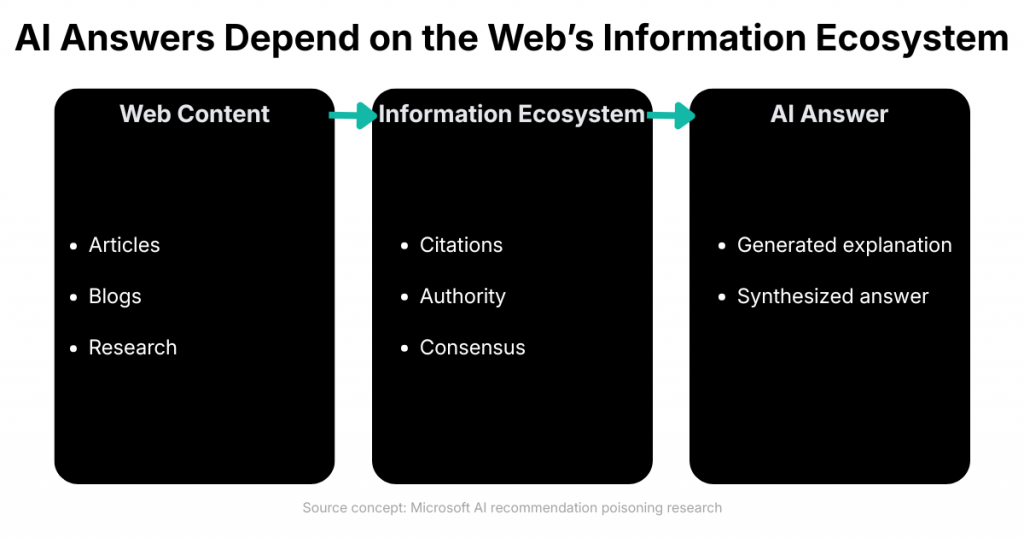
In practice, that means their responses are shaped by signals such as:
- widely published explanations across the web
- reputable sources and domains
- repeated references to similar ideas
- structured knowledge bases and citations
These are the same types of signals search engines have relied on for decades.
When an AI system generates an answer, it is usually drawing from patterns it learned during training, sometimes combined with real-time retrieval of web documents that appear authoritative.
In other words, AI answers are not replacing the web’s information ecosystem. They are summarizing and interpreting it.
This is why the Microsoft research matters. If the ecosystem itself becomes distorted, the models that depend on it may reflect those distortions.
Where Manipulation Can Enter the System
Whenever a platform becomes an important gateway to information, some actors will try to influence it.
Search engines experienced this dynamic early in their history. Entire industries developed around manipulating rankings through tactics like keyword stuffing, link farms, and other signal distortions.
AI interfaces introduce a similar incentive structure. If an AI assistant becomes a trusted advisor to millions of users, appearing in its answers becomes extremely valuable.
In theory, that creates opportunities for manipulation. For example:
- publishing large volumes of content designed to reinforce a particular narrative
- embedding subtle instructions or persuasive framing into pages intended to influence summarization
- attempting to manufacture consensus across low-quality sites
None of these ideas are entirely new. They are variations on the same signal manipulation strategies that have appeared in search ecosystems for years.
The difference is that AI systems synthesize information rather than simply ranking documents. That can make the influence less visible because the output appears as a single answer instead of a list of sources.
Still, the underlying dependency remains the same. AI systems rely on signals from the broader web environment.
Why Most Manipulation Strategies Don’t Last
The history of search engines provides a useful lesson here.
Short-term manipulation techniques appear frequently, but they rarely hold up over time. As platforms evolve, they develop new ways of evaluating credibility, filtering low-quality signals, and prioritizing sources that consistently demonstrate expertise.
The same pressures will likely shape AI-driven information systems.
Models improve. Retrieval systems become more selective. Trust signals evolve. Platforms increasingly emphasize source attribution and verifiable expertise.
When those shifts happen, the types of information that tend to survive are surprisingly consistent:
- clear explanations of real problems
- credible sources with recognizable expertise
- information that is referenced and reinforced across multiple independent sites
These qualities create what might be called informational stability. When many credible sources converge on the same explanation, the ecosystem becomes harder to distort.
For companies publishing content, that stability matters far more than any short-term optimization tactic.
Why Buyer Decision Clarity Matters
This is where the conversation becomes particularly relevant for SaaS companies.
Many SEO strategies focus heavily on content volume or keyword targeting. The assumption is that publishing enough pages will eventually generate traffic.
But the web pages that tend to become trusted reference points are usually not generic explanations. They are pages that clarify real decisions people are trying to make.
Consider a founder searching for help with growth. The question they are actually wrestling with is rarely “What is SEO?” It is usually something more specific:
- Why isn’t our traffic converting?
- Should we focus on product-led growth or search acquisition?
- When does SEO start producing revenue for a SaaS company?
Pages that unpack those decisions clearly and practically often become valuable reference material.
Other writers cite them. Readers share them. Discussions reference them.
Over time, those signals accumulate across the ecosystem.
Because AI systems draw from that ecosystem, the same pages that become trusted references in search often become the explanations that shape AI-generated answers.
How This Connects to Decision-First SEO
The core idea behind Decision-First SEO is that most SEO problems begin before content is written.
Teams often start with keywords or traffic targets rather than understanding the decisions their buyers are trying to make.
As a result, they produce large volumes of informational content that may attract visitors but rarely influence real purchasing decisions.
A decision-first approach reverses that order.
Instead of starting with keywords, it starts with identifying the decisions a buyer must navigate on the path to adopting a product. The content then focuses on clarifying those decisions in a way that is genuinely useful.
When content is built around real decision points, several things tend to happen. The explanations are more precise. The audience is more clearly defined. The insights are more likely to come from experience rather than generic research. Those characteristics make the content easier for readers to trust and easier for other sources to reference.
Over time, that creates the kind of signal environment that both search engines and AI systems are designed to surface.
A Changing Interface, the Same Information Foundations
AI assistants may become a common way people access information online. In many cases they already are.
But despite the new interface, the underlying structure of the web’s information ecosystem has not fundamentally changed.
AI systems still depend on signals generated by human knowledge shared across websites, publications, and communities. When those signals reflect expertise and genuine problem solving, the resulting answers tend to be more reliable.
For SaaS founders, this leads to a fairly simple conclusion.
The goal is not to optimize for AI. It is to contribute clear and credible explanations of the real problems your buyers are trying to solve.
If those explanations become part of the web’s shared knowledge base, both search engines and AI systems will naturally draw from them.
In the long run, that tends to be the most stable form of visibility a company can build.